Independent comparisons. We may earn from shop links. More info

How to use an air sander

Updated: 21 October 2026

The sander is out of the box, the compressor is in the corner, and the first pass can dig a groove if the pad hits the panel while it is already at speed. This is how to use an air sander: drain and regulate the air, fit a flat disc, start off the work, and keep the dust in a vacuum. Which tool you bought stays on the [air sander comparison](/hub/sanders/air-sander). The steps below follow the Draper 65084 manual, the Festool LEX 3 manual, HSE guidance and the faults UK reviews describe. Products Compared did not run these tools in a lab. A qualifying purchase can earn a commission at no extra cost to you.

The sander is out of the box, the compressor is in the corner, and the first pass can dig a groove if the pad hits the panel while it is already at speed.

Our top picks

On this page

Prepare the air before the pad

Drain the tank before you couple the tool. Water ruins a vane motor and a finish. Fit a filter and a regulator, and a lubricator only if the manual asks for it. Draper's 65084 manual expects a filter-regulator-lubricator and a daily drain. Festool's LEX 3 manual expects an oiler about every 15 minutes. Draper caps the tool at 6.3 bar. Festool caps the inlet at 6.2 bar and wants at least 350 litres per minute at 6 bar. Raising the regulator does not repair a starved compressor. Wear eye protection, and hearing protection: Draper declares 85 dB(A), and most cheap listings declare nothing.

Connect the hose and the disc

Draper specifies at least 3/8 inch, about 10 mm, on a 1/4 inch BSP inlet, and a larger bore past about 25 feet. Festool's line should be at least 9 mm inside an IAS 2 or IAS 3 hose. Do not hide a hiss by turning the regulator up. Centre the sheet, with no overhang. The Anesty mini kit changes plates with the screwdriver in the box. SPTA reviews describe a pin that locks the spindle. Change the pad with the airline uncoupled. Start off the surface, then set the pad down flat and keep it moving. Try the first pass on scrap. Which diameter belongs there is the air sander buying guide.
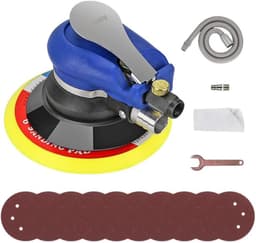
Draper Draper Storm Force 150 mm

Testsieger

Draper Draper Storm Force 150 mm
9.1/10about £51.35

Keep the dust out of the room

Connect a dust port if the tool has one. The Draper claims central extraction. The Anesty 150 mm claims a siphon hose, and a review says it is not a standard vacuum diameter. A LithiCraft review says there is no obvious port. HSE wood-dust limits are 3 mg/m³ for hardwood and 5 mg/m³ for softwood over eight hours, and mixtures use the hardwood figure. Do not blow or dry-sweep. At work, use a class M vacuum. HSG39 says a burst hose can whip and that compressed air is not for cleaning clothing. Festool's manual says not to sand asbestos. If the coating might be lead or asbestos, stop.

When the pad stops or the inlet hisses

If the pad slows after a minute and the compressor is cycling hard, the tool is using more air than the pump can replace. A RUNQIN ran out of air after about a minute and a half. A Draper on a 5 cfm compressor held speed for two or three minutes. The gauge can still show pressure. The check is the air sander compressor size page. If air still rushes and the pad does not turn, the fault is the tool. More than one Anesty 150 mm review describes that. A Draper review describes a seal leak. Sealing a hissing tail is fair. Stop if the hose is split or the pad will not turn.

Common questions

What pressure should I set?
Set the regulator to the maximum in your manual, and no higher. A listing that prints 90 psi is the same order of pressure as Draper's working figure, not a reason to exceed the cap printed for your tool. If your manual is missing, do not guess 90 psi.
Do I oil the tool every time?
Oil it when the manual says the tool needs lubricated air. Festool points to an oiler about every 15 minutes. Draper expects a lubricator in the line. A sheet that says not to oil means the tool stays dry.
What hose bore do I need?
Draper asks for at least 3/8 inch on a 1/4 inch BSP inlet, and a larger bore past about 25 feet. Festool asks for at least 9 mm inside an IAS hose. A long 6 mm hose will starve a tool that looked fine on a short test.
How do I start without gouging the panel?
Start with the pad in the air, and set it down flat once it is at speed. Keep it moving. A coarse disc parked on one edge will dig. Try the setup on scrap first.
Why does air pass and the pad not turn?
That pattern, in the Anesty reviews, is a tool fault rather than an empty tank. Check the inlet seal first. If the pad still will not turn, stop. Do not strip the motor from a forum sketch.
Can I blow the dust off my clothes?
No. HSE guidance says not to dust clothing with compressed air, and not to blow wood dust clear. Use a vacuum, and a class M vacuum for wood dust at work. Keep your face and skin out of the exhaust.
When do I stop and get a workshop to look at it?
Stop when the hose is split, when the pad will not turn although air is flowing, or when the coating may be lead or asbestos. A leaking coupler you can reseal is still your job. A dead pad is not.

Related pages

Sources

Sources taken from the research digest. Prices, stars and review counts are the stored amazon.co.uk listing figures.

  1. HSE — wood dust (retrieved 21.10.2026)
  2. HSE WIS23 — wood dust (retrieved 21.10.2026)
  3. HSE HSG39 — compressed air safety (retrieved 21.10.2026)
  4. HSE — noise for employers (retrieved 21.10.2026)
  5. HSE — hand-arm vibration (retrieved 21.10.2026)
  6. Draper 65084 air sander (retrieved 21.10.2026)
  7. Festool UK LEX 3 77/2,5 (retrieved 21.10.2026)
  8. Air Supply — compressor size (retrieved 21.10.2026)