Independent comparisons. We may earn from shop links. More info

How to test a Faraday pouch

Updated: 21 October 2026

The pouch arrived, the flap looks shut, and the car is on the drive. A how to test Faraday pouch car key check takes one trip to the driver’s door, not a phone screenshot. Peter F. is passing on the procedure the Metropolitan Police, Thatcham Research and Tracker describe. He did not laboratory-test the twelve listings in the [Faraday pouch comparison](/hub/safes-and-secure-storage/faraday-pouch). Prices and review themes on that page were taken from amazon.co.uk on 19 October 2026. A qualifying purchase can earn a commission at no extra cost to you. If the car still unlocks with the fob sealed inside, the pouch has failed for that key today, however new it looks.

The pouch arrived, the flap looks shut, and the car is on the drive. A how to test Faraday pouch car key check takes one trip to the driver’s door, not a phone screenshot. Peter F.

Our top picks

On this page

The day-one test

Do this before you rely on the pouch overnight. Put the fob you actually use fully inside. Close the hook-and-loop, the roll-top or the lid so that no corner of the fob sits in the mouth of the bag. Stand where you normally open the door, try the handle, and then try the start button if the door stayed locked. Thatcham’s guidance and the police pages describe that pair of checks: the car should not unlock and it should not start while the fob is sealed. One lanpard listing prints a version of that test in the bullets. It still has to be run on your vehicle. If the door opens, stop. The standard is the place you normally stand. Repeat the check with the spare fob in its own pouch.

Sealing hook-and-loop and roll-tops

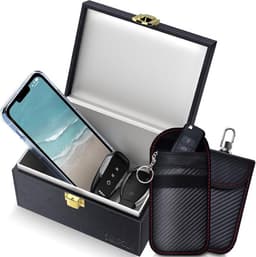
Most failures in ordinary use are a seal that never closed. A thick key head, a second remote or a metal ring in the flap leaves a gap. If the listing gives you an external hook, hang house keys there and keep the car fob alone inside. On a roll-top, roll until the Velcro meets on both sides. On a hook-and-loop flap, press the whole width. Thatcham warns that many pouches are sized for cards. Stated sizes here, where they exist, are about 9 × 14 cm, 11 × 7.5 cm, 14 × 9 cm and 13 × 9 cm. If your fob will not sit flat in that rectangle, you need a larger pouch, which is a buying decision on the Faraday pouch buying guide. The YourSecure case states one fob up to 80 × 40 × 20 mm.

Spare keys and hallway storage

Test the spare the same afternoon. A second fob on a hook by the front door answers a relay as willingly as the key you just pouched. Thatcham’s layout is one person at the car and one by the house, stretching a challenge of about two metres. Put each fob in its own closed pouch, or put every fob inside a closed hallway box. The Samfolk listing describes a box with two pouches for that pattern. If you use a box, close the lid. An open lid is a bowl. Coat pockets and letterbox-side tables are where the spare usually migrates. After the first week, look there before you assume the test still applies.

Retest schedule and wear

The Metropolitan Police tell you to retest shielding every few months. Run the door check again in the week you test the smoke alarms, or the day the clocks change. UK reviews on several of these pouches say blocking faded after weeks or months. The outside still looks stitched. You cannot see a tired lining. A phone test is only a supplement. Ofcom’s note is that no pouch is perfect. If the handset loses signal and the car still unlocks, believe the car. Do not store the fob in a microwave. Ofcom points out that a microwave can act as a cage and will cook the keys if someone starts it. Warwickshire Police say you can use a biscuit tin if you test it the same way, and you retest that tin on the same cycle.

When to stop trusting the pouch

Stop the evening the car unlocks or starts with the fob sealed and the flap fully shut. Reseat once, in case a ring was caught in the mouth, and test again. If it still opens, that pouch is finished for that key. The Consumer Rights Act 2015, sections 9 and 11, says goods must be of satisfactory quality, including durability, and must match the description. That is a conversation with the seller if the pouch never worked or fell apart at once. A listing that says jammer has used the wrong word: a pouch is passive shielding, and Ofcom does not license jammers under section 68 of the Wireless Telegraphy Act 2006. If a theft is in progress, call 999. For a pouch that has started to fail quietly, read the keyless theft limits before you treat a new bag as the whole of car security.

Common questions

How close should I stand to the car?
Stand where you normally unlock it, at the door, and try the handle. Then try the start button if the door stayed shut. The police and Thatcham checks are about whether the car responds with the fob sealed, not about a measured distance down the street. If it opens from your usual spot, the pouch has not worked. Moving further away and getting a lock is not a pass.
Does a half-closed flap count as shut?
No. A corner left open, a key ring caught in the Velcro, or a roll-top that has not met on both sides is an open pouch. The lining only matters when the fob is fully inside a closed seal. Press the whole flap, or roll until the closure meets, and test again. If the fob is too bulky for that, the pouch is the wrong size.
The phone still rings inside the bag. Is the pouch broken?
Treat the car as the verdict for a car key. A ringing phone means that handset still has a signal, which is a bad sign for the bag, and it is still not the test Thatcham and the police describe. Seal the fob, stand by the car, and try the door and the start button. If the car stays quiet, believe the car for the key.
How often should I retest?
Every few months, which is the Metropolitan Police line, and again if you have folded the pouch hard, washed it, or left it in a wet pocket. UK reviews mention blocking that fades after weeks or months while the outside still looks fine. A calendar reminder beats a guess. Use the same door and the same fob each time so you are comparing like with like.
What if the car still unlocks?
Reseat the fob once, clear the flap of rings and spare keys, and test again from the driver’s door. If it still unlocks or starts, stop using that pouch for that key. Try the spare only in its own sealed pouch. Replace the bag, or move the keys to a tin or box you have tested the same way. Do not leave the fob by the door while you wait for a refund.
Can the key ring stay outside the flap?
House keys can hang on an external hook if the listing has one. The car fob has to be inside the sealed part. A metal ring that stops the flap meeting will undo the pouch. If the only way to close it is to leave the fob’s head sticking out, you need a larger pouch. The test is simple after that: door, then start button, fob fully hidden.

Related pages

Sources

Public UK sources used for this comparison. Listing prices, stars and review counts are the amazon.co.uk figures saved for this set on 19 October 2026.

  1. Thatcham Research: how to increase your car security (retrieved 19 October 2026)
  2. Thatcham Research: what is keyless entry and start? (retrieved 19 October 2026)
  3. Metropolitan Police: preventing car and vehicle theft (retrieved 19 October 2026)
  4. Ofcom: radio spectrum and the law (retrieved 19 October 2026)
  5. Ofcom: can a microwave thwart car thieves? (retrieved 19 October 2026)
  6. This is Money: Tracker warning on cheap Faraday pouches, 22 August 2024 (retrieved 19 October 2026)
  7. Consumer Rights Act 2015, sections 9 and 11 (retrieved 19 October 2026)
  8. Warwickshire Police: keyless vehicle theft (retrieved 19 October 2026)