Independent comparisons. We may earn from shop links. More info

How to prune roses without the glove getting in the way

Updated: 17 October 2026

You have hybrid teas or floribundas that need a late-winter cut, and secateurs that will not help if a thorn catches the forearm while you hold the stem. This is how to prune roses in that UK window, and where the glove gets in the way of the catch. The Royal Horticultural Society tells you to wear gloves. It does not say what a thick cuff does to the blades. It is not a ranking of the twelve pairs in the [roses gloves comparison](/hub/protective-clothing/roses-gloves). The steps come from the RHS guides. None of these gloves was timed on a prune. A qualifying purchase through our links can earn a commission at no extra cost to you.

You have hybrid teas or floribundas that need a late-winter cut, and secateurs that will not help if a thorn catches the forearm while you hold the stem.

Our top picks

On this page

When the RHS say to prune

The Royal Horticultural Society puts the main prune of modern bush roses in late winter: often mid-February in the south, and March further north, once you can see which wood is alive. Jacksons Nurseries points UK gardeners to early March, sharp secateurs and an outward-facing bud. Do not copy an Oregon or Louisiana date onto Yorkshire or Kent. The glove does not move that calendar. Prune too early in a frost pocket and the next cold night can take the soft growth.

The cut for hybrid teas and floribundas

Use sharp secateurs, not a blunt anvil. Take out dead, diseased and damaged wood back to white pith, open the centre, and trace a sucker from below the graft. On hybrid teas, cut the strongest shoots to about four to six buds, roughly 10–15 cm. On floribundas, leave the strongest shoots at about 25–30 cm, and cut weaker shoots harder, to an outward-facing bud. The thorns are on the wood you hold while you look for that bud.
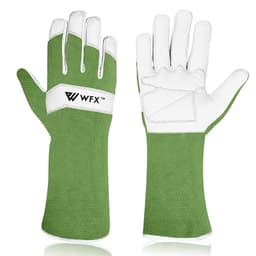
WFX WFX long goatskin glove, M

Testsieger

WFX WFX long goatskin glove, M
8.5/10about £6.79

Where the glove helps and where it gets in the way

The RHS safety note asks for long cuffs on major work with roses, berberis and pyracantha. A wrist glove covers the hand on the secateurs and leaves the forearm in the canes. The English Garden says a thorn-proof glove fails if you cannot work the secateurs. Which? gives that dexterity 21 percent of its score. COOLJOB is sleeveless and excludes its mesh back. SAWANS SA-432, WFX and the ITC elbow-length pair are the contrast when the forearm goes in. Cuff length on its own is gauntlet or wrist-length rose gloves.

What to have on your hands

A hybrid tea cut to about 10–15 cm often puts the forearm in the bush, so the cuff has to be long and the palm still has to let the blades meet. A floribunda left at about 25–30 cm can stay further out. If the catch needs a bare thumb, take the glove off for the latch only. A dirty, deep or unsettled thorn wound needs a clinician. A paid pruner falls under the PPE at Work Regulations. Size and wash are on the rose pruning gloves buying guide.

Common questions

When should you prune hybrid teas and floribundas in the UK?
The Royal Horticultural Society puts the main prune of modern bush roses in late winter: about mid-February in the south, and March in northern and colder areas. Use sharp secateurs and an outward-facing bud. Do not copy a United States extension calendar onto a UK garden. Summer deadheading is a lighter job than this winter cut.
How far back do you cut each type?
On hybrid teas, cut the strongest shoots to about four to six buds, roughly 10–15 cm. On floribundas, leave the strongest shoots longer, at about 25–30 cm. Cut weaker shoots harder, remove dead wood back to white pith, and open the centre. The glove does not change those lengths. It lets you hold the thorny wood while you find the bud.
Why do the RHS tell you to wear gloves?
The pruning pages say to wear gloves when you handle thorny roses. The garden-safety note adds thick gloves for prickles on roses, berberis and pyracantha, and long cuffs when that work is major. The point is the cane you are holding and the arm you push into the bush, not a fashion extra. A glove you cannot close the secateurs in still fails the job.
Can a thick leather glove stop you closing the secateurs?
It can. The English Garden treats a glove you cannot work the secateurs in as a failed thorn glove, whatever the title says. Which? scores that dexterity, including opening secateurs, as a large part of a garden-glove test. Some tool catches want a bare thumb. Try your own catch with the glove on before you start the bed. None of the twelve pairs here was scored on that test.
When does a long cuff matter during the cut?
It matters when your forearm goes into the bush, which is common on a hard hybrid-tea cut. The RHS asks for long cuffs on major work with sharp plants. A cuff that stops at the wrist covers the hand on the tool and leaves the arm among the canes. A long cuff still does not cover your face if you lean in.
What should you do with a wound, or with a paid worker?
If a thorn breaks the skin and the wound is dirty, deep, or not settling, have a clinician look at it. This guide does not describe a treatment. If you employ someone to prune, gloves are personal protective equipment and the PPE at Work Regulations apply. A household amazon.co.uk listing with no printed EN 388 code is not that assessment.
Which glove in this set is a poor match for reaching in?
COOLJOB is a poor match for reaching in. The cuff field is sleeveless, and the seller says the mesh back is not thorn proof. A long-sleeve listing is the shape that matches a forearm in the bush, provided you can still close the secateurs. That contrast is an illustration, not a prize for any one ASIN.

Related pages

Sources

Public UK sources and the amazon.co.uk listings used for this comparison, captured on 15 October 2026.

  1. RHS, How to garden safely (retrieved 16 October 2026)
  2. RHS, Rose pruning guide (retrieved 16 October 2026)
  3. HSE, Gloves (retrieved 16 October 2026)
  4. HSE, PPE FAQ (retrieved 16 October 2026)
  5. PPE at Work Regulations 1992 (retrieved 16 October 2026)
  6. GOV.UK, PPE enforcement regulations 2018 (retrieved 16 October 2026)
  7. SATRA, EN 388 (retrieved 16 October 2026)
  8. uvex UK, puncture-resistant safety gloves (retrieved 16 October 2026)