Independent comparisons. We may earn from shop links. More info

Silky pruning saw

Updated: 22 October 2026

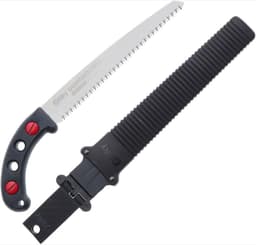
A sharp Silky does not settle whether you may cut. A Silky pruning saw in this set is a pull-stroke hand saw for wood you can reach from the ground: the curved 330 mm Zubats, the straight 240 mm Gomtaro, and the folding Gomboy and F180. Diameter comes later. This page is the check before the first pull. The [Silky saw comparison](/hub/power-saws/silky-saw) is the tool table. Consent, a nest and a stop point come first. Peter F. compared the listings and public UK guidance. There was no lab test. A qualifying purchase can earn a commission at no extra cost to you.

A sharp Silky does not settle whether you may cut.

Our top picks

On this page

What this saw is for

Use it on shrubs and small limbs you can support from the ground. Silky Fox's rule of thumb is about 20–50 mm on a 180–240 mm blade and about 120–165 mm on a 330–420 mm blade. Silky Europe states up to 120 mm on the Gomtaro 240 and up to 165 mm on the Zubat 330-7.5. One 330 mm reviewer struggled past about 100–120 mm. A large, leaning or roadside tree is a stop, as is any cut that needs a climb. The RHS sends that work to an insured arborist. From your own feet, overhead is the curved Zubat and a chest-height collar is the Gomtaro. The stroke is on how to use a Silky saw.

Collar, not paint

The collar is the swelling where the branch meets the trunk or a larger limb. The Arboricultural Association says cut outside it, with a sharp saw, and do not paint the wound. A flush cut removes the tissue that closes the scar. A long stub dies back. On a heavy limb, undercut, cut further out so the weight drops, then finish at the collar. The straight Gomtaro is easier to aim at chest height. The curved Zubat can do that cut overhead if the last stroke does not scoop into the collar. Wound paint is not part of that advice. A clean kerf is not a licence to take the branch.

Protected trees and nests

In England a tree preservation order needs written consent before you lop, top or uproot. GOV.UK states that under the Town and Country Planning (Tree Preservation) (England) Regulations 2012. A hand saw is not an exception. Ask the planning authority if you are unsure. A conservation-area tree needs the notice GOV.UK sets out, unless an exception applies. The RHS says you may trim overhang back to your boundary and should offer the prunings back. Protection still applies. Under the Wildlife and Countryside Act 1981 it is an offence to damage a nest in use or being built, or to take eggs. There is no winter all-clear. Scotland and Northern Ireland do not use the English form.

When to stop and call someone

Stop if you must leave the ground. HSE expects climbing to a competent specialist. Stop for a large, dead or roadside tree, and near a building or a power line. At work, a chainsaw on or in the tree falls under INDG317: competence and, in the usual case, a certificate. Call an arborist when the limb is beyond a trivial hand-saw cut, when consent is unclear, or when you cannot hold the wood. Once the cut is allowed, match the length on the Silky saw buying guide.

Common questions

Can I prune a protected tree if I only use a hand saw?
Not in England, unless you already have consent or a real exemption you have checked. GOV.UK requires written consent to lop a protected tree. A 240 mm Gomtaro is still lopping. Conservation-area trees need notice. Scotland and Northern Ireland run their own systems. Ask the planning authority if the status is unclear.
What is a branch collar cut?
Cut just outside the swollen ring where the branch meets the trunk. Do not flush the collar off, and do not leave a long stub. The Arboricultural Association pairs that with a sharp saw and no wound paint. On a heavy limb, undercut first so the bark does not tear, then finish at the collar.
What if the branch overhangs my garden?
The RHS describes cutting back to your boundary and offering the cuttings to your neighbour. That does not cancel a preservation order or a conservation-area notice. It does not let you reshape the crown. A large or high limb has already left trivial hand-saw work. This set has no pole saw.
Can I cut while birds are nesting?
If the nest is in use or being built, no. Damaging it, or the eggs, is an offence under the Wildlife and Countryside Act 1981. GOV.UK gives no calendar that makes every winter cut safe. Look at the tree. If you see activity, wait. The saw does not change the offence.
When do I call a tree surgeon?
When the tree is large, roadside, leaning, or near a building or a line, or when you would have to climb. Also when a preservation order is unclear, or the branch is more than the trivial job the RHS leaves to the owner. Book an insured arborist with the consent question, not instead of it.
Does a Silky replace a chainsaw in the crown?
No. INDG317 is about competence, and usually a certificate, for chainsaw work on or in a tree. A pull saw does not replace that, and it does not make climbing a DIY task. From the ground, a Silky fits a small limb only after the legal and nest checks. In the crown, call a competent person.
Are the English rules the same in Scotland?
No. GOV.UK's tree preservation order route is the English system, under the 2012 regulations. Scotland and Northern Ireland have their own tree controls. Nest protection in the 1981 Act is the UK-wide idea. The paperwork is not. In Glasgow or Belfast, check the devolved rules before you cut.

Related pages

Sources

Public sources named in the research digest, plus the amazon.co.uk listings compared on this page. Retrieved October 2026.

  1. Silky Fox: how to use a Silky saw and blade maintenance (retrieved October 2026)
  2. Silky Fox: what sized Silky blade for which sized branches (retrieved October 2026)
  3. Silky Fox: tooth configurations (retrieved October 2026)
  4. Silky Europe: how to use (retrieved October 2026)
  5. Silky Europe: fixed saws (retrieved October 2026)
  6. BBC Gardeners' World: best pruning saws (retrieved October 2026)
  7. GOV.UK: tree preservation orders and trees in conservation areas (retrieved October 2026)
  8. HSE: Chainsaws at work (INDG317) (retrieved October 2026)