Independent comparisons. We may earn from shop links. More info

Mitre saw for skirting

Updated: 21 October 2026

You are fitting skirting and the first internal corner has opened into a gap, because both ends were mitred at 45° on a wall that is not square. A mitre saw for skirting has two jobs: a paired 45° on an external corner, and a scribe on an internal corner. It also has to cross-cut the board. Many UK skirtings are about 119–170 mm tall. The [mitre saw comparison](/hub/power-saws/mitre-saw) lists the nine saws in this batch on 20 October 2026. This page stays with skirting. A qualifying purchase can earn a commission at no extra cost to you.

You are fitting skirting and the first internal corner has opened into a gap, because both ends were mitred at 45° on a wall that is not square.

Our top picks

On this page

Height against the saws in this batch

Shops stock torus and ogee around 94 mm, 119 mm, 144 mm and 169 mm. The range used here is about 119–170 mm. A fixed saw’s rule-of-thumb cross-cut, from BuildWiz, is about 120 mm on a 210 mm class blade. A 144 mm or 169 mm board, laid flat, is past a short chop. None of these listings gives a vertical capacity, so lay the board flat. If the board is taller than the chop, you need a stated slider before you set any angle. Capacity beyond skirting, including flooring, is on the sliding mitre saw vs compound page.

External corners

An external corner is two complementary 45° cuts. Measure to the outer corner. The long point of each mitre sits at the back, against the wall, and the short point faces the room. If the corner measures 90°, 45° and 45° meet. If it does not, split the angle you measured. Checkatrade’s fitting note is to measure the corner rather than assume 90°, and to take a little off rather than cut the board short. Set the saw’s 45° only after the combination-square check described on the how to use a mitre saw page. Cut to the waste side of the pencil line. A torus and an ogee do not share a point.

Internal corners

An internal corner is where two 45° mitres usually fail. Walls are rarely square. A scribe follows the profile of the board that is already fixed, so a small change in the angle does not open a V. The first board is cut square and run into the corner. The second board is mitred at 45° only to reveal the profile. You then cut along that revealed line with a coping saw. Toolstation’s guide has the teeth of the coping saw facing the handle. Take a slight back-cut so the face of the joint meets first and the back does not hold it open. Crown and cornice are a different geometry. If that layout is new, stop and get a joiner.

Which listing to take to the skirting

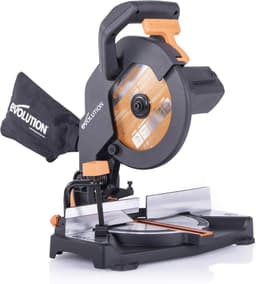
For tall skirting laid flat, take a stated slider. The R210SMS+ title says a 230 mm slide. The R255SMS+ title says a 300 mm slide. The R185SMS+ title says a 210 mm slide, and its blade-length row says 185 mm, so measure before you assume a 169 mm board will pass. Keep the fixed saws for architrave and for skirting short enough to sit inside the chop, around the 120 mm rule of thumb. The R210CMS is the best value listing when that narrow work is the whole job. If the guard jams, leave the saw.

Common questions

Do you mitre both boards on an internal corner?
Cut the first board square and run it into the corner. Mitre the second at 45° only so you can see the profile, then cope that line with a coping saw and a slight back-cut so the face meets first. Two 45° mitres on an internal corner open up when the wall is not 90°.
How do you cut an external corner?
Measure to the outer corner and cut two complementary 45° mitres, with the long point at the back against the wall. Test the fit before you nail or glue. If the corner is not 90°, split the angle you measured across the two pieces. Take a little off rather than cutting the length short.
What if the wall is not 90°?
Measure it with a bevel or an angle finder before you set the saw. An external corner uses that measurement split across the two boards. An internal corner is scribed, so the joint follows the first board instead of a theoretical 45°. A laser on the saw does not measure the wall.
Will a fixed 210 mm saw mitre 145 mm skirting laid flat?
A face around 145 mm is wider than the rule-of-thumb fixed chop of about 120 mm, and wider than the Einhell’s printed left bevel of 120 × 55 mm. One R210CMS review cites about 125 mm straight. Plan on a stated slider for boards around 144–169 mm laid flat.
Which saws in this batch state a slide?
The R210SMS+ states a 230 mm slide. The R255SMS+ states a 300 mm slide. The R185SMS+ states a 210 mm slide, with a blade-length row of 185 mm. The Einhell compound, the R210CMS, the fixed JCB and the Draper do not state a slide.
Do you stand skirting against the fence or lay it flat?
Lay it flat on the table, profile up or as the saw’s fence allows, and cross-cut the face in one pass. None of these nine listings prints a vertical capacity you could use to stand a 145 mm board against the fence. Flat, on a stated slider, is the cut that matches the heights in this guide.
When should a beginner stop and get a joiner?
Stop if the work is crown or cornice rather than skirting, or if the guard jams and will not close over the blade. Stop if an external test already fits and the next length is cut short, and you are about to hide a run of gaps with filler. A joiner’s scribe on an out-of-square chimney breast costs less than a room of open joints.

Related pages

Sources

Public UK sources first, then the manufacturer manual for the R255SMS+ only, and the BuildWiz width guide. Prices and stars are the amazon.co.uk listings captured on 20 October 2026.

  1. HSE wood dust (retrieved 20 October 2026)
  2. HSE cutting and sanding wood (retrieved 20 October 2026)
  3. HSE L108 noise (retrieved 20 October 2026)
  4. Supply of Machinery (Safety) Regulations 2008 (retrieved 20 October 2026)
  5. IEC 62841-3-9:2020 (retrieved 20 October 2026)
  6. HSE HSG141 (retrieved 20 October 2026)
  7. BuildWiz mitre saw guide (retrieved 20 October 2026)
  8. Evolution R255SMS+ manual (retrieved 20 October 2026)