Independent comparisons. We may earn from shop links. More info

Bosch cordless or corded circular saw

Updated: October 2026

You are choosing between a lead that follows you across the garden and a battery that may die halfway along an 18 mm board. That is the Bosch cordless or corded circular saw decision in this set: the PKS 55 on one side, and an 18 V UniversalCirc on the other. By the end you should know which annoyance you are willing to keep. The [Bosch circular saw comparison](/hub/power-saws/bosch-circular-saw) lists every kit and price. This page only splits the corded saw from the green cordless kits. The blue Professional body is a third path, named once at the end, because its batteries are a different system.

You are choosing between a lead that follows you across the garden and a battery that may die halfway along an 18 mm board.

Our top picks

On this page

What you are actually comparing

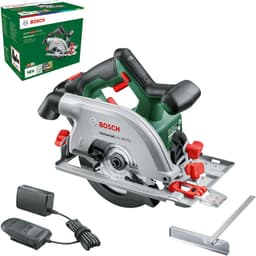
The corded saw is the PKS 55 at £87, listed at 1,200 W, with a 160 mm blade and a parallel guide in the title. The depth row is blank. The Bosch DIY GB page lists 0–55 mm at 90 degrees for this model. The cordless side is three UniversalCirc 18V-53 kits. The solo at £85 has no battery. The rail-set title at £109.99 states a two-piece guide rail and still no battery. The kit at £119.99 is the only one with a PBA 18V 2.5 Ah battery and an AL 18V-20 charger. All three state 53 mm. The EasyCirc sits on the buying guide.

Runtime against a lead that never dies

A lead does not run out of charge. That is the case for the PKS 55 on a long garage rip or a run of decking beside the house. Reviewers describe it as enough for worktops and sheds. Some wish they had bought cordless. The UniversalCirc listing states no watts. Reviews say it feels less willing in thick timber, and that the pack is the limit. The bullets claim 33 m of cutting in 19 mm chipboard per 2.5 Ah charge. The manual recommends batteries of 2.5 Ah or below. Reviews describe 2.0 Ah and 2.5 Ah packs running hot or empty on a long rip. The £119.99 kit includes that 2.5 Ah pack. The £85 solo does not.

Garden, garage, and the weight in your hands

Out by the fence, the lead is the nuisance, and an extension reel is a separate buy from the £87 saw. The solo at £85 carries a stated 53 mm into the garden if a green POWER FOR ALL pack is already charged. Its 2.93 kg row is the saw without the battery, still under the PKS 55's 5.61 kg. In a garage, the PKS 55 is the heavy one, and there is no dust bag in that box. The solo and the 2.5 Ah kit list a dust adapter, which still needs a vacuum. Depth and support are on the how to use a Bosch circular saw page.

Which one, on what condition

Take the PKS 55 if you will cut for a long time within reach of a socket and you can accept 5.61 kg and a lead. Take the solo UniversalCirc if you already own green 18 V batteries, with the limit that a 2.0 Ah or 2.5 Ah pack may not finish a long board. Take the £119.99 kit if you own no batteries and the jobs are short. Skip both if you need the 57 mm the Professional bullets state and a trade rail. That body is £171 before blue batteries, and green packs do not fit it. Set on 15 October 2026, with no lab comparison of cut speed. A purchase through our links can earn a commission at no extra cost to you.

Common questions

Is the PKS 55 more powerful than the UniversalCirc?
The PKS 55 is listed at 1,200 W. The UniversalCirc pages here state no wattage, so there is no watts contest. Bosch's data gives the UniversalCirc 4,300 rpm and 53 mm. Reviews call the cordless saw less willing in thick timber, and they say small packs die on a long rip. PKS 55 reviews cover worktops and sheds, and they mention weight and noise.
Will a 2.5 Ah battery finish a long board?
The bullets claim 33 m in 19 mm chipboard per 2.5 Ah charge. The manual recommends 2.5 Ah or below. Reviews say those packs run hot or empty on a long rip. A 2.4 m rip can sit inside the 33 m claim and still stop early in thicker timber. Keep a second pack, or use the PKS 55, when the cut has to finish in one pass.
Which is better in the garden, away from a socket?
The UniversalCirc fits better away from the house when a green battery is charged. The solo at £85 is the kit if you already own the charger. The PKS 55 can follow on an extension lead, which is the nuisance those cordless reviews are leaving behind. A flat pack halfway along a fence board is the limit you accept instead.
Is the corded saw too heavy?
The PKS 55 is listed at 5.61 kg, and reviewers call it heavy. The UniversalCirc row is 2.93 kg before the battery. On a bench, with the shoe supported, reviewers still finish worktops and doors. At arm's length on a vertical sheet, that corded weight is the reason to take the cordless body, if the pack will last.
Does the PKS 55 include a dust bag?
No dust bag is in the listed scope. The title names a blade and a parallel guide. The solo and 2.5 Ah kits list a dust adapter, which still needs a vacuum. Corded reviews are the ones that mention the mess. Indoors, the Health and Safety Executive expects suitable extraction, which this box does not supply.
When is the blue Professional saw the answer instead?
When you need the 57 mm in the Professional bullets, you own blue 18 V batteries, and you will check the G shoe before a trade rail. The body is £171 with no battery. Green packs leave it as the wrong spend, and so does a wish to drop the lead for occasional DIY. Then the UniversalCirc, or the PKS 55 near a socket, still covers the job.

Related pages

Sources

HSE, GOV.UK and Bosch UK pages listed below, plus the six amazon.co.uk listings in this comparison. Figures read on 15 October 2026.

  1. HSE, cutting and sanding wood (retrieved 15 October 2026)
  2. HSE, noise duties (retrieved 15 October 2026)
  3. HSE, work-equipment FAQ (retrieved 15 October 2026)
  4. Bosch DIY GB circular saws (retrieved 15 October 2026)
  5. Bosch Professional GKS 18V-57 G, 06016A2101 (retrieved 15 October 2026)
  6. UniversalCirc 18V-53 technical data (retrieved 15 October 2026)
  7. Bosch Professional AMPShare (retrieved 15 October 2026)
  8. GOV.UK, returns and refunds (retrieved 15 October 2026)