Independent comparisons. We may earn from shop links. More info

Bandsaw for curves

Updated: 21 October 2026

You want a shaped bracket or a curved slot that starts at the edge of the board, and a jigsaw tear-out is what you are trying to leave behind. A bandsaw for curves cuts that shape with a blade narrow enough for the radius, in stock a scroll saw would struggle to get through. It does not cut a closed hole in the middle of a panel. Watts do not tighten the turn. The seven listings are on the [bandsaw comparison](/hub/power-saws/bandsaw). The Products Compared editorial team used the UK listings and three UK blade suppliers’ charts on 19 October 2026. We did not cut a test radius. A qualifying purchase can earn a commission at no extra cost to you.

You want a shaped bracket or a curved slot that starts at the edge of the board, and a jigsaw tear-out is what you are trying to leave behind.

Our top picks

On this page

What a curve on a bandsaw actually is

The cut starts at the edge. You feed the timber so the blade follows the line, and the waste falls away because the shape is open. A Draper reviewer described this as the awkward shape a jigsaw fights. HSE Woodworking Sheet 31 still applies: you steer, and you do not twist the blade to make a corner it cannot turn. If the line kinks tighter than the blade can follow, you back out, cut a relief nick, or choose a narrower blade the saw can run. A circle drawn in the middle of a board is a different job. A bandsaw blade is a loop. It cannot be threaded into a drilled hole the way a scroll-saw blade can. Use a scroll saw when the shape is closed and fine. Use the bandsaw when the shape is open and the timber is too thick for a fret blade.

Width and the radius charts

Blade width sets the tightest curve you can steer without twisting the blade. Saws UK publishes a supplier chart, not a British Standard. On that chart a 1/4 inch blade has a minimum radius of 5/8 inch, and a 3/8 inch blade has a minimum radius of 1.5 inches. Narrower turns tighter. Dakin-Flathers say choose the widest blade that still makes the radius, and their example matches a 50 mm radius to about a 10 mm blade. Tuff Saws says many saws will not track narrower than 1/4 inch without a guide change. These figures are supplier guidance, not a promise for every cheap bench saw. Throat and blade length are on the bandsaw buying guide.

The blades in this set

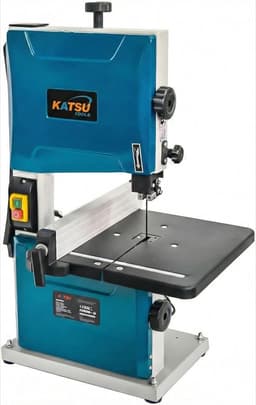
The blades in the box are general wood blades. The KATSU 100552 includes a 1400 × 6.35 × 0.35 mm blade at 6 TPI. The 100555 includes a 1400 × 6.35 × 0.4 mm blade at 6 TPI, described as pre-fitted. A width of 6.35 mm is a quarter of an inch. On the Saws UK chart that is a 5/8 inch minimum radius, about 16 mm, if the saw tracks it. Tuff Saws treats a blade narrower than 1/4 inch as a step many saws cannot take, so the included blade will follow a gentle bracket and will not follow fine scrollwork. The Draper supplies a 6 TPI blade described as 5 mm thick, and it does not state the width or the loop. The KATSU 100555 reviews already include blades that jump off the wheels. If the blade leaves the wheels while you turn, the setup is on how to use a bandsaw.

Power does not pick the radius

The RETRIN and both Generic listings claim 800 W, a cut around 70 mm and a throat around 90 mm, at £206.99 to £248.99, with no reviews. One of them says the table supports curved cutting. That sentence does not make the radius tighter. The radius is the blade width and the guide setup. A smaller throat also means less room to swing a wide blank while you turn. The KATSU’s 200 mm throat is the more useful opening for a curved bracket, even though the motor is stated at 350 W. The ONEMANA cordless saw is a pipe tool, not a curve in timber. A higher watt claim will not keep a narrow blade on the tyre. Which row to buy for small timber is on the best bandsaw UK page.

Common questions

Can a bandsaw cut curves?
Yes, when the shape starts at the edge and the blade is narrow enough for the radius. The small bench saws in this set are used for that job, including shapes reviewers say a jigsaw tears. The guard stays just above the wood. A closed shape in the middle of a board needs a scroll saw, because a bandsaw blade is a continuous loop and cannot be threaded through a hole.
How tight a radius can a 6 mm blade follow?
On the Saws UK chart, a 1/4 inch blade, which is 6.35 mm, has a minimum radius of 5/8 inch, about 16 mm. That chart is supplier guidance, not a standard, and it assumes the saw can run that width. The KATSU blades are about 6.35 mm. A tighter fret needs a narrower blade, and only if your guides can hold it. Dakin-Flathers’ example runs the other way: a 50 mm radius suits about a 10 mm blade.
Is 6 TPI right for curves?
Six teeth per inch is a general wood blade, which is what Tuff Saws calls 6 TPI, and it is what both KATSU listings include. It will cut a curve in ordinary timber. It is not a fine fret pitch. Tooth count changes the finish and the speed more than it changes the tightest radius. Width is the radius control. Buy a different TPI when the cut is burning or rough, after the width is right.
When do I need a scroll saw instead?
Use a scroll saw for internal cuts, tight fretwork and thin material, where the blade can be released and passed through a drilled hole. Use the bandsaw for open curves in thicker stock, up to the cut height of the saw, which is 80 mm on the KATSU rows. The scroll saw is a different machine. It was removed from this bandsaw set for that reason.
Can I cut a circle in the middle of a board?
Not with the bandsaw blade threaded into the middle. The loop cannot open. You can cut a disc if you start from the edge and the waste is allowed to fall away, or you can drill and use a scroll saw for a hole that must stay surrounded by wood. Relief cuts from the edge help a bandsaw turn a corner. They do not create an enclosed piercing.

Related pages

Sources

Public UK sources and the amazon.co.uk listings compared on this page. Shelf date 19 October 2026.

  1. HSE WIS31 (retrieved October 2026)
  2. HSE WD1 (retrieved October 2026)
  3. HSE: Wood dust (retrieved October 2026)
  4. PUWER overview (retrieved October 2026)
  5. Supply of Machinery (Safety) Regulations 2008 (retrieved October 2026)
  6. GOV.UK machinery guidance (retrieved October 2026)
  7. Axminster, what bandsaw to buy (retrieved October 2026)
  8. amazon.co.uk Band Saws Best Sellers (retrieved October 2026)