Independent comparisons. We may earn from shop links. More info

Electric vs gas patio heater

Updated: 21 October 2026

You are pricing one evening outside, and the two adverts do not describe the same heat. An electric vs gas patio heater choice is a choice of site: a sheltered seat with an outdoor socket, or an open patio where a bottled-gas mushroom can stand in free air. The electric lamps are the [patio heater](/hub/portable-heaters/patio-heater) table. Covered roofs are the [gazebo](/hub/portable-heaters/patio-heater/sub/patio-heater-for-gazebo) page. Peter F. used the Energy Saving Trust’s July 2026 example, Ofgem’s GB rate for 1 October to 31 December 2026, and Liquid Gas UK’s outdoor-only guidance. A qualifying purchase can earn a commission at no extra cost to you.

You are pricing one evening outside, and the two adverts do not describe the same heat.

Our top picks

On this page

They are not the same heater

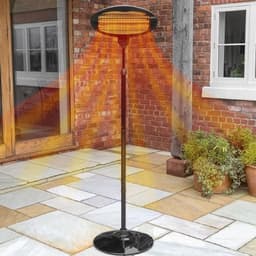
The electric heaters in this set are radiant lamps from 1,300 W to 3,000 W. The Harrier is a 2,000 W tower and the Knightsbridge is 1,300 W. They warm the person in the beam. Retail descriptions of bottled-gas patio heaters often sit around 10–13 kW for a larger open area. A 2 kW lamp does not replace that output because the electricity costs less. Infrared on these listings is the element: quartz, halogen, or a claimed carbon tube. It is still mains electricity, not a third fuel. A gas mushroom is sold for the open patio, where the cylinder can stand in free air.

What an evening costs

The Energy Saving Trust, in a July 2026 note, gives an example for 20 m² over two hours: about £3.10 for electric and about £9.30 for gas in Great Britain, and about £3.60 for electric in Northern Ireland. That is the Trust’s illustration for that area and duration, not a comfort test. For one electric lamp, Ofgem’s Direct Debit average is 26.32 p/kWh from 1 October to 31 December 2026. The standing charge is extra. The rate is not Northern Ireland and not a fixed deal. On that arithmetic, 2 kW is about 53p an hour and two hours is about £1.05. If the plate is 1,200 W rather than the 2,400 W in a Devola title, multiply 1.2. Electric can cost less on the Trust’s frame and still heat less space.

Fumes, cylinders, and plugs

LPG patio heaters burn a fuel. Liquid Gas UK says they are for outdoor use, not an enclosed space, a tent, or a marquee. Carbon monoxide is colourless and odourless. The Health and Safety Executive points to headache, dizziness, and nausea. A closed gazebo is the wrong room for that burner. Electric lamps do not make carbon monoxide. They can still start a fire in fabric, and Electrical Safety First says an outdoor-only heater stays outdoors. The plug is a BS 1363 plug into an outdoor socket of at least IP44 on an RCD. A 3 kW bar can fill a 13 A socket on its own. A landlord who supplies a gas heater needs a Gas Safe check at least every 12 months. A householder’s own cylinder heater is not given that annual instruction on the HSE domestic pages.

Which to buy for your site

Choose electric when you have an RCD-protected outdoor socket and a sheltered seat the lead can reach. In this set that is the Harrier, a 2,000 W IPX4 tower with a 1.8 m lead and the large review file. Fitting the socket is the how to use page, then an electrician. Choose bottled gas only when the patio is open air, you accept a cylinder, and the manual allows the roof. If the roof is a gazebo with sides, do not put the gas heater under it. Do not buy gas to park a mushroom under a closed canopy because a 2 kW lamp felt weak on a windy lawn. The Trust’s £3.10 and £9.30 are one dated example.

Common questions

Is an electric patio heater cheaper to run than gas?
On the Energy Saving Trust’s July 2026 example, electric is about £3.10 and gas about £9.30 for 20 m² over two hours in Great Britain, with electric about £3.60 in Northern Ireland. That is one framed illustration, not a comfort test. A 2 kW lamp at 26.32 p/kWh is about 53p an hour, a smaller job than 20 m².
Does a 2 kW electric heater replace a gas mushroom?
It replaces the mushroom only for the person sitting in the beam. Gas patio heaters are commonly sold around 10–13 kW for a larger open space. The Harrier’s 2,000 W does not add up to that coverage. Use the electric lamp for chairs near a socket, and gas only in open air if you need the larger spread.
When is gas the practical choice?
Gas is the practical choice on an open patio with no outdoor socket, where the cylinder can stand in free air and the manual allows the site. It is the wrong choice under a closed gazebo, in a tent, or in a marquee. If you already have a socket and only two sheltered chairs, the electric shortlist is the closer match.
Can I use a gas patio heater under a gazebo?
Only if the space is still open air and that heater’s manual allows the cover. Liquid Gas UK excludes enclosed spaces, tents, and marquees. Sides down are the enclosed case. An electric lamp, used at the height in its own manual, is the gazebo option.
Do I need a Gas Safe engineer at home?
You need Gas Safe if you are a landlord supplying the heater, at least every 12 months, or if the supply is piped gas. A householder using their own cylinder heater outdoors is not given that annual instruction on the HSE domestic pages. You still follow the outdoor-only rule, the regulator, and the hose that heater specifies.

Related pages

Sources

Public UK sources for plugs, weather codes, LPG and the hourly arithmetic. Listing prices, stars and review counts are from amazon.co.uk on 19 October 2026.

  1. Ofgem — Changes to the energy price cap, 1 October to 31 December 2026 (retrieved 19 October 2026)
  2. Electrical Safety First — Patio heaters (retrieved 19 October 2026)
  3. Electrical Safety First — Ratings of electrical appliances (retrieved 19 October 2026)
  4. legislation.gov.uk — Electrical Equipment (Safety) Regulations 2016, regulation 35 (retrieved 19 October 2026)
  5. Liquid Gas UK — CGS 04 (August 2020) (retrieved 19 October 2026)
  6. HSE — Carbon monoxide FAQ (retrieved 19 October 2026)
  7. Energy Saving Trust — Summer energy saving (retrieved 19 October 2026)
  8. BSI — BS EN 60335-2-30:2009+A13:2022 (retrieved 19 October 2026)