Portable barbecue weight for camping: what is too heavy?

Compare portable barbecue weights from 2.8 kg to 18.1 kg and decide what you can carry from the car, load in the boot or keep beside a motorhome.
On this page

A portable barbecue can weigh 2.8 kg or more than 18 kg, so portable does not tell you whether you can carry it to a pitch. Ask where it travels: in a backpack, from the car across a field, or on wheels beside a motorhome. Compare the kilogram figure with the packed shape, the fuel and the route.
In short
About 5 kg or less is a rule of thumb for a short walk from the car. Treat 7–13 kg as car-camping kit. A 17–18 kg barbecue belongs in the boot only if you can roll it most of the way. Add fuel and loose parts before you judge the full load.
Start with the carry, not the word portable
Shops use portable for a grill that folds into its own case, a tabletop barbecue moved from car to picnic bench, or a cooking station that collapses onto wheels. All three can be truthful. None of them answers the same packing question.
Map the journey before you compare products. Count the lift into the car, the boot lip, the walk from parking to pitch, and any steps, gravel or wet grass. A barbecue you lift once beside a motorhome can be much heavier than one you carry 400 metres with a tent in the other hand.
There is no universal comfortable kilogram limit. About 5 kg for a short walk from the car is only a sorting rule. Strength, grip, health, the shape of the barbecue and the route can make a lower number sensible.
Under 5 kg: the genuinely light group
The lightest stated model here is the CAMPLUX FoldGo at 2.8 kg. It folds to a listed 40 x 28.5 x 10.5 cm, and the bullets say the body is the case. One UK reviewer carried it to Loch Muick. Another review quotes a different folded size and a weight barely above 2 kg. Compare on the listing figure.
The CAMPLUX can burn gas or charcoal, but the gas-canister thread is not named. A light grill is not useful on the hill if your cartridge does not connect. The listed 32 x 23.5 cm grid limits how much you cook at once. One review describes space for about four burgers.
Campingaz fills the rest of this bracket. The Party Grill is listed at 2.9 kg. The Party Grill 200 CV gives 3.3 kg in the item field and 2.84 kg in the bullets. Keep both figures. The 200 CV has a transport lid, so shape may matter more than a few hundred grams.
At 4.92 kg, the Campingaz Party Grill 400 CV sits at the top of this group. The listing names a carry bag, and the cooking parts pack into the body. See the camping gas barbecue comparison for the cartridge, cooking modes and listing caveats.
From 7 to 13 kg: portable by car
At 7.1 kg, the ROVSUN two-burner griddle is not in the same carrying class as a 2.8 kg folding grill. One UK reviewer specifically did not find it very portable. The flat plate, two burners and included regulator are why you might accept the extra mass when breakfast matters more than walking distance.
The Weber Q 1100N weighs 9.1 kg. The George Foreman GFSBBQ1 prints 10 kg in the field and 7.5 kg in the bullets. Plan around 10 kg until the seller confirms the packed figure. The 50 x 70 x 34 cm line also conflicts with a smaller dimension line.
At 10.5 kg, the Campingaz Othello 1 CV prefers to stay put. UK reviews treat it as a table plancha and call it heavier than expected. It can suit a week on one pitch if you lift it once. It is a poor match if it goes back to the vehicle every evening.
The Campingaz Attitude2go CV reaches 13 kg and belongs with car or motorhome kit. The bullets describe a closed 59 x 52 x 36 cm grill, while the field prints much smaller dimensions. Its review block matches the Othello file, so it is not evidence that owners find this model easy to move.
This middle bracket is where the portable grill comparison becomes more useful than a search for the lightest number. A larger plate, lid, UK hose or two burners can justify weight when the barbecue stays near the vehicle. They do not justify it when the pitch involves a long walk.
At 17 to 18 kg, the wheels matter
The Weber Traveler Compact weighs 18.1 kg in its item field and 17 kg in the bullets. Both numbers describe the same practical category: a wheeled barbecue for car travel, not a grill you casually carry across a campsite. The one-kilogram disagreement matters for the specification, but it does not change the transport decision.
Wheels and the automatic lid lock are the point of this model. Wheels put most of the load on the ground, and the lock keeps the cooking assembly closed while you move it. They suit firm, level ground. Steps, deep gravel, mud and a steep kerb turn a rolling load back into a lift.
The Traveler Compact also takes more boot space than a suitcase-style grill. The listing gives 54.6 x 86.4 x 88.3 cm and says assembly is required. Mark the likely folded footprint in the car and leave room for fuel and luggage. An 18 kg barbecue and a 2.8 kg barbecue do not serve the same journey.
A Camping and Caravanning Club equipment guide uses a Weber bundle of around 19 kg at the heavy end of portable. That is not the measured weight of these listings. It marks the same split: heavy portable kit moves by vehicle and trolley, not in a backpack.
What to do when listing weights disagree
The Party Grill 200 CV says 3.3 kg in one place and 2.84 kg in another. The Foreman says 10 kg and 7.5 kg. The Traveler Compact says 18.1 kg and 17 kg. These are catalogue conflicts, not extra models or measured ranges.
Use the higher printed weight for the boot and the carry. That is a planning choice. Ask the seller for the current packed weight, including the parts in the box, and whether a bag or loose plate is included.
Treat dimensions the same way. Inches and centimetres may disagree, or packed and assembled sizes may appear without labels. Do not convert a suspicious line and call the result verified. Mark the boot with the larger plausible dimensions.
Review text can help explain how a product travels, but it does not replace a specification. A reviewer who calls a 13 kg grill portable may mean that it fits a motorhome locker. Another who carries 2.8 kg to a loch is describing a much harder route. Read the use case beside the adjective.
Choose the barbecue by the trip
For a backpack or a walk-in pitch, start below 5 kg, then add fuel, food and tools. The CAMPLUX at 2.8 kg is the lowest stated figure, but the canister thread is unnamed, so confirm the fitting before you treat it as a gas solution.
For ordinary car camping, roughly 3–7 kg gives more choice without a hard lift at every meal. The Party Grill 400 CV pairs a 4.92 kg stated weight with a named bag. The ROVSUN reaches 7.1 kg for a two-burner flat griddle. Contained packing and extra cooking area do not both show up in the kilogram figure.
For a motorhome or a week on one pitch, 9–13 kg can be sensible if you unload once. A lid, plancha or UK regulator may earn that weight. Browse small gas grills by packed format as well as weight, and check the fuel fitting against the supply you already own.
For a wheeled grill around 18 kg, inspect both the boot and the ground. If the route includes stairs, or you cannot safely lift the folded barbecue over the boot lip, wheels do not make it suitable. Choose a lighter tabletop model, or arrange for two people to move it.
This comparison uses amazon.co.uk listing fields and UK review material from 15 October 2026. It is not a laboratory weighing test. Prices, availability and seller fields can change. If you buy through a qualifying Amazon link, Products Compared may earn a commission at no extra cost to you.
Common questions
What is a good portable barbecue weight for camping?
Is 13 kg still portable?
Is the CAMPLUX FoldGo the light gas option?
Why does the George Foreman barbecue have two weights?
How much does the Weber Traveler Compact weigh?
Can a backpack gas barbecue weigh 2.8 kg?
Should I trust dimensions shown in inches and centimetres?

Peter F. is the editor for DIY & tools at productscompared.co.uk. Comparisons in this category are checked against amazon.co.uk listings, review evidence and public UK sources.
Related articles
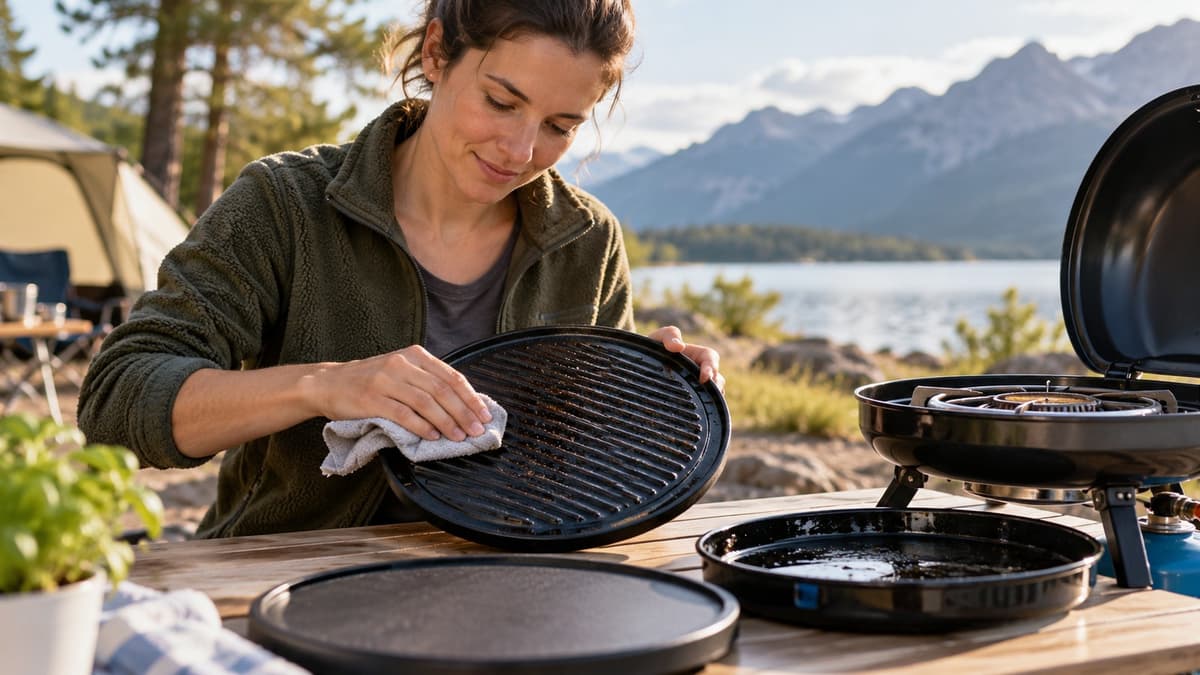
Cleaning a portable gas grill plate
Clean water trays, non-stick plates and enamel surfaces without treating them as the same material.

Packing a portable barbecue in the boot
Plan space for the grill, loose parts and fuel before the rest of the camping kit fills the car.

When to retire a camping gas hose
Know which signs mean a barbecue hose or regulator should no longer travel with you.