Independent comparisons. We may earn from shop links. More info

How to use a rivet gun

Updated: October 2026

The bracket is clamped, the gun is already in the box, and the first rivet is the one that usually goes wrong. How to use a rivet gun comes down to the hole, the nosepiece, and a mandrel that snaps and then leaves the jaws. This assumes a hand plier from the [rivet gun comparison](/hub/pliers/rivet-gun). If you are still choosing a size, start with the [rivet gun buying guide](/hub/pliers/rivet-gun/sub/rivet-gun-buying-guide). The Products Compared editorial team did not film a test. Listing notes are from amazon.co.uk on 15 October 2026.

The bracket is clamped, the gun is already in the box, and the first rivet is the one that usually goes wrong.

Our top picks

On this page

Before you squeeze

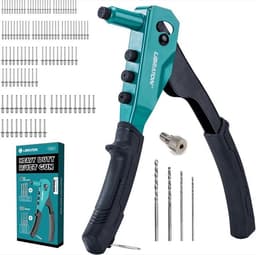
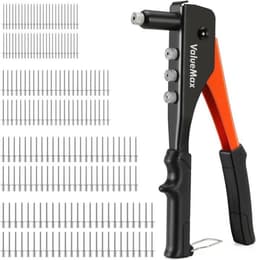
Measure the stack first. Grip is every layer, including a washer. JRP says the published grip range has to include that thickness. Drill about 0.1 mm over the rivet. Danetre’s chart and Westfield’s DIN 7337 table give 3.3 mm for 3.2 mm and 4.9 mm for 4.8 mm. GESIPA UK uses the same allowance. Fit the nose that matches the rivet. GESIPA UK says a mismatch damages the joint and the tool. ValueMax and WORKPRO noses turn by hand. The Rolson needs its spanner, and the Libraton 900913 needs its wrench. Put eye protection on before the snap.

Set one rivet

Clamp the sheets so the holes cannot creep. Push the rivet in from the side you can see, flange flush, mandrel towards you. Open the handles, seat the mandrel fully in the nosepiece, and bring the nose onto the flange. A mandrel that is only half in the jaws slips and bends. Squeeze in a steady pull until the mandrel breaks. On a short aluminium rivet in thin sheet, one or two closes are often enough. If the handles bottom out and the pin is intact, stop. Open the handles so the stem drops out before the next rivet. If you can rotate the rivet with your fingers, it has not set. Drill it out and use more grip.

When the stem sticks

Stop if the handles go light without a snap, or if they lock. The usual cause is a nose that does not match. The Libraton 900913 listing says the rivet must match the nozzle or it can catch. The Libraton 919011 includes a removal nozzle for a stuck rod. The WORKPRO listing says not to unscrew the body. Take the nose off, fit a larger one if you need room, and open the handles so the stem can come back. A mandrel that snaps halfway usually means a short rivet or an oversized hole. Flushing the stub does not clamp the sheet. Drill the body out and use a longer rivet of the same diameter. The one-hand choice is on one handed vs two handed rivet gun.

When to stop

A 4.8 mm aluminium rivet that will not break will not improve if you stand on the handles. Stainless and 6.4 mm are where these kits usually run out. WORKPRO and JiGiU list a 6.4 mm nose, and reviews on both dispute whether it sets. One failed trial is enough. Call a professional for a structural joint, for a rivet the tool will not rate, and for work at a height where you cannot hold the gun safely. A painted vehicle panel is the same stop. Gutters and thin non-structural sheet are the jobs in scope, which rivet gun for sheet metal sets out. Links can earn a commission at no extra cost to you.

Common questions

What are the steps, in order?
Clamp the sheets, drill about 0.1 mm over the rivet, and fit the matching nose. Seat the rivet with the flange flush, push the mandrel fully into the gun, and squeeze until it breaks. Open the handles so the stem falls out. If the rivet still turns in the hole, it has not set. Drill it out rather than riveting on top of it.
What hole do I drill for 3.2 mm and 4.8 mm?
Use about 3.3 mm for a 3.2 mm rivet and about 4.9 mm for a 4.8 mm rivet. A 4.0 mm rivet wants about 4.1 mm, and a 6.4 mm rivet about 6.5 mm. Those are the DIN 7337 figures Westfield publishes. Some UK how-tos say the same diameter, then enlarge if tight. That is a closer hole than the fastener table. Follow the table.
How many squeezes until it pops, and how do I change the nose?
There is no shared squeeze count. A short aluminium rivet in thin sheet often breaks in a couple of closes, which is only a rule of thumb. The C-500RH counts belong to that tool. Screw the matching nose on until it seats. Knurled noses on the ValueMax, WORKPRO, JiGiU, KLRStec and Libraton 919011 are described as tool-free. The Rolson needs its spanner and the Libraton 900913 its wrench. The Mardatt listing does not say how the nose comes off.
The stem is stuck, or the mandrel snapped halfway. What now?
Stop pulling. Remove the nosepiece rather than unscrewing the body. The WORKPRO listing says to fit a larger nose if you need clearance, then open the handles. A halfway snap means the joint is not clamped. One Libraton 900913 review describes heavier rivets sawn off after that failure. Cutting the stub flush does not tighten the sheet. Drill the body out and reset with the right grip.
When should I get a professional?
Stop if the joint is structural, if you cannot hold the gun safely at that height, or if the panel is painted bodywork. Also stop when a matched rivet will not snap. These kits are for occasional aluminium rivets. A load-rated bracket, stainless, or a 6.4 mm rivet that stalls is outside the job. One failed trial is the point to change tool, not to drill the next hole.

Related pages

Sources

Public UK and standards sources listed in the research digest, checked with the amazon.co.uk prices and stars dated 15 October 2026. Shelf prices can change.

  1. ISO 14588:2000 Blind rivets — Terminology and definitions (retrieved 15 October 2026)
  2. ISO 15977:2002 Open end blind rivets with break pull mandrel (retrieved 15 October 2026)
  3. GESIPA UK: Find the right nosepiece (retrieved 15 October 2026)
  4. GESIPA UK: Calculate the length of blind rivets (retrieved 15 October 2026)
  5. JRP: Blind rivets application guide (retrieved 15 October 2026)
  6. Westfield Fasteners: DIN 7337 blind rivet tables (retrieved 15 October 2026)
  7. HSE: PUWER overview (retrieved 15 October 2026)
  8. Consumer Rights Act 2015 (retrieved 15 October 2026)