Independent comparisons. We may earn from shop links. More info

Punch pliers vs drive punch

Updated: October 2026

The revolving head will not reach the middle of a bag panel, and a mallet-struck tube is a poor tool for one extra hole in a belt on the kitchen table. Punch pliers vs drive punch is a reach-and-thickness choice, not a brand war inside this amazon.co.uk plier set. Punch pliers are for near-edge strap holes you can squeeze in one go. A drive punch is for anywhere on a panel, and for stock a turret will only crush. None of the eight kept rows is a drive punch, so this page will not invent a mallet listing. The [punch pliers comparison](/hub/pliers/punch-pliers) remains the plier table. If the mark sits in a panel, you already need the other tool.

The revolving head will not reach the middle of a bag panel, and a mallet-struck tube is a poor tool for one extra hole in a belt on the kitchen table.

Our top picks

On this page

Two different tools

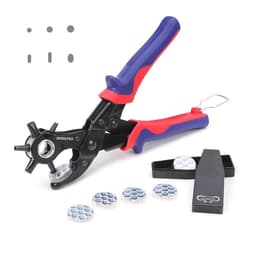
Punch pliers put a hollow tube opposite a pad in a pair of handles. You squeeze, a slug shears, and the hole sits as far from the edge as the throat allows. A revolving head in this set is typically 2–4.5 mm, or 2–4.8 mm on the Draper Expert 63637. British Leather Supplies describes rotary punches as convenient multi-size tools, weaker on thick leather than a struck tube. A drive punch is a hollow cutter you strike with a mallet onto a cutting board. There is no throat, so you can place the tube anywhere on the hide. You need a mallet and a poly board or end-grain block. Leathercraft practice is not to use granite or a kitchen worktop, because the tube rolls or chips. The punch pliers buying guide chooses among plier families. This page chooses whether a plier is the wrong family entirely.

Reach

On a 30 mm belt the hole is near the edge, so revolving pliers reach. On a wallet back, a bag flap or a saddle skirt, the hole can sit 40 mm or more from any edge. Workshop notes put a typical rotary throat around 1.5–2 inches. Treat that as a rule of thumb, not a measurement of Diyife or Draper. If you cannot get the pad under the mark with the tube square, the pliers will not make that hole. WORKPRO’s ellipse and rectangle cutters do not change the throat. A mixed-shape head is still a plier. United Kingdom reviews of Diyife, TOWOT and the strrng describe watch straps and sandal straps. A hole in the centre of a panel is not that job. If you are twisting the work to cheat the throat, stop. How to stop a bad squeeze is on how to use punch pliers.

Thickness and hole shape

British Leather Supplies’ split is rotary for ordinary strap work, and a drive punch when the leather is thick or the hole is large. A workshop band for rotary punches is around 5 oz, or 2 mm, of leather. That is a rule of thumb, not a maximum on these listings. United Kingdom TOWOT notes already split on thick belts. One UK WORKPRO review said a handle came off after an oval in 3 mm leather. None of those notes is a licensed thickness rating. Round tubes match round buckle tongues. Oblong slots, large washers and decorative panel holes are drive-punch profiles. WORKPRO’s 6.1 mm ellipse is still limited by jaw orientation. Punch pliers are quicker for one belt hole, because there is no board to fetch. More squeeze will not create reach that is not there.

If you only punch belts

Stay with punch pliers if you only add belt holes. British Leather Supplies’ starter advice is that a mid-range rotary is enough for most belt jobs. In this capture that is a revolving 2–4.5 mm head, or Draper if you want a named 4.8 mm tube. Buy a drive punch as well when the next job is a bag panel, thick veg-tan, or a slot the WORKPRO jaws will not feed. Punch pliers suit near-edge holes in ordinary belt leather. A drive punch suits a mark beyond the throat, or a turret that only dimples the grain. Knipex 90 70 220 is still a revolving plier, not a drive punch, and it is not a row here. Do not strike these handles with a mallet.

Common questions

Can punch pliers reach the middle of a bag panel?
Usually no. The throat of the jaws sets how far from an edge you can place a hole. A drive punch has no throat, so you can sit the tube on any mark on the panel. If you are already twisting the work to cheat the C-shape, you are past punch pliers.
How thick is too thick for a revolving head?
There is no lab figure on these listings. Workshop guides often treat rotary punches as a poor match once leather gets around 2 mm, or 5 oz, and United Kingdom reviews already report incomplete cuts on thick belts. If the grain only crushes, switch tool.
Do I need both tools?
Not if you only add holes to belts and watch straps. You need a drive punch as well if you punch bag panels, thick veg-tan, or large oblong holes. British Leather Supplies treats a mid-range rotary as enough for most belt-only jobs.
What extra gear does a drive punch need?
A mallet and a poly or end-grain cutting board. Do not strike onto granite or a kitchen worktop if you are following leathercraft practice, because the tube can roll or chip. Loose cutters also need storage, which punch pliers avoid by keeping the sizes on one head.
Is a mixed-shape plier a substitute for an oblong drive punch?
No. WORKPRO’s ellipse is still a plier with limited throat, and United Kingdom reviews say the oval will not feed along a belt. An oblong drive punch is the tool for a slot you can place anywhere on the strap or panel.
Should a belt-only buyer bother with a drive punch?
No. A revolving punch is the matching tool for near-edge round belt holes. Keep a drive punch for the day the hole sits in the middle of a panel. Unused iron in a drawer does not make tonight’s belt hole cleaner.

Related pages

Sources

Public UK sources from the research digest, last checked on 19 October 2026. Shelf prices and star lines are the amazon.co.uk figures in the display file.

  1. amazon.co.uk listings in this category, 19 October 2026 (retrieved 19 October 2026)
  2. Knipex 90 70 220 revolving punch pliers (retrieved 19 October 2026)
  3. Draper 63637 revolving punch plier (retrieved 19 October 2026)
  4. GOV.UK: General Product Safety Regulations 2005, Great Britain (retrieved 19 October 2026)
  5. GOV.UK: Placing UKCA or CE marked products on the market in Great Britain (retrieved 19 October 2026)
  6. legislation.gov.uk: Consumer Rights Act 2015, section 9 (retrieved 19 October 2026)
  7. HSE: INDG291, providing and using work equipment safely (retrieved 19 October 2026)
  8. British Leather Supplies: a beginner’s guide to punching holes in leather (retrieved 19 October 2026)