Independent comparisons. We may earn from shop links. More info

How to use mole grips

Updated: 21 October 2026

The pair is in your hand, the nut is already shiny, and squeezing harder only walks the jaws off the flats. How to use mole grips is a set, lock and release loop, not a harder squeeze. You offer the jaws square, turn the screw until they kiss the work, add a small extra turn, then close the handles until they click over centre. This page is that sequence. It does not rank the three amazon.co.uk listings. The table is on the [grip pliers comparison](/hub/pliers/grip-pliers). We did not time a lock in a workshop. A qualifying purchase can earn a commission at no extra cost to you.

The pair is in your hand, the nut is already shiny, and squeezing harder only walks the jaws off the flats. How to use mole grips is a set, lock and release loop, not a harder squeeze.

Our top picks

On this page

How the lock actually works

Mole grips are a toggle. The adjustment screw sets how far the jaws travel. The handles and a link bar go over centre, and a spring wants to throw them open again. Once the linkage has clicked past that point, the jaws stay shut without you holding on. Wonkee Donkee treats that click as the working sign. If the handles close with no effort, the screw is too loose and the first turn polishes the nut. If they will not close, the screw is too tight and you are bending the frame. Stanley names TruLock, WORKPRO names a quick-release lever and an adjustment screw, and Amtech puts quick release in the title only. Keep your fingers off the inside of the handles.

Set, lock and release in order

Open the pair and offer the jaws square, on the largest contact you can get. Across the flats if any flats remain. Around the tube if the job is pipe. The curved or straight jaw page is the geometry fork. Turn the screw until the jaws just kiss the work, then add a small extra turn. Close the handles until you feel a firm over-centre click. No resistance means the screw is too loose. No click without leaning means ease it off. To release, ease the handles together a few millimetres if the pair is clamped hard, then press the lever. Do not pry the linkage with a screwdriver. Wipe factory grease off a new Stanley before the first bite.

If they will not lock or will not open

Most will-not-lock faults are the screw, or jaws that meet in a V because they are not square. Reset both before you force the frame. A stuck release wants the same unload: squeeze slightly, then press the lever. WORKPRO UK reviews mention a stiff release. That is not a cue to hit the lever with another tool. If the frame has already bent, stop. One WORKPRO review describes a buckle on a snapped engine bolt. Under PUWER 1998 that pair comes out of service if you use it at work. Polished teeth will slip on a rounded nut however hard you click. That job is on mole grips for a rounded nut. None of these three is marked for live work. Prove dead first.

What differs on Stanley, WORKPRO and Amtech

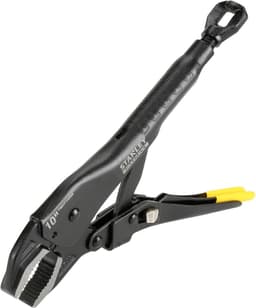
TruLock is Stanley's name for the release on the 250 mm curved FatMax, not a second mechanism and not insulation. If the lock clicks but the work still rocks, one UK review points at jaw play against a Milwaukee pair, not at your sequence. WORKPRO names both the screw and the lever, the most complete control set of the three. Use the 250 mm curved piece for pipe and fasteners, and the 165 mm straight jaw for flat stock. Do not over-tighten the small pair to chase alignment. UK notes already mention wobble. Amtech does not name an adjuster. Do not invent a screw the listing does not show. If a 130 mm pair will not click on a radiator valve, the tool is too small. The buying guide is where you change length.

Common questions

How do you set the adjustment screw?
Open the jaws, offer them square, and turn the screw until they just kiss the work. Add a small extra turn, then close the handles to an over-centre click. If they close with no effort, the screw is too loose. If they will not close, ease it off. Half a turn extra is a rule of thumb, not a figure printed on these listings.
Why will my mole grips not lock?
Usually the screw is in the wrong place, or the jaws are not square on the work. Reset both before you lean on the handles. Forcing a lock that will not click bends the frame. On the Amtech, repeated UK notes that the pair will not stay locked also mean the tool may simply be too small.
How do I release them when they are clamped hard?
Ease the handles together a little to unload the toggle, then press the release lever. Do not pry the linkage with a screwdriver. WORKPRO reviews mention a stiff release. Unloading first is the fix, not a hammer on the lever.
What is Stanley TruLock for?
It is the release named on the FatMax listing. It is not a self-adjusting jaw and it is not an insulation mark. Wipe factory grease, set the screw, click over centre, then use that release. One UK review still notes more jaw play than a Milwaukee pair.
Can I use one hand?
You can close a set pair with one hand once the screw is right. Setting the screw and offering the jaws square is usually two-handed. Do not try to lock and turn a rounded nut one-handed. That is how the pair walks off and polishes the head.
Will the handles spring open and pinch me?
Yes, they can. The spring that throws the linkage also throws the handles. Keep fingers off the inside faces when you release, especially if the pair was clamped hard. Store them open so you are not fighting a loaded spring next time.
Should I store them locked?
No. Store them open, dry, and with the screw backed off. A lock left on scrap steel keeps the spring loaded and can take a set in the jaws. None of these three is a live-work tool, so storage next to electrical kits does not make the handles safe.

Related pages

Sources

Public UK sources from the research digest, last checked on 19 October 2026. Shelf prices and star lines are the amazon.co.uk figures in the display file.

  1. Stanley FatMax locking mole grips, amazon.co.uk B01MQK1HT7 (retrieved 19 October 2026)
  2. WORKPRO 3-piece locking pliers set, amazon.co.uk B01KZM2R4O (retrieved 19 October 2026)
  3. Amtech 130 mm locking grip pliers, amazon.co.uk B009DNBIKG (retrieved 19 October 2026)
  4. Wonkee Donkee Tools: which type of mole grips (retrieved 19 October 2026)
  5. HSE: PUWER overview (retrieved 19 October 2026)
  6. BSI: BS EN IEC 60900:2018 (retrieved 19 October 2026)
  7. Screwfix: pliers buying guide (retrieved 19 October 2026)
  8. B&Q: mole grips (retrieved 19 October 2026)