Seedling heat mat: what to check before you buy
A February windowsill in Britain often sits below the temperature on a tomato or pepper packet. A seedling heat mat is the flat pad under the tray so the compost, rather than the whole room, picks up that warmth. You are choosing among 12 amazon.co.uk listings, with shelf prices on 16 October 2026 from £8.90 to £42.99. Check the crop, then whether you can set a temperature, then the heated rectangle, then the plug and the water claim. The [seedling heat mats](/hub/plant-accessories/seedling-heat-mat) comparison holds the full table. This page is that decision order. A purchase through our amazon.co.uk links can earn a commission at no extra cost to you.
A February windowsill in Britain often sits below the temperature on a tomato or pepper packet. A seedling heat mat is the flat pad under the tray so the compost, rather than the whole room, picks up that warmth.
A February windowsill in Britain often sits below the temperature on a tomato or pepper packet. A seedling heat mat is the flat pad under the tray so the compost, rather than the whole room, picks up that warmth. You are choosing among 12 amazon.co.uk listings, with shelf prices on 16 October 2026 from £8.90 to £42.99. Check the crop, then whether you can set a temperature, then the heated rectangle, then the plug and the water claim. The seedling heat mats comparison holds the full table. This page is that decision order. A purchase through our amazon.co.uk links can earn a commission at no extra cost to you.
Our top picks
| Badge | Product | Control | Heated area | Supply | Note | Price | Offer |
|---|---|---|---|---|---|---|---|
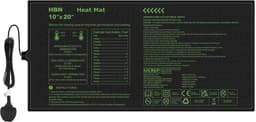
| Best overall |  HBN HBN 17.5 W fixed heat mat | None; leave it on until you unplug it | 25 × 50 cm | 230–240 V | 7.8 | about £14.99 | View offer |
| Alternative |  Senua Senua 20 W fixed heat mat | None; plug in only | 25 × 52.7 cm | Not stated | 7.0 | about £14.99 | View offer |
 WADEO WADEO 50 W probe heat mat | Digital thermostat with a separate probe | 52 × 25 cm | Not stated | 8.0 | about £24.22 | View offer |


On this page
What the mat is for
Control before watts
The heated rectangle, not the wattage
Plug, voltage and water
Common questions
Does a 25 × 52 cm mat fit two British full trays?
Which listings print a mains voltage?
Why does a model code ending in EU or UK fail to settle the plug?
Can you wash a mat that says IP67, IPX4 or waterproof?
What does a nameplate watt cost per day, and what does that miss?
Related pages
Sources
Public UK sources checked for this comparison, plus the amazon.co.uk listing facts in the display file on 16 October 2026. Shelf prices and star lines are those UK figures. The Ofgem unit rate is the Direct Debit average for England, Scotland and Wales, not a Northern Ireland tariff and not a measured bill.
- RHS: how to sow seeds indoors (retrieved 16 October 2026)
- RHS: grow your own chilli pepper (retrieved 16 October 2026)
- Ofgem: energy price cap, 1 October to 31 December 2026 (retrieved 16 October 2026)
- Electrical Equipment (Safety) Regulations 2016, regulation 35 (retrieved 16 October 2026)
- The English Garden: heated propagators (retrieved 16 October 2026)
- BBC Gardeners' World: heated propagators (retrieved 16 October 2026)
- Thompson & Morgan: full-size seed tray (retrieved 16 October 2026)
- BSI: BS EN 60529, degrees of protection (IP code) (retrieved 16 October 2026)