Independent comparisons. We may earn from shop links. More info

How to install a solar mole repeller

Updated: 23 October 2026

You are standing on a damp British lawn with a box of solar stakes, fresh heaps near the border, and no leaflet worth the name. Knowing how to install solar mole repeller spikes will not turn a budget buzzer into a guaranteed cure. It will stop you cracking the plastic cap or drowning the battery on the first wet weekend. Brand rankings stay on the [solar vole repellent comparison](/hub/pest-control/solar-vole-repellent). This page is the order of operations once the box is open: how long to charge the head, how deep to sink the shaft without a hammer, where to leave an exit, and when to pull the stake out.

You are standing on a damp British lawn with a box of solar stakes, fresh heaps near the border, and no leaflet worth the name.

Our top picks

Nitoer Nitoer S40 4-pack

Best overall

Nitoer Nitoer S40 4-pack
8.1/10about £19.90
NIKAND NIKAND R_4 4-pack

Best value

NIKAND NIKAND R_4 4-pack
7.3/10about £33.96
BURMONG BURMONG PTMR 2-pack

Alternative

BURMONG BURMONG PTMR 2-pack
6.5/10about £13.99
On this page

Charge before you push

Charge the head before the first night. The Lodi Racan RAC-1105 manual says two full days with the switch off. Nitoer and NIUBDHQ also say at least 48 hours, and Nitoer quotes up to four days once full. Panel conflicts are in the solar vole repellent buying guide.

Pilot hole, not a hammer

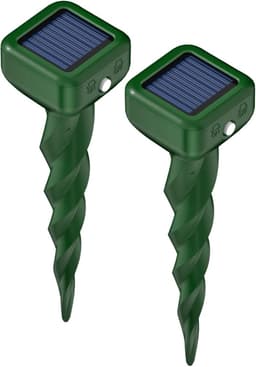
Do not use a mallet. The Lodi Racan RAC-1105 manual and the Pest-Stop PSSPMR instructions forbid hammering, because the cap splits. Skip frozen or waterlogged ground. Make a pilot hole with a rod or stake, or bore one as the NIUBDHQ listing suggests. A spiral shaft such as BAI-LUU twists in by hand unless the soil is stony. Press only on the rim.
Nitoer Nitoer S40 4-pack

Testsieger

Nitoer Nitoer S40 4-pack
8.1/10about £19.90

Panel up, soil firm

The tube needs firm earth, and the cap must stay out of puddles. One NIKAND line says set the cap flush, and a buyer who did that for mowing reported failure. Nitoer says about 5 cm (2 inches) above the surface, and KSLDNZMA says at least 5 cm in direct sun. Lodi Racan says bury up to three quarters of the tube and keep the top clear of dirt, snow, and ice.

Where it sits in the garden

The Lodi Racan manual says moist clay carries vibration better than dry sand, and never to push the spike into a tunnel. Sink it in solid soil beside the freshest mound. Do not ring the lawn, or the mole has no exit. Place one stake between the house and the newest heap, then shift it toward the fence every few days. Lodi quotes about 25 metres. Listings claim 30 metres or 650 m². Treat those as upper limits, and keep the stake away from a neighbour's window. Only BURMONG and the BOJYS 8-pack list a mode switch.

When to stop

Wait one to four weeks: a week on BURMONG and the BOJYS 8-pack, 7 to 14 days in the Lodi Racan manual, about two weeks for Pest-Stop, two to four weeks for NIUBDHQ, about four for BAI-LUU. If the holes are in a bank by water, stop and read moles or voles. Lift the stake before flood or frost. If heaps still rise after four weeks from October to April, see solar vole repellent versus traps.

Common questions

Do I hammer a solar mole repeller into the lawn?
No. You should never hit a solar mole repeller with a hammer or mallet, even in dry turf. Both the Lodi Racan RAC-1105 manual and the Pest-Stop PSSPMR instructions forbid hammering because impact cracks the solar cap and loosens internal parts. Make a pilot hole first with a steel rod or wooden stake, or twist in a spiral-shaft model by hand.
How far above the ground should the solar head sit?
On the amazon.co.uk listings that state a clearance, Nitoer advises leaving the head about 5 cm (2 inches) above the surface and KSLDNZMA specifies at least 5 cm (2 inches) above ground so rainwater cannot enter. In the wider product family, the Lodi Racan manual says to bury up to three quarters of the tube while keeping the panel clear of dirt, snow, and ice.
Can I bury the cap flush with the turf so the lawnmower clears it?
Burying the solar head flush with the lawn lets surface water and wet clippings pool over the seal. One NIKAND snippet mentions setting the cap flush with the ground, but buyer reviews for that listing report that burying the unit for mowing caused it to fail, whereas keeping the cap above the turf kept it working. Pull the stake out before mowing instead.
How long should I charge a solar mole spike before first use?
The Lodi Racan RAC-1105 manual advises charging the unit in daylight for two full days with the switch off before garden use. Among the captured amazon.co.uk listings, both Nitoer and NIUBDHQ also ask for at least two days (48 hours) of initial charging, while NIUBDHQ adds that five hours of sun supplies roughly 38 hours of run time once active.
When should I take a solar mole repeller out of the ground?
Remove the stake whenever flooding is likely and before winter frost freezes the soil, as both the Lodi Racan and Pest-Stop instructions warn against frozen or waterlogged ground. Buyer reviews on amazon.co.uk confirm that heavy rain and internal condensation stop budget stakes from charging, and frozen turf can grip the plastic tube so tightly that pulling it out snaps the shaft.
Why are there more molehills in the first week after installing a stake?
An initial burst of fresh molehills does not mean the unit has failed on day one. The Lodi Racan RAC-1105 manual notes that increased digging during the first few days can be normal while a mole reacts to the new vibration in its tunnel system, and listings ask you to wait between one and four weeks before judging the result.

Related pages

Sources

Public UK sources used for this comparison. Shelf prices, stars and review counts are the amazon.co.uk figures captured for these eleven listings. Last checked 19 October 2026.

  1. GOV.UK, foxes, moles and mink (retrieved 19 October 2026)
  2. RHS moles (retrieved 19 October 2026)
  3. RHS mice and voles (retrieved 19 October 2026)
  4. ASA pest repellents (retrieved 19 October 2026)
  5. GOV.UK water voles (retrieved 19 October 2026)
  6. NatureScot water voles (retrieved 19 October 2026)
  7. Lodi UK Racan manual RAC-1105 (retrieved 19 October 2026)
  8. Pest-Stop instructions (retrieved 19 October 2026)