Independent comparisons. We may earn from shop links. More info

Moth trap or moth killer: which do you need?

Updated: October 2026

Choose a moth trap when you need to know whether adult males are still flying. Choose a moth killer only when its labelled method can reach the relevant place: by contact on an accessible surface or within an enclosed wardrobe, drawer or storage bag. A moth trap or moth killer is therefore not a weaker-versus-stronger choice. Neither clears larvae beneath fitted carpet that you cannot reach. Our main [moth protection comparison](/hub/pest-control/moth-protection) covers all 12 listings. This page compares the pheromone traps with the contact and enclosed killers in the set.

Choose a moth trap when you need to know whether adult males are still flying.

Our top picks

On this page

Males on the board, larvae in the pile

Clothes-moth pheromone glue traps imitate the female signal and attract males. English Heritage says the lures are specific and that traps will not control an infestation because they catch only males. Which? likewise treats them as tools for monitoring, locating activity and reducing flying adults rather than eradication. You can have several moths stuck to a board while new holes still appear in wool. The board is recording one adult sex above the surface. Larvae remain in carpet pile, seams, dark folds or upholstery and continue feeding until they are removed or reached by a suitable treatment. Species matters. A clothes-moth lure is not a pantry-moth lure. London Moth explicitly excludes Indian meal moth, among other species, while Insectix names male common clothes moth, Tineola bisselliella. Do not import advice for flour or cereal pests into a wardrobe problem.

The traps in this set

Insectix costs £13.56 for a title claiming six traps, although a pieces field says one. The bullet names male common clothes moth and up to 90 days, and the listing shows 4.5 stars from 401 reviews. That makes it the clearest option if your aim is species-specific monitoring over roughly three months. Glue sticking to fingers and occasional empty-board reports are the main practical drawbacks. London Moth costs £17.95 for ten traps and states about four months once opened. The 4.4-star line is based on 3,153 reviews, and the listing prints several species limits as well as the target clothes moths. Write the opening date on each board. The higher price buys duration and review evidence, not a larval kill. The Acana ten-pack is the third monitor: cardboard boards aimed at common and case-bearing clothes moths, with no stated working life in the extract. All three are checks rather than clearances. Heavy catches can help identify an active area. No catch cannot overrule visible webbing, cases or textile damage.

Killers only where they can reach

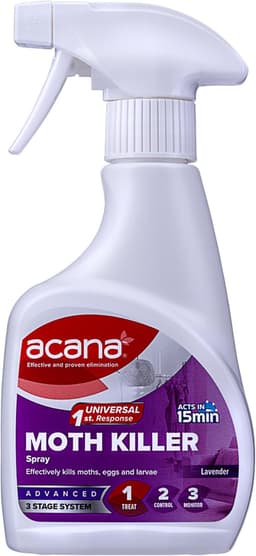
The contact killer here is Acana’s 275 ml transfluthrin spray at £8.68, aimed at carpets, curtains and cushions. The 15-minute kill and the three-month repeat are seller claims, not our test. English Heritage’s limit still applies: sprays kill larvae only where contact occurs. Use it on an accessible carpet edge or cushion seam when the label permits. It is not a whole-room fog. Reviewers say the bottle is small for a large room. Larvae under fixed carpet, deep in a sofa or inside folded cloth stay out of reach. English Heritage describes transfluthrin sachets as killing adult moths in enclosed spaces. Broader eggs-and-larvae bullets are not proof that an enclosed product clears inaccessible carpet. A specification field that says HSE is not an endorsement. Enclosed formats are in the moth protection for wardrobes and drawers guide. Cedar and plant sachets are repellents. The moth protection buying guide is where they fit.

When to use a trap and when to use a killer

Use a pheromone trap to see whether male clothes moths are active and where catches concentrate. Keep cleaning and treating textiles while it monitors. After a professional treatment, only that professional can define what counts as control. Use the labelled spray on a reachable carpet edge, curtain or cushion, and a labelled enclosed killer for a closed wardrobe, drawer or bag. Vacuum first. Placement does not replace removing the source. Call a pest controller when fresh damage continues in fitted carpet, a sofa or a void. A chimney or loft nest may need a sweep. A textile you cannot wash or freeze belongs with a conservator. If somebody feels unwell, stop and seek medical advice. The order of work is in how to get rid of clothes moths.

Common questions

Do pheromone traps kill larvae in carpet?
No. They attract adult males to adhesive and do not reach larvae in carpet pile. Vacuum and treat the affected carpet as appropriate, including professional help for inaccessible fitted areas. A dead adult on a board is not evidence that larvae are dead.
Will a clothes-moth trap catch pantry moths?
Not reliably. Pheromone lures are species-specific, and Indian meal moth is a different stored-food pest. London Moth explicitly excludes it. If moths are around flour, cereals or pet food, identify that source and use advice intended for pantry pests.
When is the Acana spray the right tool?
It is the contact tool in this set for reachable carpets, curtains and cushions, used exactly as labelled. It is the wrong sole treatment for larvae inside wool, under inaccessible fitted carpet or deep in a sofa. Its 15-minute line is a listing claim, not our measured result.
How long do these traps last?
Insectix says up to 90 days. London Moth says about four months after opening. Acana does not state a life in the extract. Write the opening date where possible and follow the physical instructions rather than applying one brand’s replacement period to another.
Can I use a trap and a killer together?
Yes, if each is used for its own job. A killer treats the labelled surface or enclosure, while a pheromone board monitors male activity. Continue cleaning and checking textiles. Neither product makes an inaccessible infestation disappear, and neither result should be read in isolation.

Related pages

Sources

Public UK sources and the amazon.co.uk listings in this set, last checked on 16 October 2026.

  1. HSE, authorised biocidal products (retrieved 16 October 2026)
  2. HSE, using biocides (retrieved 16 October 2026)
  3. HSE, GB expiry postponements (retrieved 16 October 2026)
  4. Regulation (EU) No 407/2014 (retrieved 16 October 2026)
  5. HSE, COPR conditions (retrieved 16 October 2026)
  6. Southwark Trading Standards, mothball warning (retrieved 16 October 2026)
  7. English Heritage, understanding clothes moths (retrieved 16 October 2026)
  8. BPCA, moth control (retrieved 16 October 2026)