Independent comparisons. We may earn from shop links. More info

Mole repellent for a lawn

Updated: 17 October 2026

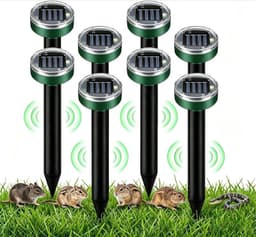
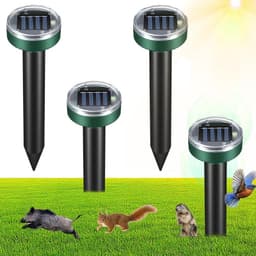
The mower is out, and fresh heaps will smear into the grass if you cut through them. A mole repellent for a lawn is often the next search, but turf comes first: sweep the hills, firm collapsed ground and reseed bare patches in spring. A solar stake is an optional experiment after that, and a four-pack does not come with a measured radius for your garden. The twelve listings are in our [solar mole repellent comparison](/hub/pest-control/mole-repellent-solar). Peter F. did not laboratory-test them. A qualifying Amazon purchase can earn us a commission at no extra cost to you.

The mower is out, and fresh heaps will smear into the grass if you cut through them.

Our top picks

On this page

Sweep the hills before the mower

Molehills are spoil, not a disease of the grass. The Royal Horticultural Society says moles eat invertebrates and that damage to plants is usually incidental. It also says to remove hills before you mow, and to fill collapsed surface runs so you are not cutting into a dip. BBC Gardeners' World, on 21 March 2019, says sweep the soil up first, or the blades smear it across the lawn. Flattening with a boot does the cosmetic job the RSPCA describes. It does not remove the animal. The RHS February lawn note says activity tends to increase in January and February because of mating and fortress building. That is biology, not a tip about solar charging. If you cannot live with the hills, remove the largest, firm the soil and reseed in spring. Netting under the turf is an RHS option only when it is laid before the lawn, not a retrofit.

One mole can make many hills

A small garden covered in heaps can still be one animal. The RHS makes that point explicitly: the hills in one garden may be a single mole. Buying four or eight stakes because you counted eight heaps treats each heap as a separate job. It is not. A four-pack is a set of pulsers you might spread across the turf, not four proven clearances. Do not judge a stake overnight, and do not bury its cap so the mower can pass. KSLDNZMA says the head should remain at least 2 inches above ground. NIKAND reviews describe units that stopped charging after the head was pushed down for the cut. The install guide covers charging and placement, and the buying guide covers pack and IP checks.

What the coverage lines do not measure

Seller coverage claims disagree and none describes a surveyed lawn. Figures include 650 square metres, 460 square metres, 15.24 metres, a 44-foot diameter and 4,000 square feet. A four-pack is not four measured radii, so do not convert these claims into guaranteed coverage. A GEOKILO buyer used four stakes on a garden of 25 feet by 15 feet, about 7.6 by 4.6 metres, and still found new mounds beside them. A buzzer may only move the mole to another part of the plot.

A lawn next to a house

Most UK lawns that grow molehills also sit beside a patio, a bedroom window or a neighbour's fence. NIKAND reviewers describe a beep every few tens of seconds, sometimes with a complaint from next door. Crazifuny prints 400 to 1,000 Hz, and one of its few reviews calls the sound loud. If you would notice the pulse from the kitchen, assume a neighbour might too. Moving hills next door is not success. Gardeners' World notes that a buzzer may move a mole to the other end of a large garden or to a neighbour. If you need the animal gone, the England rules are on the mole repeller versus trap page. Call a professional where holes affect a path, a pitch, a paddock or livestock. Another pack will not fix a path that is collapsing.

Common questions

Will one 4-pack cover a small UK lawn?
There is no measured radius you can apply to every small lawn. Seller figures disagree, from tens of metres to 650 square metres. One GEOKILO review used four stakes on a 25-by-15-foot garden and still saw new mounds. Read the spacing on the listing you buy, and treat it as a claim.
Why are there more hills in January and February?
The Royal Horticultural Society says mole activity tends to rise in January and February because of mating and fortress building. It is not a statement about solar output, and it is not GOV.UK's October-to-April window for reducing numbers by control. Fewer hills in April do not mean a stake worked.
If the hills stop, has the stake been proved?
No. Moles pause, and a single garden's hills may be one animal that has moved a few metres. The RHS says a buzzer may only shift activity elsewhere. A seller's wait of a couple of weeks is not a UK trial the Advertising Standards Authority has accepted. Keep the stake only if you are content with an experiment, not because a quiet fortnight is proof.
What if the mole moves to the neighbour's lawn?
That outcome is one Gardeners' World describes for electronic buzzers on a large garden, and it is not a result to aim for. The RHS already frames these devices as something that may relocate the mole rather than resolve the tunnelling. A neighbour's new hills are not evidence your lawn is protected. If the relationship next door matters more than the experiment, take the stakes out.
When is a lawn unsafe enough to call someone?
Call a professional if runs are undermining a path, a pitch, a paddock or ground used by livestock, or if you are considering gassing. GOV.UK expects a trap, where you use one, to be at least 150 millimetres down in the main tunnel and checked at least once a day. If you are not confident of that, do not improvise. Aluminium phosphide is for trained users, not a weekend lawn job.

Related pages

Sources

Sources from the research digest; last checked on 15.10.2026.

  1. Foxes, moles and mink: how to protect your property from damage (retrieved 15.10.2026)
  2. ASA advice online: pest repellents (retrieved 15.10.2026)
  3. RHS: moles (retrieved 15.10.2026)
  4. RSPCA: Living with moles (2022) (retrieved 15.10.2026)
  5. Gorman and Lamb, 1994: radio-tracked moles (retrieved 15.10.2026)
  6. HSE: active substances subject to the poisons law (retrieved 15.10.2026)
  7. GOV.UK: aluminium phosphide general information (retrieved 15.10.2026)
  8. Animal Welfare Act 2006, section 4 (retrieved 15.10.2026)