Independent comparisons. We may earn from shop links. More info

How to apply wood preserver to bare timber

Updated: October 2026

You can waste a full tin by brushing it over old varnish, racing an approaching shower or painting before the treatment has dried. Learning how to apply wood preserver therefore starts with the label and the timber, not a universal wait-24-hours rule. This method is for sound, accessible wood and amateur products whose current labels permit the job. Use our [wood preserver comparison](/hub/paints-and-varnishes/wood-preserver) to check the listing, then treat the container instructions as authoritative. Drying ranges in the products compared vary from hours to several days, and only some explicitly allow damp timber. A qualifying purchase can earn a commission at no extra cost to you.

You can waste a full tin by brushing it over old varnish, racing an approaching shower or painting before the treatment has dried.

Our top picks

On this page

Get back to bare, sound wood

Preserver intended to penetrate timber needs contact with bare wood. Remove paint, varnish, loose stain and surface contamination by the method appropriate to the coating and substrate. Ronseal's consumer instructions call for clean, dry wood, whereas the Everbuild Triple Action sheet permits damp timber. One brand's allowance is not permission to ignore another label. A screwdriver sinking easily into structural timber, spreading fungal growth or continuing fresh bore dust needs more than a cosmetic coat. The liquid will not harden wet rot. Find and stop the moisture source, then replace or professionally assess wood that has lost strength. Pre-1960 coatings may contain lead, so avoid creating uncontrolled dust and follow current UK safety guidance. HSE's central rule for biocides is to use the product according to its authorised label and user category.

Apply the coats and saturate end grain

Stir or prepare the product exactly as directed; do not dilute it unless the label says you may. Apply an even, liberal coat with the permitted tool and keep a wet edge so dry patches are easy to see. Two coats are common in manufacturer instructions, but the number, interval and application method belong to the specific product. Pay particular attention to end grain, joints, checks and freshly cut edges because they absorb liquid quickly. The Sika sheet tells users to soak end grain and, where practical, dip it for three minutes. That is a product instruction for suitable accessible components, not a way to convert an ordinary fence post into certified ground-contact timber. Do not assume spraying is permitted because it is quicker. Spray application increases drift and may be excluded by an amateur label. For volume before you start, the fence and shed preserver page turns listed coverage rates into worked examples.

Plan around rain, temperature and ventilation

Choose a dry weather window long enough for the product to reach the label's rain-safe point. Rain can wash out a water-based treatment or leave an uneven surface before it has dried. Manufacturer guidance for exterior Cuprinol products warns against application when rain is likely before drying and against temperatures below 5°C. That exact threshold should not be transferred to every tin, but it shows why the forecast and label matter. Ventilate indoor work throughout application and drying, following any restrictions printed by the maker. Keep people and pets away for the period on the label and do not invent a safe-when-touch-dry rule.

Drying time belongs to the product

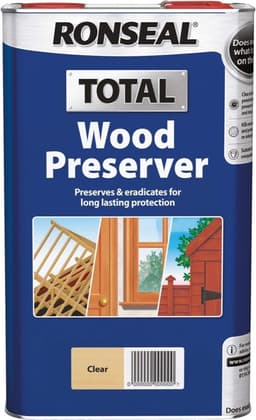
The products in this comparison demonstrate why one waiting period cannot cover the category. Everbuild clear says to wait 48 hours before painting or varnishing external wood. The Cuprinol clear 5 litre listing gives a broad 1–5 day dry time depending on surface and weather. Ronseal's own page gives 24 hours between coats, while some amazon listings omit a numerical drying time altogether. Quick drying in a product title is not enough information to schedule a topcoat. Touch-dry, ready for a second treatment coat and ready for paint can be three different points. If the timber still feels oily, cool or unusually tacky, do not trap uncertainty beneath paint. The wood preserver before painting page covers compatibility and test patches.

Common questions

How many coats of wood preserver should I apply?
Two coats are common in the manufacturer material reviewed, but follow the exact container rather than treating two as universal. Coat count, interval and coverage may change with the product and absorbency. End grain often needs particular attention because it drinks treatment faster than a smooth face.
Can wood be damp before treatment?
Only when that product permits it. Everbuild Triple Action and some listings say application to damp timber is allowed; Ronseal's consumer method calls for clean, dry wood. Damp is not the same as rotten, waterlogged or rain-soaked, and treatment does not correct the moisture source.
Can I apply preserver if rain is forecast?
Do not apply when rain is likely before the label's drying or rain-safe period. Water can dilute, wash out or mark an uncured treatment. Check both the hourly forecast and the time needed for all coats, rather than assuming a short surface-dry period is enough.
Why does clear preserver look like water or milk?
Some low-odour water-based treatments are very thin, and Sika says Triple Action appears milky before drying clear. Appearance alone neither proves nor disproves quality. Verify the sealed product, model, batch and label, then look for the expected clear result on a small test area.
When can I paint over wood preserver?
Use the product-specific topcoat time: examples here range from 16 hours in Cuprinol guidance to 48 hours for Everbuild external wood and 1–5 days on a Cuprinol listing. Compatibility matters as much as time, particularly with oily or waxy treatments.
When should I stop and call a professional?
Stop when structural wood is soft, fungal growth is spreading, fresh bore dust persists or the moisture source is hidden. A competent specialist can determine whether timber needs drying, repair, replacement or targeted treatment. Surface preserver cannot restore lost load-bearing strength.

Related pages

Sources

Public UK sources used for the safety and use-class points on this page. Prices, stars and review counts are from the amazon.co.uk listings on 16 October 2026.

  1. HSE — Using biocides (retrieved 16 October 2026)
  2. HSE — Product type 8, wood preservatives (retrieved 16 October 2026)
  3. BSI — BS 8417:2024 scope (retrieved 16 October 2026)
  4. WPA buyer guide via TDCA (September 2025) (retrieved 16 October 2026)
  5. European Wood Protection Association — use classes (retrieved 16 October 2026)
  6. Cuprinol — Wood Preserver Clear (BP) (retrieved 16 October 2026)
  7. Ronseal — Total Wood Preserver (retrieved 16 October 2026)
  8. amazon.co.uk listings for the twelve ASINs (retrieved 16 October 2026)