Independent comparisons. We may earn from shop links. More info

Best clear varnish spray: a practical buying guide

Updated: October 2026

Searching for the best clear varnish spray can put four quite different products on the same results page: furniture lacquer, general clear coat, craft varnish and artist fixative. Before comparing prices, decide what you are coating, how much area it covers and whether you want a visible shine. Our [varnish spray comparison](/hub/paints-and-varnishes/varnish-spray) keeps the eleven amazon.co.uk listings, prices and review counts together. This guide explains the decisions behind that table, so you do not end up protecting a wooden box with a tiny sketch fixative or buying a matt-labelled can for a job that cannot tolerate sheen.

Searching for the best clear varnish spray can put four quite different products on the same results page: furniture lacquer, general clear coat, craft varnish and artist fixative.

Our top picks

On this page

Four sprays that share one search

A conventional clear aerosol is the most recognisable option. Motip and Tetrion sell pressurised cans intended to leave a continuous clear film on hard surfaces; these make sense for a frame, decorative metalwork or a small piece of furniture. The surface list still matters. Tetrion names wood, metal, ceramic and plastic, whereas the Motip gloss surface field names plastic, metal, glass and stone and only its bullets add wood. If low sheen is the reason you are buying, read the matt or gloss varnish spray guide before treating the cap colour as a guarantee. HOMY ARTY is more craft-led. A UK review describes a manual pump rather than the aerosol stated in the product field. DISRIC sits further away from furniture varnish: it is marketed as a fixative for pencil, charcoal and pastel. Start with a job description rather than a brand. For a wood-specific shortlist, see varnish spray for wood.

Area matters before brand

Maker sheets suggest the scale of work these cans suit. Motip states approximately 1.5–2 m² from a 500 ml clear coat, while Polar states up to 2 m² from 400 ml and PlastiKote lists up to 1.75 m² for a comparable 400 ml clear lacquer. These are manufacturer figures, not guaranteed yields. Open grain, curved objects, overspray and extra coats can all reduce the useful area. A 250 ml can can be enough for a frame or craft piece. Three 250 ml cans give SFM 750 ml in total and the lowest calculated price per litre in this set, but that value depends on all three cans arriving and on the disputed matt sheen being suitable. Once the job grows to a floor, several doors or a run of kitchen cabinets, a tin is normally the more controllable purchase.

Read fields that disagree

Amazon listings can combine title text, structured fields and seller bullets that were not written together. The imustbuy page says gloss in its title and satin in the finish field. Those terms describe visibly different results, so do not silently choose the one you prefer. Ask the seller to identify the current can, or buy only if either sheen would be acceptable after a test.

Claims the listing does not prove

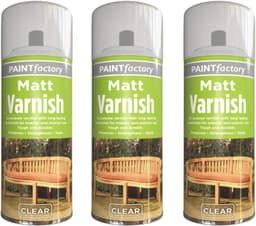
A waterproof tick is not a weathering test. Tetrion and some Paint Factory rows tick waterproof, but the extracts do not state exposure duration, preparation system or test method. Motip gloss does the reverse: waterproof is false while another line says water resistant. None of those fragments alone proves that a coating will protect a garden bench through a British winter. Pick the product type for the object, verify the named surface, choose sheen, estimate area with waste allowed, then resolve any contradictory field. Only after those checks should price and stars separate the remaining cans. Our best varnish spray UK picks apply that order to the strongest gloss and value options in this comparison.

Common questions

Is clear lacquer spray the same as varnish spray?
Retailers often use the terms interchangeably for a transparent protective aerosol, but the formulation and intended surface still matter. “Varnish spray” results can also include craft sealers and artist fixatives. Check the current can’s surface list, binder, finish and hazard instructions rather than relying on the search label.
How much can a 400 ml or 500 ml can cover?
Comparable maker sheets commonly state roughly 1.5–2 m² for a 400–500 ml clear aerosol. Treat that as an order-of-magnitude estimate. Open timber, overspray, complex shapes and several coats reduce practical coverage, so a large table or multiple doors may need a tin instead.
When is a 250 ml can enough?
A 250 ml can can suit a small box, frame, model or repair when the product names the substrate. It leaves less margin for testing and wasted spray than a 400–500 ml can. Measure all faces, allow for overspray and do not assume the headline size equals usable coating.
Which listing is a fixative rather than furniture varnish?
DISRIC is presented for pencil, charcoal, pastel and acrylic artwork. It is not the general wood or furniture coating that Motip, Tetrion and Paint Factory products resemble. Its low review score and conflicting mini-can volumes also make testing on spare material essential.
Does a waterproof tick mean the coating survives rain?
No. A tick without a test method, exposure period and compatible preparation system is only a listing claim. Exterior durability depends on the complete coating system and substrate. For an outdoor item, use a product whose current technical information explicitly covers that exposure.
Why do some listings disagree about gloss and satin?
Titles and structured marketplace fields may come from different data sources or product variants. The imustbuy row contains exactly that gloss-versus-satin conflict. Do not infer the finish from one field; confirm the label supplied or choose a listing whose sheen is consistent.

Related pages

Sources

Public UK sources and maker pages used for the limits on this page. Prices, stars and review counts are the amazon.co.uk listing figures for the eleven products compared here.

  1. VOC in Paints, Varnishes and Vehicle Refinishing Products Regulations 2012 (retrieved 17 October 2026)
  2. Defra post-implementation review 2025 (UKIA 2025/48) (retrieved 17 October 2026)
  3. Aerosol Dispensers Regulations 2009, Schedule 1A (retrieved 17 October 2026)
  4. GOV.UK — aerosol dispensers regulations 2009 (retrieved 17 October 2026)
  5. HSE — spraying hazardous substances (retrieved 17 October 2026)
  6. MOTIP Clear Coat technical data sheet (retrieved 17 October 2026)
  7. Winsor & Newton — how to varnish acrylic paintings (retrieved 17 October 2026)
  8. North London Waste Authority — aerosols (retrieved 17 October 2026)