Independent comparisons. We may earn from shop links. More info

How to apply matt emulsion

Updated: 23 October 2026

The wall goes patchy when you stop mid-bay or roll into an edge that has already dried. If the tin of matt emulsion is chosen and the plaster is already painted and dry, the order is simple: clean and fill, cut in, roll with a medium pile while the edge is wet, then repeat after the recoat time on the tin in your hand. New plaster is a short warning, not a second article. Listings are on the [matt emulsion paint comparison](/hub/paints-and-varnishes/matt-emulsion-paint). Products Compared has not painted these walls. A qualifying Amazon purchase can earn a commission at no extra cost to you.

The wall goes patchy when you stop mid-bay or roll into an edge that has already dried.

Our top picks

On this page

Prepare the surface

Wash the wall with sugar soap or a mild detergent, rinse, and leave it dry. Lightly abrade a glossy patch so the matt has something to grip. Fill cracks, let the filler dry, and sand flush. Dust shows as grit in a flat finish. Stir. A colour such as Manhattan Grey will flash if the first metre comes from an unmixed top. If two tins of the same colour meet on one wall, box them in the scuttle. Trade sheets for this sort of vinyl matt say not below about 10°C. Check the tin for leaks. Reviews here include missing lid tape, paint in the carton, and a smashed Crown base. If the wall is damp, soft, or mouldy, stop.

Cut in before you roll

Cut in before you roll. A 50 millimetre brush lays a band along the ceiling line, the skirting, and the architrave. Keep that band wet so the roller can overlap it. Homebuilding's sequence is the same: brush first, roll into the wet edge, and cut in again for the second coat. Rolling the middle and leaving the edges until tomorrow leaves a picture-frame line that matt does not hide.

Roll with a medium pile, then recoat

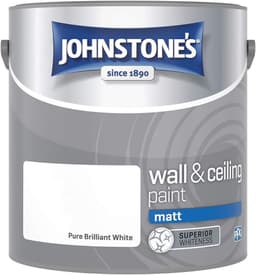
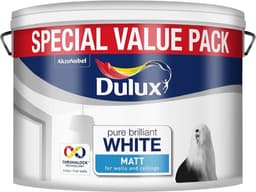
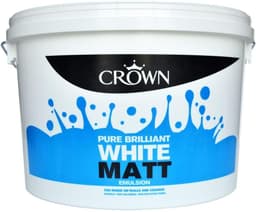
Use a medium-pile roller. Dulux specifies a medium pile for matt and a short-pile mohair for silk. A foam roller whips bubbles that side light will show. Load the sleeve and lay a W across the bay. Keep a wet edge. Sheen is on matt or silk emulsion. Plan a second coat even on white over white. The listings disagree on time. Johnstone's 2.5 litre white prints 1.5 hours for dry time and full cure, and the bullet says 1–2 hours. Crown's 10 litre prints 4 hours dry and 1 hour full cure, which cannot both be the instruction. Follow the tin in your hand.

New plaster, thin paint, and when to stop

A wall that is already painted does not need a mist coat. New bare plaster does. Dulux's guidance is to let it dry first, about four weeks as a rule of thumb, then a mist coat of about ten parts emulsion to one part water, then two undiluted coats. Quote the ten-to-one figure as Dulux's figure, not as the only site habit. If the plasterer says the walls are still drying, wait. If the paint feels watery, a second coat is the remedy on a sound wall. Adding water so it goes further on old paint is how you lose hide. The matt emulsion buying guide explains why 35 square metres per litre is not a buying figure. Johnstone's trade sheet says not to breathe spray and not to pour wash water into drains. A neat second coat still does not make ordinary matt into bathroom paint. That choice is on matt emulsion for bathrooms and kitchens.

Common questions

Do I cut in before I roll?
Yes. Brush a band along the ceiling, skirting, and frames, then roll into that band while it is wet. Cut in again for the second coat. If the edge dries first, you get a lap, and matt makes the line dull rather than invisible. A 50 millimetre brush is the usual size. Rolling the field and cutting in next day is how picture-framing starts.
Which roller should I use for matt emulsion?
Use a medium-pile sleeve. Dulux recommends a medium pile for matt and a short-pile mohair for silk. A foam roller leaves bubbles and an orange-peel film that shows in side light. Load from a scuttle and lay off in one direction before the bay sets. A sleeve washed and left damp can do the second coat if the nap has not clogged.
How long should I wait before a second coat?
Read the tin you are holding. In this extract Johnstone's 2.5 litre white lists 1.5 hours for both dry time and full cure, Dulux's 7 litre lists 4 hours, and Crown's 10 litre lists 4 hours dry and 1 hour full cure. When fields disagree, follow the can rather than a bullet that only says 1–2 hours. The wall should be touch-dry and not soft under a fingertip.
Do I need a mist coat on a wall that is already painted?
No. A mist coat is for new bare plaster after it has dried. Dulux's rule of thumb is about four weeks, then about ten parts emulsion to one part water, then two full coats. An old painted wall wants cleaning, filling, and two undiluted coats. Thinning the first coat on a sound wall reduces hide.
What if the paint feels thin and slides under the roller?
Lay it on and plan the second coat. Reviews of the Crown whites and the Dulux 7 litre describe watery paint that still covers once you stop expecting one coat. Do not keep adding water on a previously painted wall. If a third coat is still flashing, the Crown field that says up to 35 square metres per litre is not a reason to stretch the tin.
Can I spray this emulsion, and where does the brush water go?
Brush and roller are the method for a room. Spraying needs the respiratory warning, masking, and ventilation. Do not breathe overspray, and do not pour milky wash water down the drain. Seal a little paint for touch-ups and take the rest to a site that accepts emulsion. A leaked delivery is a reason to contact the seller, not to paint from the cardboard.

Related pages

Sources

Public sources from the research digest, last checked on 22 October 2026. Shelf prices and star lines are the amazon.co.uk figures in the display file. The price band is this set, not a market average. No listing was lab-tested.

  1. VOC Regulations 2012, Schedule 2 (retrieved 22 October 2026)
  2. VOC in Paints, Varnishes and Vehicle Refinishing Products Regulations 2012 (retrieved 22 October 2026)
  3. Consumer Rights Act 2015, section 9 (retrieved 22 October 2026)
  4. BS EN 13300:2022 preview (retrieved 22 October 2026)
  5. Dulux: painting on new plaster (retrieved 22 October 2026)
  6. Dulux Matt (retrieved 22 October 2026)
  7. Johnstone's matt emulsion (retrieved 22 October 2026)
  8. Crown Trade vinyl matt emulsion (retrieved 22 October 2026)