Independent comparisons. We may earn from shop links. More info

How to paint rusty metal

Updated: 22 October 2026

The tin is open, or it is still in the basket, and the metal is a steel gate, a railing or a patch you have already decided to treat. What fails is usually the order: flakes left on, a coat laid on too thick, or a second coat rushed because the listing printed a different dry time. By the end you should have the sequence for a Hammerite colour coat, the shorter wait if you used a converter, and where the brush wash goes. This is not a ranking of the eight tins. The [anti-rust paint comparison](/hub/paints-and-varnishes/anti-rust-paint) does that. Peter F. has not filmed a job. The steps follow Hammerite’s UK smooth page, the hammered after-use notes, and the saved amazon.co.uk reviews, compiled on 20 October 2026. A qualifying purchase can earn us a commission at no extra cost to you.

The tin is open, or it is still in the basket, and the metal is a steel gate, a railing or a patch you have already decided to treat.

Our top picks

On this page

Prepare the metal

Direct to rust still means the loose rust comes off. Wire-brush flakes and scale until what remains is tight to the steel. Wash grease off with detergent, rinse, and let the metal dry. A film of dust or oil is why a later coat lifts, and reviewers who like the result still describe that brush-off first. If the old paint is sound, Hammerite’s smooth page asks for a test patch left for about an hour before you commit to one coat. Bare or rusty ferrous metal is a two-coat job, not a single heavy pass. Stop if the gate is bare galvanising, zinc or aluminium. Those surfaces are outside this first coat and belong on the maker’s special primer or galvanised paint. The buying guide is the split between a colour coat and a converter if you have not chosen yet. Thick paint on a pre-1960s railing may contain lead. Wet sand, do not breathe the dust, and treat that as a precaution rather than a test result for your particular bars. Severe pits can take a rust treatment before the colour. That choice is on the converter versus paint page, not a step you invent in the middle of a gloss coat.

Put the colour coat on

Work between 8°C and 25°C. Hammerite’s smooth instructions say not to thin the paint for the brush. Dip about a third of the bristles, start at the top, and keep the coat thin. Reviewers of the top-pick smooth black tin call it very thick. It dries on the brush in warm weather, one of them says keep the job under about 20°C, and overloaded drips set in seconds. That 20°C line is a review, not a new specification. The maker’s window is still 8–25°C. If the enamel is skinning, you are too warm or you are leaving the brush loaded in the sun. Two coats on bare or rusty metal. One coat can be enough on sound old paint after the test patch holds. Recoat after 4 hours on the maker’s smooth and hammered pages, once the first coat is dry. Touch dry is often 1–2 hours. Do not over-apply. A thick coat sags, and the sag dries in. Edges and scrolls take a small brush first so the film is not starved where water sits. Reviews often treat the brush as finished once this enamel has skinned in the bristles.

If you used a converter

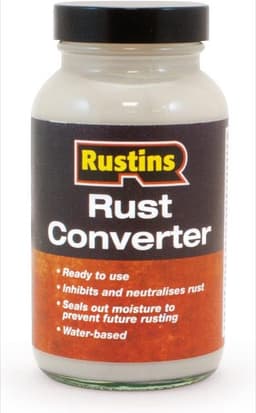
Kurust and Rustins are not on the 4-hour colour-coat clock. Both want a topcoat after a minimum of about 3 hours. Rustins prefers that topcoat the same day, at about 15–25°C, and says reapply after about 30 minutes if the rust has not turned blue-black. Kurust’s page says the same idea: if there is no colour change in about an hour, put more on. A pale, yoghurt-like result in a Rustins review is that unfinished reaction, not a decorative shade. Do not return leftover converter to the bottle. Water cleans these brushes. Vividye’s bullets ask for a minimum of 2 hours between coats and call the matte black a base for topcoats, even though some reviewers leave it as the visible colour. What you do not do is wait 4 hours for a Hammerite recoat you have not bought, or paint a converter that never went dark and hope the enamel will hide an unconverted pit. Loose rust still comes off before any of these liquids.

Clean up

Solvent enamel stays in a through-draught. HSE’s OCE2 note on solvent brushwork is the UK control: ventilate, and keep thinners off your skin. The hammered after-use block says clean with Hammerite Brush Cleaner & Thinner, let the solids settle, and do not pour the paint, the cleaner or the washings down the drain. Do not assume white spirit is the right cleaner for every tin in the basket. Read the tin you opened. Leftover paint is a council hazardous-waste question on GOV.UK, not a sink question. Kurust and Rustins are water-based, and Rustins still says the waste does not go down the drain. Gloves are what Kurust reviewers mention because the liquid is messy and runny.

When the job is too big

Stop and call someone when the steel is structural and thinned, when the job is a vehicle chassis, or when a large area of old paint may contain lead and you are about to sand it dry. Vividye’s bullets put sandblasting in front of severe scale, which is often a workshop. Fresh galvanising without the specified primer is the same kind of stop. A garden gate you can walk around, on a dry day, with flakes already off, is still a home job if you accept two thin coats and the 4-hour wait.

Common questions

Do I still wire-brush if the tin says direct to rust?
Yes. Hammerite’s smooth page and the gate guide both say loose rust and flaking paint come off, then detergent, a rinse and a dry. Reviews that praise the finish describe the same brush-off. Direct to rust means you can paint tight rust without a separate primer on ferrous metal. It does not mean flakes stay on.
How long before the second coat?
Four hours on Hammerite’s UK smooth and hammered pages, after the first coat is dry, inside 8–25°C. Touch dry is often 1–2 hours. Kurust and Rustins take a topcoat after a minimum of about 3 hours, and Rustins prefers the same day. Vividye’s bullets say at least 2 hours between its own coats.
Why does the listing say 24 or 48 hours?
Those numbers are amazon.co.uk dry-time fields on these tins. One black 750 ml listing says 48 hours, another says 24 hours, and a full-cure field on a 250 ml tin prints 8 years. The maker’s recoat is 4 hours. Use the maker when the fields disagree, and do not treat 8 years as a drying time.
Can I thin it?
Not for brush application of Hammerite Direct to Rust. The smooth product page says no thinning. A general brush article that mentions turpentine is looser than that page. Vividye’s bullets allow water under 10% if you need to thin that converter. Do not thin the enamel because it feels like treacle. Lay it on thinner instead.
What if it skins on the brush?
You are usually too warm, or the brush is sitting loaded. Reviews of the top-pick black tin describe exactly that, and one reviewer aims to stay under about 20°C. The stated window is still 8–25°C. Keep the coat thin, keep the tin out of hot sun, and expect a ruined brush if the enamel has already set in the bristles.
How do I clean the brush, and can I tip the tin down the sink?
Use Hammerite Brush Cleaner & Thinner on the hammered system, let solids settle, and do not pour paint, cleaner or washings down the drain. Do not assume white spirit for every Hammerite tin. Kurust and Rustins brushes rinse in water, and the waste still stays out of the sink. Leftover paint goes through the council route on GOV.UK.
When should I stop and call someone?
When the bar is structural and wasting away, when you are inside a chassis, when a large pre-1960s coating may contain lead, or when the surface is fresh galvanising and you do not have the primer Hammerite names. Heavy scale that the Vividye bullets say to sandblast is the same kind of stop. A single garden gate on a dry day is not that job.

Related pages

Sources

Public sources from the research digest, last checked on 22 October 2026. Shelf prices and star lines are the amazon.co.uk figures in the display file. The price band is this set, not a market average. No listing was lab-tested.

  1. Hammerite Direct to Rust (retrieved 22 October 2026)
  2. Hammerite Direct to Rust metal paint, smooth finish (retrieved 22 October 2026)
  3. Hammerite Direct to Rust metal paint, hammered finish (retrieved 22 October 2026)
  4. Hammerite Kurust (retrieved 22 October 2026)
  5. VOC in Paints, Varnishes and Vehicle Refinishing Products Regulations 2012 (retrieved 22 October 2026)
  6. HSE OCE2: solvent brush painting controls (retrieved 22 October 2026)
  7. GOV.UK: hazardous waste disposal (retrieved 22 October 2026)
  8. Rustins rust converter data sheet (retrieved 22 October 2026)