Independent comparisons. We may earn from shop links. More info

How to move a heavy plant pot

Updated: 21 October 2026

You are on a UK patio with a planted pot that has sat in one place all summer, and you need it a metre along the slabs. How to move a heavy plant pot, once a caddy is under the foot, is a roll on level hard ground with the brakes tested first. You should finish knowing where that roll stops: a step, soft grass, a paving joint that swallows a small wheel, or a brake that creeps. The twelve listings in this set are in the [plant roller comparison](/hub/painting-supplies/plant-roller). Peter F., editor for DIY & tools, compared those amazon.co.uk files and public UK sources, with no lab test of a loaded roll. A qualifying purchase can earn us a commission at no extra cost to you.

You are on a UK patio with a planted pot that has sat in one place all summer, and you need it a metre along the slabs.

Our top picks

On this page

Plan the route before you touch the pot

Walk the path before you tilt anything. A caddy is for level slabs or a firm floor, so a slope, a threshold, and a slab gap belong in the plan. The Health and Safety Executive's leaflet INDG143 says to think before you lift and to use a handling aid. Push when you can see ahead, and take a second person on a slope. The figures of about 25 kg for men and 16 kg for women in that leaflet are workplace filters, not a household limit. Water after the move when the plant can wait. Wet compost is heavier, so a soaked pot is harder to tilt and harder to stop. That timing is a rule of thumb, not a weighed sample. The Royal Horticultural Society says not to leave a watered pot sitting in a puddle. Garden Forum's older notes say wheels of about 3 cm stuck in paving joints, while larger wheels bridged them. Those notes are not a test of these caddies, and the prices in that PDF are not current. Board a wide joint, or change the line. A clear metre of slab is not a licence for the lawn. If you have no caddy yet, the plant caddy buying guide measures the foot, and it will not stretch a narrow disc.

Get the caddy under the foot

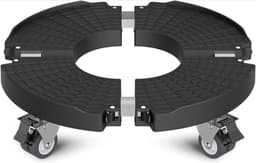
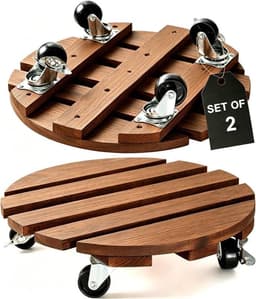
Set the caddy before the pot is full, if you still can. Centre the foot, lock the wheels, and only then add compost. If the pot is already planted, the disc is often too wide to slide under a foot that sits flush on the slabs. Tilt it a few centimetres with a second person, slip the caddy under the near edge, and lower the foot onto the centre. Do not lift the full pot clear of the ground. A pot on the rim of a 30 cm disc is unstable, whatever figure the listing prints. Whether that figure covers the wet weight is on the heavy pots guide. Open an extendable frame evenly so the load spreads across the wheels. One UK shop states 100 kg for its mover only, so do not copy that figure onto yours. RHS Plants sells a 40 cm taxi with rubberised wheels, a brake, and a stated 80 kg at £21.09. That shop example is not a test of this set.

Lock, push, and relock

Lock the wheels before the pot goes on, and test them on your paving the first day. Health and Safety Executive guidance says brakes should work. Stored BURNTOP UK reviews say some do not fully hold, which describes that listing, not every caddy. If the disc creeps on a dry slab, it will creep more on a damp slope, so do not start the move. Push from the base of the pot so you can see the next joint. A bay in a pot of about 40 cm on small castors will snatch if a wheel drops, so keep a hand on the pot and walk. Lock again at a doorway, because an unlocked pause is how a pot reaches an edge. If the brake fails once the pot is loaded, get help rather than steering with your foot. Wipe oil off new castors before an indoor floor when the listing warns of it. TreeGun says oil is normal on its wheels, and that film marks oak even when a patio slab hides it.

Where a caddy stops

Stop at a step, on soft grass, or when a wheel has failed. A metre of patio is not permission for the lawn. An Oypla manual, for that product only, says not to take the trolley down steps. The pot tips forwards, and a small wheel does not bridge the drop. Use a hand truck, or a second person, for a change of level. A board can cross a short muddy strip if the board sits firm. It does not turn turf into a patio, and a sunk wheel means you are lifting again. A cracked castor or a brake that now creeps is not a three-wheel shortcut. Call for help if you cannot tilt the pot on, if a slope needs two people as INDG143 describes, or if the pot is cracked. Load and foot width stay on the heavy pots guide. The material of the disc does not change the stop.

Common questions

Should I water the pot before I move it?
Water after the move when the plant can wait. Wet compost is heavier, so the pot is harder to tilt and to stop. That is a rule of thumb, not a weighed sample. The Royal Horticultural Society says not to leave a watered pot in a puddle, and a CHAMSUREUK review says not to lift when the soil is wet. If the plant cannot wait, water lightly and let it drain before you tilt.
How do I get a caddy under a pot that is already full?
Tilt the pot a few centimetres with a second person, slide the disc under the foot, and lower it onto the centre. A wide caddy will not slip under a pot that sits flush on the slabs. Set the caddy first if the pot is still empty. If you cannot make that short tilt, use a sack truck. A foot that overhangs the disc is less stable than one that sits fully on it.
When should I lock the wheels?
Lock the wheels before the pot goes on, at every pause, and again when you stop. Test them on your paving with a gentle lean. Health and Safety Executive guidance says brakes should work, and BURNTOP UK reviews say some do not fully hold. If the disc creeps on a dry slab, do not aim it at a step. Relock at a doorway so the pot cannot run.
What if the castors drop into the slab joints?
Small castors drop into paving joints and then snatch. Garden Forum notes describe wheels of about 3 cm sticking, while larger wheels bridged the gap. That note is not a test of these caddies. Lay a short board over a wide joint, or take another line. Forcing the wheel tips the pot, so a joint is a place to stop.
Can I roll a plant caddy down a step?
Do not roll a plant caddy down a step. An Oypla manual, for that product only, says not to take it down steps, and silence on another listing does not change the drop. The pot tips forwards and a small wheel does not bridge it. Use a hand truck or a second person. A slope can still need two people, as INDG143 says. The RHS Plants taxi, stated at 80 kg and £21.09, is for flat slabs, not for a step.
What should I do with oil on new wheels indoors?
Wipe new castors before a wooden floor or a pale rug if the listing says oil on the wheels is normal. TreeGun's amazon.co.uk listing carries that warning for its own wheels. The residue marks indoor finishes and is less trouble on a patio slab, though grit in the grease makes the next roll harsher. If the listing is silent, still check the wheel for dust from the box.
When should I stop and get help?
Stop if you cannot tilt the pot on, if the route has a step or soft grass, if a wheel or a weld has failed, or if the brake creeps. INDG143 points to a handling aid instead of a heavy lift, and a slope can need a second person. The 25 kg and 16 kg figures in that leaflet are workplace filters, not a personal limit. A sack truck or another person takes over. Do not keep rolling if the next metre fails those tests.

Related pages

Sources

Public UK sources used for this comparison. Listing prices, stars and review counts are the amazon.co.uk figures saved on 19 October 2026. Retrieved 19 October 2026.

  1. HSE INDG143, Manual handling at work (retrieved 19 October 2026)
  2. HSE, Manual handling (retrieved 19 October 2026)
  3. Consumer Rights Act 2015, section 9 (retrieved 19 October 2026)
  4. Which?, What to do if you have a faulty product (retrieved 19 October 2026)
  5. GOV.UK, Report a product safety issue (retrieved 19 October 2026)
  6. RHS, Houseplants growing guide (retrieved 19 October 2026)
  7. RHS Plants, Plant taxi pot mover (retrieved 19 October 2026)
  8. Garden Forum, Pot movers (retrieved 19 October 2026)