Independent comparisons. We may earn from shop links. More info

Socks for safety boots

Updated: 16 October 2026

You tried the safety boots in a thin pair at the shop, then wore a thicker work sock on the first shift and the gap at your toes disappeared. Socks for safety boots are the socks you will actually wear, checked late in the day, with room left at the longest toe. Listings and prices are on our [work socks comparison](/hub/occupational-safety/work-socks). Products Compared editorial team, 15 October 2026, from amazon.co.uk listings and public UK sources, not a boot lab. A purchase through our links can earn a commission at no extra cost to you.

You tried the safety boots in a thin pair at the shop, then wore a thicker work sock on the first shift and the gap at your toes disappeared.

Our top picks

On this page

Wear the shift sock, late in the day

Fit the boot at the end of the day, in the socks you work in. uvex safety UK asks for at least 10 mm from the longest toe to the end of the insole. The TUC’s working-feet leaflet puts the gap at about 1 cm and says you should not feel the toecap. Those are two sources. Do not fold them into a third official millimetre. Feet swell, so a morning try-on in a dress sock flatters a boot that feels shorter at four o’clock. If the retailer used a thin pair and your multipack is a cushioned crew, walk the boots again in that crew before Monday.

Walk, crouch, and check the collar

Stand, walk, and crouch before you accept the fit. The heel should stay seated when you crouch. Heel lift after a change of sock thickness means the lock has gone, even if the toes felt fine at the counter. Check the longest toe, which is not always the big toe, against the front of the insole. uvex’s 10 mm is measured there. The boot collar should sit on the sock. One review of the £5.94 cotton-rich listing calls the socks very short, like ankle socks. JCB prints UK 6–11, and a reviewer who gave their size as UK 10 found that pack far too tight.

Blisters and cuffs

If a new sock rubs a blister on day one, stop wearing that boot-and-sock pair until the skin has healed. NHS advice is to leave a blister intact and to stay out of the shoe that caused it. NHS inform in Scotland adds clean socks, and a change twice a day if your feet sweat. Reviews of Niorasen’s three-pair merino often describe a cuff that leaves marks, including after people sized up. A cuff that numbs the leg, a hot spreading foot, or a blister when you have diabetes needs NHS care or a podiatrist, not a different listing.

What a sock will not fix

A boot that was the wrong length on the day you bought it stays the wrong length. A thicker sock can pad a rub, and the same bulk can erase the 10 mm uvex asks you to keep. The 200 joule drop and the 15 kilonewton compression that uvex safety UK describes for BS EN ISO 20345:2022 are tests of the cap, not of the knit. In Northern Ireland, check the Health and Safety Executive for Northern Ireland, because the published instrument is extent-marked England, Wales and Scotland. If two pairs might press your toes into a steel cap, use socks for steel toe boots.

When to refit, and when to stop

If you already own the boots, walk one new pair before the rest of the pack. If the collar sits on skin, or the heel lifts when you crouch, that pair is the wrong length for those boots.

Common questions

Which socks should I wear to try safety boots on?
Wear the socks you will use on shift, and try the boots at the end of the day. uvex safety UK asks for at least 10 mm from the longest toe to the end of the insole in those socks. The TUC’s figure is about 1 cm, with a toecap you should not feel. A thin pair at the till makes the boot feel longer than it will feel in a cushioned crew.
How much room should I have at the toes?
Keep at least 10 mm at the longest toe, the uvex figure, and treat the TUC’s about 1 cm as the same kind of gap in different words. You should not feel the toecap. Measure to the end of the insole. If a thicker sock removes that gap, the sock is too much for that boot. The boot’s impact rating does not grow to compensate.
What if I already own the boots and I am only changing socks?
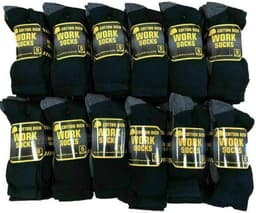
Treat the new sock as a new fitting. Walk and crouch in one pair before you rely on a six-pack or a twelve-pack. Heel lift, a collar on bare skin, or toes that meet the cap are reasons to stop. Cushioned on a title is not a measurement of your boots.
Does a longer sock matter at the boot collar?
The collar should sit on fabric. A sock that ends below it leaves a skin line where the boot rubs, especially once you sweat. One review of the £5.94 listing calls those socks ankle-short. Crew is claimed on some titles here and missing on others.
What do I do if a new sock gives me a blister on day one?
Stop wearing that combination until the skin has healed. NHS advice is to leave the blister intact and to stay out of the shoe that caused it. In Scotland, NHS inform suggests a second change on a sweaty day. A hot spreading foot, diabetes, or a numb cuff needs a clinician.
Are work socks part of the boot’s safety standard?
The standard sits on the boot. uvex safety UK describes 200 joules and 15 kilonewtons for the toecap under BS EN ISO 20345:2022. None of these sock listings carries that marking. Regulation 3(2)(a) keeps ordinary working clothes outside the PPE supply duties. A reinforced heel on a title is knitting.

Related pages

Sources

Public UK sources recorded in the research digest of 15 October 2026. Listings were read from amazon.co.uk files, not from a lab.

  1. HSE: PPE overview (retrieved 15 October 2026)
  2. Personal Protective Equipment at Work Regulations 1992, regulation 3 (retrieved 15 October 2026)
  3. uvex safety UK: correctly fitting footwear (retrieved 15 October 2026)
  4. uvex safety UK: guide to EN ISO 20345:2022 (retrieved 15 October 2026)
  5. GOV.UK: textile labelling (retrieved 15 October 2026)
  6. Regulation (EU) No 1007/2011, Annex VII (retrieved 15 October 2026)
  7. NHS: athlete’s foot (retrieved 15 October 2026)
  8. Royal College of Podiatry: blisters (retrieved 15 October 2026)
  9. NHS: blisters (retrieved 15 October 2026)
  10. TUC: working feet (retrieved 15 October 2026)