Weighted gloves vs wrist weights
Both tabs say gloves, and you cannot tell which object you are buying. Weighted gloves vs wrist weights is a shape question. Meister is an open-palm glove with iron sand on the back of the hand. USINGFIT is a cotton thumb-loop strap. If you shadow box, start with the 1 lb Meister pair if the fingers fit. If you walk, start with the £14.90 strap if you can close it. The captures are on the [sand-weighted gloves comparison](/hub/occupational-safety/sand-weighted-gloves). Products Compared, 16 October 2026. No lab test. A purchase through our links can earn a commission at no extra cost to you.
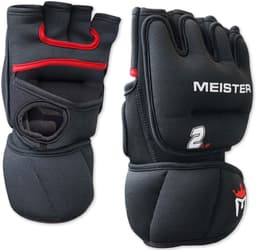
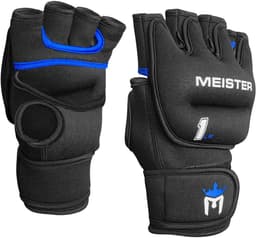
Both tabs say gloves, and you cannot tell which object you are buying. Weighted gloves vs wrist weights is a shape question. Meister is an open-palm glove with iron sand on the back of the hand.
Both tabs say gloves, and you cannot tell which object you are buying. Weighted gloves vs wrist weights is a shape question. Meister is an open-palm glove with iron sand on the back of the hand. USINGFIT is a cotton thumb-loop strap. If you shadow box, start with the 1 lb Meister pair if the fingers fit. If you walk, start with the £14.90 strap if you can close it. The captures are on the sand-weighted gloves comparison. Products Compared, 16 October 2026. No lab test. A purchase through our links can earn a commission at no extra cost to you.
Our top picks
| Badge | Product | Shape | Load | Fill | Note | Price | Offer |
|---|---|---|---|---|---|---|---|
| Best overall |  Meister Meister 2 lb weighted gloves | Open-palm glove | 2 lb each (4 lb pair) | Dense iron sand | 9.2 | about £39.99 | View offer |
| Alternative |  Meister Meister Elite 1 lb weighted gloves | Open-palm glove | 1 lb each (2 lb pair) | Dense iron sand | 9.0 | about £29.99 | View offer |
| Best value |  USINGFIT USINGFIT wrist weights 0.5 kg pair | Thumb-loop strap | 0.5 kg each | Not stated | 8.8 | about £14.90 | View offer |

On this page
They are listed as gloves and they are not the same object
Back of the hand, or the wrist
What fails on each shape
When to buy which
Common questions
Is a wrist weight with gloves in the title a weighted glove?
Which one leaves the hands freer?
Can I use wrist weights for the same class as the gloves?
Are the gloves safer than the straps?
Should I buy both USINGFIT ASINs to compare weights?
Related pages
Sources
Public UK sources and the amazon.co.uk captures used for this comparison. Page updated 16 October 2026.
- GOV.UK, General Product Safety Regulations 2005 (retrieved 16 October 2026)
- Consumer Rights Act 2015, section 9 (retrieved 16 October 2026)
- Consumer Rights Act 2015, section 22 (retrieved 16 October 2026)
- GOV.UK, product safety advice for businesses (retrieved 16 October 2026)
- HSE, using the right type of PPE (retrieved 16 October 2026)
- HSE, gloves and EN 388 (retrieved 16 October 2026)
- HSE, gloves and warm clothing (anti-vibration) (retrieved 16 October 2026)
- Parkinson's UK, tremor (retrieved 16 October 2026)
- UHCW, wrist strengthening (retrieved 16 October 2026)
- Meshberg and colleagues, Clinical Rehabilitation, 2002 (retrieved 16 October 2026)