Independent comparisons. We may earn from shop links. More info

FFP2 vs FFP3

Updated: 21 October 2026

You searched for a dust mask and amazon.co.uk returned both classes, sometimes with FFP3 on a box the search still calls FFP2. FFP2 vs FFP3 is a protection-factor choice, not a comfort upgrade. FFP2 fits when you need assigned protection factor 10 against particles and the mask seals. FFP3 fits when the dust is heavier, the assessment asks for 20, or clinical work specifies fit-tested FFP3. Peter F. used HSG53 and NHS fit-testing guidance, updated 19 October 2026. This is not a lab test. A qualifying purchase can earn a commission at no extra cost to you. Every row on the [FFP2 masks comparison](/hub/medical-protection/ffp2-masks) is FFP2 on purpose.

You searched for a dust mask and amazon.co.uk returned both classes, sometimes with FFP3 on a box the search still calls FFP2. FFP2 vs FFP3 is a protection-factor choice, not a comfort upgrade.

Our top picks

3M 3M 8822, 10-pack

Best overall

3M 3M 8822, 10-pack
9.0/10about £25.14
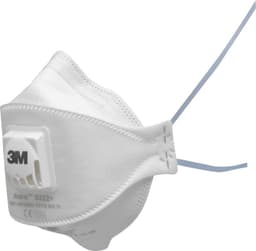
3M 3M Aura 9322+, 10-pack

Alternative

3M 3M Aura 9322+, 10-pack
8.8/10about £35.67
On this page

Two numbers that are not the same

SATRA’s note of EN 149 puts FFP2 at a minimum of 94 percent of the test aerosol and total inward leakage at or below 8 percent. FFP3 is at least 99 percent, with inward leakage at or below 2 percent. HSG53 then sets assigned protection factors of 4, 10 and 20 for FFP1, FFP2 and FFP3. They are particle-only, and at work they depend on a fit test. A gap at the nose beats both numbers. HSE does not recommend ear-loop respirators as tight-fitting workplace RPE in either class. A valve, or a layer count in a title, does not change the class.

When FFP2 is the class to buy

Stay with FFP2 when particles need assigned protection factor 10 and the mask seals. Ordinary sanding of wood or filler, with extraction, is that example. A valve, a headband or a star rating does not make one of these FFP2 listings into FFP3. Neither class stops varnish vapour. FFP2 is not a control for asbestos or high silica, and a medical-use bullet does not make it a surgical mask.
3M 3M 8822, 10-pack

Testsieger

3M 3M 8822, 10-pack
9.0/10about £25.14

When FFP3 is the class to buy

Buy FFP3 when you need assigned protection factor 20. HSE points to it for high levels, including heavy grain dust and mould spores. Prolonged fine dust in a small room, with extraction failing to clear the air, is the DIY version. Two FFP2 masks do not add up to 20. NHS fit-testing guidance points to fit-tested FFP3 for aerosol-generating procedures. An ear-loop FFP3 is still outside HSE’s workplace recommendation.

A conditional recommendation

If assigned protection factor 10 is enough and the mask fits, stay on this comparison. Use the table for price, valve and strap, then the FFP2 mask buying guide if the harness is still open. Move to FFP3 when the dust is heavy, the assessment asks for more than 10, or the setting is an NHS aerosol-generating procedure. Sanding, with extraction first, is FFP2 mask for sanding. Once 10 is enough, best FFP2 dust mask says who should skip the top pick and the best value.

Common questions

What is the actual difference between FFP2 and FFP3?
FFP2 has a filter floor of at least 94 percent and total inward leakage at or below 8 percent in the EN 149 test, and a UK assigned protection factor of 10 when it fits. FFP3 is at least 99 percent, leakage at or below 2 percent, and an assigned protection factor of 20. Both are particle respirators. Neither stops gas or vapour. The higher percentage is not, by itself, a reason to ignore the factor the task needs.
Is FFP3 always safer?
No. FFP3 is the class to select when you need assigned protection factor 20 or the dust level is high. For a particle job that is properly inside APF 10, a sealing FFP2 matches the factor, and an ill-fitting FFP3 does not become safer because the box says 99 percent. Facial hair, a gap at the nose, and ear loops used as workplace RPE undermine both classes. Breathing resistance is generally higher for FFP3, which is a comfort limit, not the selection rule.
When is FFP2 the right class for DIY dust?
FFP2 is the right class for ordinary particle dust, such as sanding wood or filler with extraction, when assigned protection factor 10 is enough and the mask seals on your face. It is the wrong class for varnish vapour, asbestos, high silica, and for NHS aerosol-generating procedures. A valve, a famous brand or a large review count does not change the factor. Prices for the FFP2 listings in this set are on the main comparison, from about £8.99 to about £35.67.
When should I leave this comparison and look at FFP3?
Leave when the dust is heavy, a safety data sheet or COSHH assessment asks for more than APF 10, or you need the fit-tested FFP3 specified for NHS aerosol-generating procedures. HSE’s dust-mask guidance points to FFP3 for high levels, with heavy grain dust and mould spores as examples. Buying more FFP2 masks does not add up to APF 20. The FFP3 products are not in this table.
Does a valve turn an FFP2 into an FFP3?
No. A valve lets heat and exhaled air out. It does not raise the filter class or the assigned protection factor. An FFP2 with a Cool Flow valve is still APF 10 if it fits, and it does not filter what you breathe out. Class is the FFP mark on the mask. If you need source control, the valve is a reason to avoid that model, not a reason to call it FFP3.
Do both classes fail if the seal is poor?
Yes. Inward leakage at the face bypasses the filter, so a poor seal defeats FFP2 and FFP3 alike. HSE expects a user seal check every time you don a disposable respirator, and a fit test when tight-fitting RPE is used at work. Ear-loop straps are not recommended for that workplace job in either class. If you still taste dust after a proper check, stop. Pinching the nose clip harder will not turn a failing seal into APF 20.

Related pages

Sources

Public UK sources named below. amazon.co.uk prices, stars and review counts are the figures on these seven listings. Page updated 21 October 2026.

  1. HSE HSG53, Respiratory protective equipment at work (retrieved 21 October 2026)
  2. HSE disposable respirator poster (retrieved 21 October 2026)
  3. HSE safety bulletin, ear loop respirators (retrieved 21 October 2026)
  4. HSE disposable dust masks (retrieved 21 October 2026)
  5. Designated standards notice, PPE, 15 October 2026 (retrieved 21 October 2026)
  6. GOV.UK product marking, UKCA and CE (retrieved 21 October 2026)
  7. 3M technical bulletin, FFP2, KN95 and N95 classes (retrieved 21 October 2026)
  8. SATRA, EN 149 filtering facepieces (retrieved 21 October 2026)