Independent comparisons. We may earn from shop links. More info

How to use a drain camera

Updated: 23 October 2026

You have the reel on the grass and the cover in front of you, and the useful result is a clip you can watch later, not a head jammed at the first bend. This is how to use a drain camera from an access you can reach while you stay outside. The limits already visible on the twelve listings in the [sewer camera comparison](/hub/measuring-equipment/sewer-camera) sit next to HSE guidance on confined spaces. We did not film a drain for this page. A qualifying purchase through our links can earn a commission at no extra cost to you. If the picture is there to explain a repeating blockage, read it on the [blocked drain camera](/hub/measuring-equipment/sewer-camera/sub/sewer-camera-blocked-drain) page after you know the sequence.

You have the reel on the grass and the cover in front of you, and the useful result is a clip you can watch later, not a head jammed at the first bend.

Our top picks

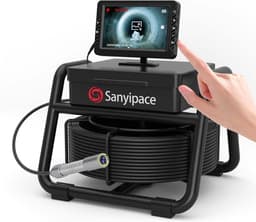
Sanyipace Sanyipace S5517 20 m

Best overall

Sanyipace Sanyipace S5517 20 m
8.0/10about £269.99
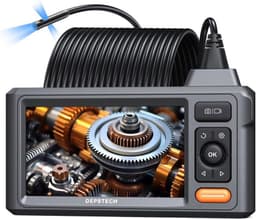
DEPSTECH DEPSTECH DS620 15 m

Best value

DEPSTECH DEPSTECH DS620 15 m
8.4/10about £89.99
On this page

Open the access, and stay out of the hole

Start at a rodding eye, a soil access cap, or an inspection chamber you can work from ground level. Plastic chambers are put in so the drain can be cleaned and inspected without anyone going down. A manhole, in that usage, is a chamber with room for a person at drain level. That is the hole you do not climb into to aim the camera. The Confined Spaces Regulations 1997, regulation 4, prefer avoiding entry. HSE's INDG258 names remote cameras as the way to inspect without going in. Welsh Government advice on drains says not to enter the chamber. Gloves matter because the rod comes back wet with sewage. That is hygiene, not a medical claim. Lift the cover with a tool, not with your fingers under the rim, and set it where it cannot fall back. If the only opening is a public sewer in the road, stop. United Utilities tells people not to work on its sewer without approval, and it treats those manholes as a hazardous area. These amazon.co.uk cameras are not described as Ex-rated equipment for that job.

Check the picture before the pipe

Turn the camera on in daylight before the head goes near the water. You want a sharp frame of something you can name, such as the hinge of the cover or the printed metre mark, so you know the screen is live. Wipe the lens. UK reviews of the DEPSTECH say the lens dirties quickly in a pipe, and a brown frame is often muck, not a collapsed drain. Fit the card before you push. Most reels here claim a 16 GB or 32 GB card and a DVR. A clip you forgot to record is a second visit. Only two listings in the comparison claim a self-levelling head, and their reviews are not United Kingdom texts. A GAMWATER UK review says that camera is not self-levelling, and that a trickle of water shows which way is down. Use that trickle as a clue if your reel does not claim an upright image. The Sanyipace S5517 bullet says the picture is sharp at about 7–10 cm and blurry closer or further. If the head is pressed into a joint, softness can be focus, not a broken camera. Head size and length are chosen on the buying guide.
Sanyipace Sanyipace S5517 20 m

Testsieger

Sanyipace Sanyipace S5517 20 m
8.0/10about £269.99

Push slowly, with your hands at the opening

Keep your hands at the mouth of the pipe. Feed the rod in short lengths and watch the screen, rather than walking backwards until the reel is empty. A little water down the line reduces friction. It does not give you permission to ram. Scanprobe, a UK camera maker, says a camera is not a battering ram, and that cracked lenses and kinked rods come back from people who pushed a blockage. A trade manual for a different brand says the same: do not use the head as a cleaner. Those sentences are about technique. They are not the instruction booklet for the twelve listings here. At a bend, pause. If the picture shows the curve and the rod still moves, ease it through. If the picture freezes and the rod stops, pull back rather than shove.

If it stops or the picture fails

Pull back before you push harder. A dirty lens looks like a failed camera: brown, bright in the middle, no edges. Withdraw the head and wipe it before you decide the pipe has collapsed. If the head will not come back, stop pulling against a kink. A steady pull along the line of the pipe is different from a tug that folds the rod. Do not climb in to fetch it. A stuck camera is the point where a drainage firm takes over, because they have the rods and the access to retrieve it without you entering the chamber. Note how much rod is still out, from the metre mark if you have one, so you can tell them where it stopped.

What to keep, and when a firm takes over

Save the clip with three facts written down while you are still at the cover: which access you used, the metre mark or the length of rod that went in, and what you could actually see. "Roots at about 6 m from the front chamber" is useful. "The drain is fine" is not, if the lens never passed the blockage. None of these cameras writes a defect code, and only the 9 inch Sanyipace claims a distance counter. A counter still is not a 512 Hz sonde, so you cannot mark the spot on the ground from these reels. Call a firm when the head will not return, when the only access is a public sewer, or when someone else needs a coded report. Until then, the home sequence is short: open an access you can use from above, prove the picture in daylight, push until the rod resists, and stop.

Common questions

Where do I put the camera in?
Use a rodding eye, a soil access cap, or an inspection chamber you can work while standing at ground level. Those openings exist so the pipe can be reached without entry. Do not start by lifting a deep manhole in the road. If you cannot name the access, you are not ready to push. The chamber lid stays beside you, not poised over the hole.
Do I climb into the manhole to aim it?
No. Regulation 4 of the Confined Spaces Regulations 1997 is about avoiding entry, and HSE guidance points to cameras so that people stay out. Welsh Government advice says not to enter the chamber. Aim from the opening. If you cannot get a picture without going down, the job has left a home reel and needs a firm that is set up for that space.
Should I run a hose while I push?
A modest flow can cut friction and, on a camera that is not self-levelling, show which way is down. A UK review of the GAMWATER reel describes that trickle. Do not turn the hose into a jet, and do not use the camera head to break the blockage. Water helps the rod slide. It does not clear the pipe, and it does not make a dirty lens honest.
What do I do at a bend?
Pause and watch. If the picture shows the curve and the rod still feeds, ease it round. If the picture freezes and the rod stops, pull back rather than shove. A 23 mm head is more likely to stop in a tight trap than a 17 mm head. One UK review fitted a 17 mm head into a 32 mm pipe only on a long 90 degree bend. A second hard push is how lenses crack.
Can I use it on a public sewer in the road?
Not on your own. A public sewer needs the undertaker's permission, and at least one water company treats work in its manholes as a hazardous-area job. These listings do not claim an Ex rating. In England and Wales, many shared sewers outside the boundary transferred in 2011. If you are not sure the pipe is yours, do not lift the cover. That question belongs with the water company, not with a longer cable.

Related pages

Sources

Public UK sources from the research digest, last checked on 21 October 2026. Shelf prices and star lines are the amazon.co.uk figures captured with these twelve listings. The price bands are this set, not a market average.

  1. Approved Document H (2015) (retrieved 21 October 2026)
  2. GOV.UK: private sewer transfer (retrieved 21 October 2026)
  3. SI 2011/1566: private sewers transfer (retrieved 21 October 2026)
  4. Confined Spaces Regulations 1997, regulation 4 (retrieved 21 October 2026)
  5. HSE INDG258: safe work in confined spaces (retrieved 21 October 2026)
  6. WRc: sewer condition classification (MSCC) (retrieved 21 October 2026)
  7. Severn Trent: building over or near sewers FAQ (retrieved 21 October 2026)
  8. Welsh Government: drains and sewers (retrieved 21 October 2026)