Independent comparisons. We may earn from shop links. More info

Analogue vs digital soil moisture meter

Updated: 22 October 2026

You are comparing a dial at about £9.99 that needs no battery with a screen at about £26.99 that lists pH, fertility, and EC. An analogue vs digital soil moisture meter decision on this amazon.co.uk shelf is about whether you need the screen. Neither format measures a true water percentage. The eleven listings are on our [plant moisture meter comparison](/hub/measuring-equipment/plant-moisture-meter). The Products Compared editorial team used those listings, the United Kingdom review notes, and public sources on probe pH. This is not a lab trial of these ASINs. The capture date is 21 October 2026. A qualifying purchase can earn a commission at no extra cost to you.

You are comparing a dial at about £9.99 that needs no battery with a screen at about £26.99 that lists pH, fertility, and EC.

Our top picks

On this page

Two formats on this shelf

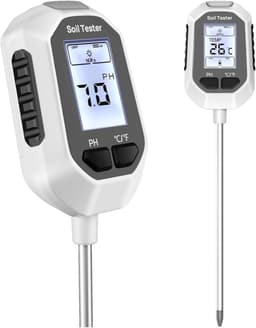
Analogue here means a needle and a colour scale. Moisture-only dials in this capture run from about £6.99 to £13.42, and most say no battery. The Sonkir MS02 at about £9.99 and the DUYRTKAM 3-in-1 at about £12.99 are still analogue: a needle and a switch for moisture, light, and pH. Wonkee Donkee, a UK tool guide, separates that indicator from a digital LCD, which needs cells. A pH scale without a battery is not a soil analysis. Digital here means an LCD. The YAMRON 4-in-1 is about £19.99, with a backlight. The YAMRON 7-in-1 is about £26.99 and adds fertility, EC, and TDS, and four AAA batteries are not included. The TOWODE 6-in-1 is about £18.99, with 4.7 from 10 reviews. Probe length is a separate choice. The soil moisture meter buying guide matches about 26 cm tools and the Green 40CM colour field to pot depth. Both YAMRON cards say to insert about 10 cm.

Moisture, with or without a screen

For moisture, the two formats are the same kind of instrument. Metal meets damp compost, and the meter reports how conductive that contact is. A needle and a digit can both be wrong in the same compost. Garland Products explains why a glass of water can read dry: soil is the electrolyte. Fertiliser salts can push the reading towards wet. UK notes do not show that a screen is more truthful. On the XLUX T10, 50 United Kingdom texts in a file of 65,286 reviews mostly describe a useful colour reading, with one report of saturated soil still reading dry. On the YAMRON 4-in-1, texts praise the backlight, then describe moisture stuck, including one report at 5 percent. A stuck digit is a dead channel with a light behind it. Steps for placing and wiping the probe are on how to use a soil moisture meter. A digital probe left in the pot still corrodes.

The pH mode

This is where the extra money usually goes, and where the UK notes in this capture refuse the claim. On the YAMRON 4-in-1, pH is called inaccurate and described as a channel that does not change between samples. On the 7-in-1, reviewers compared pH and EC with other devices and called them inaccurate, including a pH stuck near 6.9 on soils they believed ranged from about 5.6 to 6.5. No calibration instructions were in that box. The TOWODE listing prints a pH range of 3.9 to 9, with 4.7 from 10 ratings and one UK sentence. One praise line cannot support an accuracy claim. Garden Junkie, writing for UK gardeners, treats a cheap probe pushed into the soil as a weak pH method when the result will change what you add. The RHS still wants a proper test before you change soil pH. Do not lime a bed from any meter on this page.

Batteries and what you are paying for

The price gap here is roughly £7 to £13 for a dial and £19 to £27 for an LCD. UK notes on both YAMRON models say a backlight is easier to read in a dim room, including on plant-care rounds at work. That is a weak reason if you are buying a fertility mode you will not use. The 4-in-1 and the TOWODE say battery powered without saying the cells are in the box. The flintronic dial disagrees with itself: bullets say no batteries, and the technical details say battery powered. Failure shows up in both camps. Sonkir notes include a unit dead after about six weeks. A YAMRON 7-in-1 note includes a stop after a few months. A digital meter is not more durable in this file. The best soil moisture meter page names the T10 as the default watering dial and the long XLUX when the pot is deep. Buy the screen only if you will ignore every mode that claims to be a soil laboratory.

Common questions

Is a digital soil moisture meter more accurate?
Not on the evidence in this capture. Both formats are metal probes that respond to conductivity, not a laboratory water percentage. A backlight can be easier to read. Readability is not accuracy. One false dry reading still appears in the XLUX notes, and the YAMRON 4-in-1 file includes a moisture channel stuck at 5 percent. Neither format is a single-swing certainty.
Why does a 3-in-1 show pH with no battery?
The Sonkir MS02 and the DUYRTKAM listing both say no battery and still print a pH scale, because the indicator is a passive needle, not an LCD. Wonkee Donkee makes that split. No battery does not mean the pH scale has been calibrated. In the Sonkir UK file, people keep the moisture mode and call pH unreliable. A light reading can still be a handy extra. It is not a soil analysis.
Are the YAMRON pH numbers usable?
Not for a decision to lime or to change compost. UK reviews call the 4-in-1 pH channel inaccurate, and on the 7-in-1 a reviewer saw pH stuck near 6.9 where they expected a wider range. EC failed the same kind of cross-check, and no calibration instructions were in that box. Use a proper soil test if the number will change what you add. EC and TDS on the 7-in-1 are not a feed chart.
Do I have to buy batteries?
For the YAMRON 7-in-1, yes. The listing says four 1.5 V AAA batteries, and they are not included, on top of about £26.99. For the YAMRON 4-in-1 and the TOWODE, the line says battery powered and does not say the cells are in the box, so check the parcel. The XLUX dials, the Sonkir, and the Keratobleem pair say no battery. The flintronic card disagrees with itself, so do not assume that dial is in the no-battery group.
Is a backlight worth £20?
Only if you cannot read a needle where you water, and if the moisture channel on that unit actually moves. UK reviews mention the YAMRON backlight, including an angled screen, then describe stuck moisture. Paying about £26.99 for the 7-in-1 adds fertility, EC, and TDS, and it excludes the batteries. Those extra modes are not what the backlight is for. The screen does not graduate the probe.
Can I check ericaceous compost with a Sonkir?
You can switch it to pH and watch the needle. Do not treat that as proof the compost is ericaceous or alkaline. The Sonkir file is 4.0 from 45,448 reviews, and UK texts report the same pH result on both composts. One reviewer replanted gardenias after trusting the needle. Ericaceous compost is a decision from the bag, or from a proper soil test if you are amending a bed. The moisture mode is the part those reviews still use.
Which format should I buy if I only water?
The analogue moisture dial. In this capture that is the XLUX T10 at about £9.99 for ordinary pots, with 4.4 from 65,286 reviews, no battery, and a five-minute limit on the listing. Move to the long XLUX at about £12.99 only when the pot is deep. A digital meter is the second choice, and only for the screen, with pH and fertility ignored. The about £6.99 dials can arrive with a dead needle.

Related pages

Sources

Public UK sources from the research digest. Shelf prices and star lines are the amazon.co.uk figures captured with these eleven listings. A live Soil Meters bestseller page on 21 October 2026 still showed the short XLUX at £9.99, with a public rating line of 4.3 from 68,604. This page keeps the captured lines. The price bands are this set, not a market average.

  1. RHS: How to water containers (retrieved 21 October 2026)
  2. RHS: How to help a poorly houseplant (retrieved 21 October 2026)
  3. RHS: Ten top tips for peat-free success (retrieved 21 October 2026)
  4. Garland Products: soil moisture meter (retrieved 21 October 2026)
  5. GOV.UK: General Product Safety Regulations 2005 (retrieved 21 October 2026)
  6. Consumer Rights Act 2015, section 9 (retrieved 21 October 2026)
  7. Gardens Illustrated: best soil moisture meters for 2025 (retrieved 21 October 2026)
  8. The Guardian, 13 January 2026: do moisture meters prevent overwatering? (retrieved 21 October 2026)