Independent comparisons. We may earn from shop links. More info

Caravan gas bottle level indicator for the locker

Updated: 22 October 2026

You are on a pitch, the kettle is slowing, and the spare cylinder is the one you hoped not to lift before dark. A caravan gas bottle level indicator is worth having only when it fits the cylinder in the locker and you still keep a bottle you can swap. For most UK caravans and motorhomes that cylinder is exchange propane, often 6 kg or 13 kg, upright and strapped, not the green patio bottle with a gauge already on the collar. The [gas bottle level indicator comparison](/hub/measuring-equipment/gas-bottle-level-indicator) is the wider set of cards and the Truma LevelCheck. This page stays with the locker. Nothing was laboratory-tested. If you buy through our links, we may earn a commission at no extra cost to you.

You are on a pitch, the kettle is slowing, and the spare cylinder is the one you hoped not to lift before dark.

Our top picks

Truma Truma LevelCheck

Best overall

Truma Truma LevelCheck
9.2/10about £74.99
Volnamal Volnamal magnetic strip

Best value

Volnamal Volnamal magnetic strip
6.6/10about £3.99
On this page

The bottle in the locker

Calor's which-bottle note lists caravanning as 6 kg or 13 kg propane, and patio heating as 5 kg or 13 kg patio gas. Those are different cylinders. The 6 kg propane page gives a diameter of 256 mm and a height of 495 mm, with a tare band of about 7.3 kg to 10.9 kg. Propane still vaporises in a cold locker, and it is not an indoor fuel except for short trade work. The cylinder lives in the gas locker, upright and secured. You exchange it. You do not refill it. If you smell gas after the valve is shut, stop and use a Gas Safe engineer qualified for LPG. Calor's 5 kg patio bottle is listed with Gas Trac fitted.

A card low on a steel wall

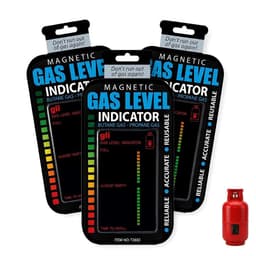
A magnetic strip can live in the locker if the wall is steel and the magnet holds. Cowiny and Rivvra are the listings in this set that say steel. Most of the other cards never use the word, including the Volnamal single at £3.99. If the magnet slides off, the card is finished for that bottle. Stick it on the lower half, then run the hob or the heater. Volnamal's instructions say 10 minutes with the gas on. Light the hob or the heater for that wait, read the boundary, then turn it off. On a 495 mm tall 6 kg bottle the card covers a band, not the whole shell. You do not learn that 4 kg remains. Take the card off when you exchange the bottle. The steps for the bars are on how to use a gas bottle level indicator.
Truma Truma LevelCheck

Testsieger

Truma Truma LevelCheck
9.2/10about £74.99

A probe you can carry in the locker

The Truma LevelCheck is the ultrasonic meter in this set, at £74.99, with 4.3 from 686 amazon.co.uk reviews. You hold it against the wall. Truma states steel and aluminium from 200 mm to 350 mm. The Calor 6 kg diameter of 256 mm sits inside that window. This page will not invent a 13 kg propane diameter, because the Calor note used here does not print one. A 47 kg cylinder is wider than 350 mm on published UK dimension tables, so it is outside the stated range. Aluminium is where the probe earns the money a card cannot. Buyers name a 9 V smoke-alarm cell, while the listing power field says gas powered. A dead battery looks like a red light.

When the bottle already shows its level

If the cylinder is a patio bottle with Gas Trac, read Hi and Lo on that fitting and leave the locker tools for the exchange propane. If the cylinder is a Flogas Gaslight or another see-through composite, look at the liquid. The shell is not a magnet surface. Shop prices for base sensors such as Mopeka and Senso4s are not amazon.co.uk prices in this set, so they stay off this page as products to rank. The decision between a £4 card and the £75 probe is on magnetic versus ultrasonic. Which method matches the wall in general is on the buying guide.

Common questions

What about a 13 kg bottle?
Calor lists 13 kg propane for caravanning and a different 13 kg patio bottle for heaters. This page does not quote a 13 kg propane diameter, because that Calor note does not print one. Reviewers mention 13 kg patio bottles among the sizes that sometimes struggle. If the shell is wider than 350 mm, it is outside the probe's stated limit. A steel 13 kg can still take a magnetic card on the lower wall.
Do I still need a gauge if the bottle has Gas Trac?
Read Gas Trac if it is fitted. Calor's 5 kg patio bottle is sold with that indicator, a 300 mm diameter, and a 27 mm clip-on. A stick-on card repeats a job the collar already does, and it can disagree with it. Keep a strip or a probe for the locker bottle that has no built-in reading.
Can I leave the card on between trips?
You can, if the magnet still holds and the face is not left in full sun against the locker wall. Remove it when you exchange the cylinder, or the next person receives your gauge. Check the bars again with gas flowing. A card that has sat all winter is not a stored measurement of what is left.
What if I use a lightweight or composite bottle?
A see-through composite such as Flogas Gaslight shows the liquid. Do not put a magnet on it. Aluminium needs the probe or the scales, not a strip. Older Calor Lite bottles were a lightweight steel with their own history, including a recall on some years, and one LevelCheck reviewer suspected mixed results on that surface. Match the tool to the wall you have this season, not to the name lite on a forum post.
When do I stop checking and call someone?
Stop if you smell gas, if the hose or regulator looks damaged, or if the cylinder itself is dented or leaking. That is a Gas Safe engineer qualified for LPG, and then the supplier for a damaged exchange bottle. A blank card, by itself, is a method problem: gas off, card too high, or a wall that is not cooling. Work through the use steps before you treat the tool as failed.

Related pages

Sources

Public UK sources from the research digest, last checked around 20 October 2026. Shelf prices and star lines are the amazon.co.uk figures captured with these twelve listings. The price bands are this set, not a market average.

  1. Thermographics: gas level indicator theory (retrieved 20 October 2026)
  2. Liquid Gas UK: cylinder guidance for consumers (retrieved 20 October 2026)
  3. HSE: LPG legal framework (retrieved 20 October 2026)
  4. GOV.UK: LPG general information (retrieved 20 October 2026)
  5. Flogas: how to tell if a cylinder is empty (retrieved 20 October 2026)
  6. Truma LevelCheck product page (retrieved 20 October 2026)
  7. Gas Safe Register: frequently asked questions (retrieved 20 October 2026)
  8. Calor: gas bottles and Gas Trac (retrieved 20 October 2026)