Independent comparisons. We may earn from shop links. More info

How to use a digital spirit level

Updated: October 2026

You have the tool on the timber, the first number looks tidy, and you are about to fix the shelf. That is when a digital reading is most persuasive and least checked. How to use a digital spirit level starts with one comparison on the same spot, not a tour of the buttons. Button names differ across the twelve listings in the [digital spirit level comparison](/hub/measuring-equipment/digital-spirit-level), so this page stays with the principle and sends you to that manual. Peter F. did not calibrate these units in a lab. A qualifying purchase can earn a commission at no extra cost to you.

You have the tool on the timber, the first number looks tidy, and you are about to fix the shelf. That is when a digital reading is most persuasive and least checked.

Our top picks

On this page

Check it before the job

Flip the tool 180° on the same spot before you trust it. Note the reading, rotate it end for end, and note the second reading. Bosch’s en-GB manual tells you to calibrate if the two values differ. Do not paste another brand’s tolerance onto a Huepar or a Trend. If the two readings disagree by more than your own model’s band, do not fit yet. A mismatch is a test result, not yet a calibration. Bosch says the surface should be within 3° of level for that routine. Mecurate buyers could not find a recalibration and had to zero again after auto-off. Follow the manual in your hand. If there is no calibrate function, return a unit that will not repeat. A different body is a digital spirit level buying guide question.

Degrees, percent, or mm/m

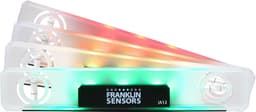
Leave the tool in the unit the drawing uses. Degrees suit a saw angle and a roof pitch. Percent and mm/m suit a fall. Inches per foot, including on the SAVSEC, are the wrong unit for a UK drain drawn in millimetres. A tenth of a degree is about 1.75 mm per metre by arithmetic. That conversion is not a drainage design. If the vial and the digits disagree, stop. Johnson Level says you recalibrate when they do not match. That rule of thumb is theirs, not a UK law. On a Franklin there is no degree display. Green means level, the tool is for indoor use, and there is no in-field calibration. If green and the bubble disagree, use the bubble or stop. Pipe slopes belong on the digital level for a fall page.

Absolute and relative zero

Absolute mode is the angle against gravity. Relative zero is a difference between two faces. Use it only when you mean that difference. Unplug the saw first. Level Developments, on a mini level that is not one of these ASINs, says zero on the table, put the magnet on the blade, and expect 90° if the blade is square. Trend’s DLB how-to is the same sequence, with ±0.2° stated on Trend’s page. Keep the box square to the table. Do not invent one button order for all twelve models. Auto-off drops a relative zero. Trend’s page mentions a five-minute auto-off on the DLB. If the screen sleeps, zero on the table again before you touch the blade. A beep at level does not replace the flip check, and it does not tell you a fall of 25 mm per metre.

When the reading will not settle

A cube that changes when you put it back is not ready to mark from. UK reviews on the XUNTOP describe tenths that jump. Wait until it settles, then do the 180° check. If it will not repeat, stop. An Error legend is model-specific. Open that manual rather than inventing a code. No calibrate button means you cannot trim a bent zero. Mecurate reviews include that dead end. The Franklin cannot be field-calibrated at all. A long wall, a drain, or a ramp is where a pocket box should leave the job. If the work is notifiable drainage, or a ramp that has to meet Approved Document M, a level does not replace a plumber or Building Control.

Common questions

How do I know the number is honest before I fit anything?
Use one spot. Read it, turn the tool 180°, and read it again. Bosch and Digi-Pas both teach that comparison. The pass mark is your model’s stated band, not a tolerance copied from another brand. If the two values differ, do not fix the shelf. Run that manual’s calibration, or return the tool.
What is the difference between zero and absolute mode?
Absolute mode is the angle against level, so 0° means level and 90° means plumb, within the stated band. Relative zero stores the current face as the new nought, so the next face is a difference. Use it on a saw table before you read the blade, and clear it when you want true level again. If auto-off clears the memory, zero on the table once more.
Which unit should I leave it on?
Use degrees for a blade or a pitch, and mm/m or a 1:N figure for a fall. Inches per foot will not match a UK drawing in millimetres. If you are hunting for 25 because a 1:40 fall is 25 mm per metre, the screen must be in mm/m. Left on degrees, that slope is about 1.43° by arithmetic.
How do I set a saw blade without a live machine?
Unplug the saw so the blade cannot start. Zero the box on the table, then place the magnetic face on the blade and keep the box square to the table. You expect 90° if the blade is square, using Trend’s DLB sequence. Zero again only if you want the bevel measured from vertical. A live machine is the point where you stop.
What if the bubble and the digits disagree?
Do not average them. Recalibrate only if that model has the step. Mecurate buyers have failed to find one. On the Franklin, green is the lamp and there is no degree display to trim. If you cannot bring vial and digits together by the manual, do not fit.
When should I stop and get a longer level or a professional?
Stop using a pocket box when the surface is longer than the tool. A cube cannot represent a door, a worktop, or a 6 m pipe. Stop altogether when the fall is notifiable drainage or a ramp that must meet Approved Document M. A repeatable millimetre reading does not approve the work.

Related pages

Sources

Public UK sources on product safety, measuring instruments, Class 2 lasers, and faulty goods. Prices, stars, and review counts are the amazon.co.uk listing figures in this set. Prices move. There was no laboratory test. Retrieved 17 October 2026.

  1. Measuring Instruments Regulations 2016, GOV.UK (retrieved 17 October 2026)
  2. General Product Safety Regulations 2005, GOV.UK (retrieved 17 October 2026)
  3. Product safety advice for businesses, GOV.UK (retrieved 17 October 2026)
  4. Laser radiation safety advice, GOV.UK (retrieved 17 October 2026)
  5. HSE, lasers (retrieved 17 October 2026)
  6. Stabila TECH 196 DL (retrieved 17 October 2026)
  7. Trend DLB, manufacturer page (retrieved 17 October 2026)
  8. Consumer Rights Act 2015 (retrieved 17 October 2026)