Independent comparisons. We may earn from shop links. More info

Alcohol meter vs hydrometer

Updated: 22 October 2026

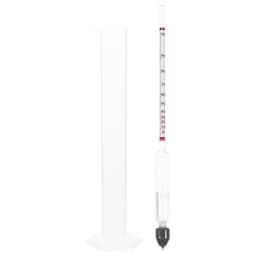
You are looking at a glass float for a demijohn and a 0–100% spirit meter. An alcohol meter vs hydrometer choice is a choice of scale and of how many readings you take. A spirit alcoholometer takes one dip in unsweetened distillate. A brewing hydrometer needs a gravity before fermentation and a gravity after. The [alcohol meter comparison](/hub/measuring-equipment/alcohol-meter) is the set of amazon.co.uk listings. Jar technique stays on [how to use an alcohol meter](/hub/measuring-equipment/alcohol-meter/sub/alcohol-meter-how-to-use). If you are fermenting, use a brewing hydrometer twice. If you are proofing a low-sugar distillate, use the spirit meter once. The Products Compared editorial team did not run a lab test. A qualifying purchase can earn a commission at no extra cost to you.

You are looking at a glass float for a demijohn and a 0–100% spirit meter. An alcohol meter vs hydrometer choice is a choice of scale and of how many readings you take.

Our top picks

On this page

Same shape, different scale

A volume alcoholometer is graduated in percent alcohol by volume for water and ethanol, referenced at 20°C. In this set that is the Thermometer World IN-239, at £14.95 with a stated 0–100 vol % scale and a 100 ml trial jar. The selling text limits it to little or no sugar. One dip is the whole method, and only while the liquid matches that calibration. A brewing hydrometer is graduated in specific gravity, with a potential-alcohol band. It floats in wort, must, or juice, where sugar changes the density. Homebrewing.org describes potential alcohol as an estimate of what the sugar still in the juice could make, often printed from 0% to about 20%. That print is a forecast, not the alcohol already in the wine. The alcohol meter buying guide keeps the refractometer and the vinometer in their own lanes.

One reading or two

Potential alcohol assumes the sugar will ferment out to about 1.000 specific gravity. You read it once, before the yeast has worked. It is a forecast of a dry finish, not the alcohol in the glass today. Beer rarely finishes at 1.000. A stout can stop well above that, so the print overstates what you will bottle. A kitchen estimate needs two readings: original gravity before fermentation and final gravity when it has stopped. A home-brew rule of thumb is (original gravity − final gravity) × 131.25. Treat that as a rule of thumb, not as exact alcohol by volume or a duty result. A wine hydrometer calibrated around 15°C is a specific-gravity note. Do not copy it onto the Thermometer World stem, which is referenced at about 20°C.

Where each one fails

The spirit meter fails as soon as the liquid is not a low-sugar alcohol and water mix. UK reviews on the Thermometer World listing say it is not for sugar-based wine or beer, and that a wine sample may not float. If the stem sits on the bottom, you have not measured 0% alcohol. The brewing hydrometer fails the other way. A single dip cannot show alcohol already produced, because the scale is still looking at density from sugar. Two gravities can support a kitchen estimate, and that estimate is still not the route HM Revenue and Customs describes for finished beer and wine when the figure is for duty. Use the spirit meter when you are diluting unsweetened distillate and you will read it before flavour, near 20°C. One reading on a ferment is a gravity, not an ABV.

The listing that claims both

The GARVALON set blurs the two names. At £12.49 it is a plastic hydrometer and cylinder sold for home brew and liquor. The title cites specific gravity and alcohol, and also 0–100% accuracy. The technical details print no volume scale, no specific-gravity range, and no reference temperature. Amazon shows 5.0 from two ratings and no written reviews. Do not choose it as the bridge between the two tools. The Thermometer World stem states 0–100 vol % and about 20°C, with 4.5 from 1,027 ratings, and the reviews already mark where wine and beer make it fail. If you are fermenting, buy a brewing hydrometer with a gravity range printed in the details.

Common questions

Can I dip a brewing hydrometer once and read ABV?
No. One dip gives you specific gravity, or a potential-alcohol forecast if the ferment finishes near 1.000. It does not give you the alcohol already in the beer or the wine. You need an original gravity and a final gravity, and the difference is still an estimate. A spirit alcoholometer is the one-dip instrument, and only in a low-sugar distillate.
What is the potential-alcohol scale actually saying?
It estimates how much alcohol the sugar still in the juice could make, often printed up to about 20%. It assumes a dry finish around 1.000 specific gravity. Beer often stops higher, so the printed potential overstates a typical beer. Read it before fermentation for the forecast, then take a final gravity if you want an estimate of what happened.
What is a simple ABV sum from original and final gravity?
A home-brew rule of thumb is (original gravity − final gravity) × 131.25. It is not exact alcohol by volume and not a duty figure. An illustration: 1.050 minus 1.010 is 0.040, and 0.040 × 131.25 is 5.25. Change the final gravity and the estimate changes. HM Revenue and Customs does not treat this sum as the finished strength of beer or wine for duty.
Does beer finish at 1.000?
Often it does not. Scales that assume about 1.000 are a better sketch for dry wine, cider, and mead than for beer. A beer that finishes at 1.012 still has body, and the alcohol is lower than the brew-day print suggested. Write down both gravities instead of trusting the first float.
Do I need a proper method if the number is for a label?
Yes. A kitchen sum and a £15 spirit stem are not the HM Revenue and Customs method for a strength you put on a label. Finished beer and wine are not a single hydrometer dip. Spirits that are only alcohol and water follow a density route at 20°C. If the number leaves your kitchen, use the alcoholic products technical guide.

Related pages

Sources

Public UK sources from the research digest. Shelf prices and star lines are the amazon.co.uk figures for these five listings. The price band is this set, not a market average. The gravity formula is a rule of thumb, not a tested accuracy.

  1. HMRC: alcoholic strength, section 11 (retrieved 22 October 2026)
  2. SI 2023/806 Schedule 2 (retrieved 22 October 2026)
  3. Laboratory Alcohol Table (retrieved 22 October 2026)
  4. GOV.UK: alcoholic products producer approval (retrieved 22 October 2026)
  5. Finance (No. 2) Act 2023, section 84 (retrieved 22 October 2026)
  6. OIML R 44 (1985): alcoholometers (retrieved 22 October 2026)
  7. Alcoholometers Regulations 1977 (retrieved 22 October 2026)
  8. Homebrew hydrometer scales (retrieved 22 October 2026)