Independent comparisons. We may earn from shop links. More info

How to use a sack truck

Updated: 22 October 2026

You have a sack truck in the hall, boxes stacked, and a route that might include a flat path, a threshold, or a kerb. Solid wheels do not change the physics: the load sits on the toe plate, the weight balances over the axle when you tilt, and a standard two-wheel barrow is the wrong tool for bouncing up stairs. This page walks through check, load, move, and stop. Rows stay on the [sack truck solid wheels comparison](/hub/lifting-equipment/sack-truck-solid-wheels). Floor choice is on [solid vs pneumatic sack truck wheels](/hub/lifting-equipment/sack-truck-solid-wheels/sub/sack-truck-solid-wheels-solid-vs-pneumatic). Buying order is in the [buying guide](/hub/lifting-equipment/sack-truck-solid-wheels/sub/sack-truck-solid-wheels-buying-guide).

You have a sack truck in the hall, boxes stacked, and a route that might include a flat path, a threshold, or a kerb.

Our top picks

On this page

Check the truck before it is loaded

Start with the capacity for the mode you will use. A 2-in-1 prints one figure for two wheels and another for four. Tilted sack-truck mode uses the lower two-wheel line. A stated 85 kg is the plate, not proof you can handle a fridge alone. At work, manual handling rules still apply. Pneumatic tyres need even pressure and a glance for cuts. Solid and flat-free tyres skip inflation but still need a secure axle pin. Modern Group and REDCAMP trucks often arrive with the wheels off. Fit each wheel with the split pin or cotter pin supplied. If a pin is missing, do not load the truck. UK reviews in this set treat a missing pin as a defect. Inspect the toe plate for bends or cracks. Handle-iT’s supplier guidance says a bent plate is replaced, not hammered straight. Check the handles sit roughly between waist and shoulder, as HSE’s INDG143 describes. Most of this set has no wheel brake. The MoverX MX-FT150 locks its swivel rear wheels, which helps on a slope only if you engage the lock.

Load and tilt

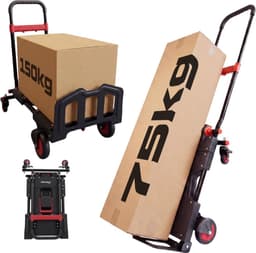
Slide the toe plate fully under the load, or as far as the carton allows. Put the heavier side of an awkward item against the frame, as BIL Group’s notes suggest for tall appliances. Stack with the heavy piece low. A high centre of gravity makes the truck twitchy on turns. Tilt until the weight transfers onto the wheels and the truck balances without you fighting the handle. That is usually a modest lean. If the load slides, strap it. Several folders show a bungee in the picture, though WMR buyers often say extras were missing. On flat ground, push so you can see the path. Pull only when the space forces it. Take a short test roll first. Solid tyres feel firmer than pneumatic ones on tile and concrete. That is not an excuse to ignore a wheel that wobbles because a pin is loose.

Kerbs, stairs, and slopes

Do not bump a conventional sack truck up a kerb. Supplier risk guidance treats that impact as stress on the toe plate and the axle, and solid wheels do not cushion it the way a soft pneumatic might for a moment. Use a ramp, a second person, or another route. Stairs are a stop for a standard two-wheel barrow unless the listing describes a stair mechanism. CAMBA markets stair-climbing wheel technology. UK reviews still disagree about doorways and wheel retention. One reviewer on steps with a steel solid-tyre truck is an anecdote, not a stair rating. On a slope, do not leave a loaded truck unattended. Downhill, walk with the truck in front so it cannot run into you. Uphill, you may pull while the load stays lower than you. A camber without a brake can swing the truck. The MX-FT150 swivel lock is only partial help. Solid wheels remove punctures on a smooth floor. They do not remove these rules.

When you should not continue

Stop when you cannot hold the load if the truck slips, when the route has unassessed stairs or a kerb you cannot ramp, or when the toe plate or pin is damaged. At work, if the task was not considered under the Manual Handling Operations Regulations, and the truck is work equipment under PUWER, involve a manager before you improvise. If threads will not start or wheels will not mount, that is a return, not a reason to load a half-built frame. REDCAMP and Modern Group reviews in this set show that pattern. A gravel route or a pallet that overhangs the toe is the wrong truck, not a technique problem.

Common questions

How do I get the load onto the toe plate?
Tip the carton or appliance so the plate slides under the bottom edge, or lower the stack from above if the plate is fixed. For a washing machine, two people and a cleared path beat a solo heave.
Do I push or pull?
Push on open flat ground so you see ahead. Pull only when space forces it, and keep strokes short.
Can I bump it up a kerb?
Not with a standard sack truck if you can avoid it. Use a ramp or help, and protect the plate and your back.
What if the truck has solid wheels and the route has stairs?
Unless the listing is built for stairs, treat stairs as out of scope. CAMBA is the only stair claim in this set, and UK reviews on it are mixed.
How high can I stack?
Keep the heavy items low. INDG143 and supplier guides focus on stable wheels and handle height, not a maximum stack height. Use judgement and straps.
What do I check before the first load if the wheels were in the box separately?
Pins seated, wheels that spin freely without wobble, a flat toe plate, and a stated capacity that matches the mode you will use.
What if the toe plate is bent?
Do not load it. Replace or return the truck. Bending it back is poor practice in supplier guidance.
When should I stop and get help?
When you cannot control the tilt, when pins or plates are faulty, when stairs or kerbs are unavoidable, or when work rules require an assessment you do not have.

Related pages

Sources

Public UK sources named below. amazon.co.uk prices, stars and review counts on these seven listings were read on 20 October 2026. Page updated October 2026.

  1. Sack Trucks: sack trucks buyers guide (retrieved 20 October 2026)
  2. Handle-iT: sack truck risk guidance (retrieved 20 October 2026)
  3. HSE INDG143: manual handling at work (retrieved 20 October 2026)
  4. HSE L23: Manual Handling Operations Regulations 1992 (retrieved 20 October 2026)
  5. PARRS: guide to sack trucks (retrieved 20 October 2026)
  6. HSE: lifting equipment and LOLER (retrieved 20 October 2026)
  7. BIL Group: sack trucks and trolleys (retrieved 20 October 2026)
  8. Consumer Rights Act 2015 (retrieved 20 October 2026)