Mitre shears vs a mitre box: when you keep the saw
You already own a mitre box, or you are about to buy one, and a hand shear looks quieter for the bead in the hallway. Mitre shears vs a mitre box is a conditional choice. Use the shear when the piece finishes in one clean squeeze. Use the box or the saw when it does not. Peter F. compared UK guides and amazon.co.uk reviews in our [mitre shears comparison](/hub/lawn-and-garden-equipment/mitre-shears) on 22 October 2026. A qualifying purchase can earn a commission at no extra cost to you. Steps are on [how to use mitre shears](/hub/lawn-and-garden-equipment/mitre-shears/sub/mitre-shears-how-to-cut). Profile limits are on [mitre shears for skirting](/hub/lawn-and-garden-equipment/mitre-shears/sub/mitre-shears-skirting-and-beading). The [mitre shears buying guide](/hub/lawn-and-garden-equipment/mitre-shears/sub/mitre-shears-buying-guide) is the next read only if a shear is still plausible.
You already own a mitre box, or you are about to buy one, and a hand shear looks quieter for the bead in the hallway. Mitre shears vs a mitre box is a conditional choice.
You already own a mitre box, or you are about to buy one, and a hand shear looks quieter for the bead in the hallway. Mitre shears vs a mitre box is a conditional choice. Use the shear when the piece finishes in one clean squeeze. Use the box or the saw when it does not. Peter F. compared UK guides and amazon.co.uk reviews in our mitre shears comparison on 22 October 2026. A qualifying purchase can earn a commission at no extra cost to you. Steps are on how to use mitre shears. Profile limits are on mitre shears for skirting. The mitre shears buying guide is the next read only if a shear is still plausible.
Our top picks
| Badge | Product | Angle range | Stated cut | Spare blades | Note | Price | Offer |
|---|---|---|---|---|---|---|---|
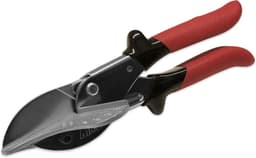
| Best overall |  Knipex KNIPEX 94 35 215 mitre shears | 45° square, marks at 60°, 75°, 90° | Plastic, rubber, soft timber, ribbon cable | Not in the box; 94 19 215 separate | 9.4 | about £66.60 | View offer |
| Best value |  Xpert Xpert GKT03104 SK5 mitre shears | Up to 45°, markings on the anvil | 50 mm; plastic, gasket, wood to 15 mm | None listed | 9.2 | about £15.90 | View offer |
| Alternative |  O'Shine O'Shine OS003 mitre shears | Click stops from 45° to 135° | Soft wood dowel; not for metal | 1 spare, with a sheath | 9.2 | about £35.99 | View offer |


On this page
What each tool is for
Where the shear is the better hour
Where the saw or the box stays
If you still buy a shear
Common questions
Do mitre shears replace a mitre box?
Do they replace a powered mitre saw?
What should stay on the saw?
Is a box more accurate than a cheap shear?
Can I mitre architrave with shears?
What about MDF?
Related pages
Sources
Public UK sources from the research digest, last checked on 23 October 2026.
- Homebuilding: angled cuts on moulding and trim (retrieved 23.10.2026)
- Wonkee Donkee: what mitre shears can cut (retrieved 23.10.2026)
- Wonkee Donkee: parts of mitre shears (retrieved 23.10.2026)
- Wonkee Donkee: what mitre shears are (retrieved 23.10.2026)
- DIY Doctor: angles (retrieved 23.10.2026)
- Knipex datasheet, 94 35 215 (retrieved 23.10.2026)
- HSE: PUWER overview (retrieved 23.10.2026)
- Consumer Rights Act 2015, section 22 (retrieved 23.10.2026)