Independent comparisons. We may earn from shop links. More info

Scarifier vs lawn raker

Updated: October 2026

Two amazon.co.uk titles both promise to pull moss, and the cheaper one might only have wires. Scarifier vs lawn raker is a question about the metal on the drum, not about which page uses which word. This comparison kept ten corded machines that state both a scarifying drum and a rake or aerator drum. A raker-only listing was removed. The table is the [electric scarifier comparison](/hub/lawn-and-garden-equipment/electric-scarifier). Peter F. wrote this on 22 October 2026 from UK sources and those captures, not a lab. A qualifying purchase can earn a commission at no extra cost to you.

Two amazon.co.uk titles both promise to pull moss, and the cheaper one might only have wires. Scarifier vs lawn raker is a question about the metal on the drum, not about which page uses which word.

Our top picks

Bluemars Bluemars 2000 W

Best overall

Bluemars Bluemars 2000 W
9.2/10about £129.99
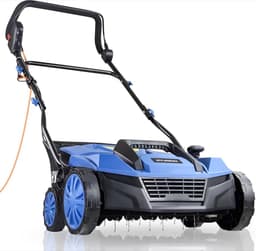
Hyundai Hyundai HYSC1800E

Rank 2

Hyundai Hyundai HYSC1800E
9.0/10about £125.99
Hyundai Hyundai HYSC1532E

Best value

Hyundai Hyundai HYSC1532E
9.0/10about £89.99
On this page

Why the names disagree

Lawnsmith describes blades as the tool that cuts thatch, and wires as the tool that pulls moss and should stay above the soil. Gardeners’ World treats sprung-tine cylinders as lawn rakers and two-drum machines as 2-in-1. Electrical Safety First says a scarifier is also called an electric lawn raker. Those UK pages do not use the words the same way. The Lawn Man argues that calling any rake a scarifier is wrong, and that light raking will not clear a real thatch layer. That piece also sells visits, so you set it beside the RHS, which still points a small job at a spring-tine rake and a larger lawn at a powered machine or hire. You still want a UK 3-pin plug, an RCD at no more than 30 mA, and the cable over your shoulder.

Wires, blades, and the word aerator

Sprung wires comb moss and loose dead grass. Lawnsmith’s point is that they should not be driven into the soil like knives. A wire drum on the deepest blade mark bends tines and tears grass without slitting thatch. The Hyundai HYSC1500E manual is a sibling document, not a sheet in every box here. It keeps springs on the higher settings and blades on the lower ones. Blades will cut living grass if you start at −12 mm. STIHL UK’s about 2–3 mm, and not beyond about 4 mm, is a blade conversation. The listings print scales down to about −12 mm. “Aerator” on these cartons usually names the second drum, not hollow tines that pull cores 10–15 cm deep. The purchase order is the electric scarifier buying guide.
Bluemars Bluemars 2000 W

Testsieger

Bluemars Bluemars 2000 W
9.2/10about £129.99

Which one, on which lawn

Choose wires, or a hand spring-tine rake, when the moss is loose, you can see grass, and the patch is small. The RHS is content with a rake on a small area. A powered wire drum will not chew out a spongy thatch layer that hides the soil. Choose blades when the lawn is matted, you cannot see soil, and a rake has already failed. You still mow first, wait for a dry day, and start shallow. A 2000 W motor makes a deep mistake faster. It does not make −12 mm correct. A 2-in-1 is the compromise when both drums are in the parcel. The Hyundai HYSC1532E components line names a scarifying drum and a raking drum separately. Other rows only say 2-in-1. A moss carpet with almost no grass is electric scarifier for moss.

What this comparison includes

Every machine in the comparison states a scarifying drum and a second rake or aerator drum. They are corded, 1500–2000 W, and 32–40 cm. A BLACK+DECKER GD300 capture was removed because the item type was Lawn Raker. It is not a row, and this page does not invent a price for it. Lawnsmith notes that many machines sold as electric scarifiers are wire rakers. This category was filtered so the kept rows claim both. If you only need wires on a small patch, a hand rake may be less fuss than any of these mains machines. If you need blades and the lawn is large, the RHS hire point still stands.

Common questions

What is physically different?
Blades slit thatch and can cut the surface. Sprung wires comb moss and should stay above the soil. A 2-in-1 gives you both cassettes. The title does not settle which one you have until you read the components line or look at the metal.
I only have moss. Do I still need blades?
Not if the moss is loose and the grass is still there. Wires or a hand rake, kept high, match that job. The deepest blade mark rips healthy grass on a moss-only pass. A blade will not turn shade into a lawn.
Will wires clear a thick spongy layer?
Usually not. They pull the loose top and leave a mat you still cannot see soil through. That is the case for blades, started around 2–3 mm on a dry, mown lawn. If the carton contains only springs, it is a raker, whatever the title says.
Why do 2-in-1 machines exist?
Moss and thatch often share one lawn, and a second cassette costs less than a second machine. They work only if both drums are supplied and you change over. Running springs at blade depth, or blades at −12 mm on the first pass, wastes the second drum. The listings here claim both. You still confirm the parcel.
Is aerator the wire drum or the blade drum?
In these captures it is marketing for the second drum, often the raking side, not hollow tines. A fork or hollow tines about 10–15 cm deep are the RHS suggestion for puddles. A lever that stops around −12 mm does not do that job. If the bullets are vague, look for knives versus springs.
Are lawn rakers in this comparison?
Not as raker-only machines. The raker capture was removed. What remains are corded 2-in-1 listings that claim a scarifying drum and a rake or aerator drum. The spring cassette inside those boxes is still a raker drum. You use it for moss, on the higher settings.

Related pages

Sources

Sources from the research digest, last checked on 22 October 2026. Shelf prices and star lines are from the amazon.co.uk capture on 22 October 2026.

  1. RHS, Lawn care in autumn (retrieved 22 October 2026)
  2. RHS, Moss in lawns (retrieved 22 October 2026)
  3. RHS, Waterlogged lawns (retrieved 22 October 2026)
  4. Electrical Safety First, Scarifiers (retrieved 22 October 2026)
  5. HSE, electrically powered equipment (retrieved 22 October 2026)
  6. GOV.UK, outdoor equipment noise (retrieved 22 October 2026)
  7. Scarifier definition, SI 2001/1701 (retrieved 22 October 2026)
  8. STIHL UK, lawn scarification (retrieved 22 October 2026)