Independent comparisons. We may earn from shop links. More info

Insect netting for vegetables: name the pest

Updated: 16 October 2026

Three amazon.co.uk titles can all say fine mesh while one has holes you could push a pencil through. Insect netting for vegetables only works if the hole matches the animal. A 15 mm or 20 mm bird net stops a pigeon and does not stop carrot fly. This guide sorts the twelve listings from 15 October 2026 into those jobs. The price table stays on the [vegetable protection net comparison](/hub/herb-seeds/vegetable-protection-net). Written by the Products Compared editorial team from those UK listings and from RHS guidance. A qualifying purchase through our amazon.co.uk links can earn a commission at no extra cost to you. Updated 16 October 2026.

Three amazon.co.uk titles can all say fine mesh while one has holes you could push a pencil through. Insect netting for vegetables only works if the hole matches the animal.

Our top picks

KINGLAKE KINGLAKE 2 × 5 m, 35 g/m²

Best overall

KINGLAKE KINGLAKE 2 × 5 m, 35 g/m²
8.2/10about £14.99
WOHOHOHO WOHOHOHO 2 × 5 m, 1 mm

Best value

WOHOHOHO WOHOHOHO 2 × 5 m, 1 mm
7.6/10about £8.99
OAHAO OAHAO 2.5 × 10 m

Alternative

OAHAO OAHAO 2.5 × 10 m
7.8/10about £16.99
On this page

Name the pest before the brand

The RHS bands are the ones this page uses. Standard insect mesh is about 1.3–1.4 mm. It stops many larger insects, and it does not reliably stop aphids, flea beetle, allium leaf miner, or leek moth. Fine mesh, about 0.8 mm, is the band that adds those. Butterfly net of 4–7 mm can stop cabbage whites only while the foliage does not touch the cloth. Bird net sits near 15–20 mm. A secondary allotment page sometimes treats about 7 mm as enough for carrot fly. This guide does not. The RHS asks for a full cover, and the standard or fine insect bands are the ones that match that job. Write the pest down before you buy. If the title says fine mesh and prints no millimetre, the hole is unknown. Stretching over hoops widens the gaps, so a tight fit can undo the size you paid for.

What each type in this set actually is

Four listings talk like insect sheets. KINGLAKE states 0.8 mm and 35 g/m². OAHAO states 0.8 mm and no cloth weight. WOHOHOHO puts 1 mm in the title, close to standard mesh and not the same as 0.8 mm. AOOWU mentions 0.38 mm in a bullet only. That is not a measured hole, and a review says a butterfly got through after the holes stretched. KINGLAKE against WOHOHOHO is the best vegetable protection net page. Three listings are bird sheets whatever the title says. MAIYADUO and RIFNY state 15 mm. Straame states 2 × 2 cm and still calls the net fine mesh. They suit fruit and pigeons. They do not suit carrot fly. DIVCHI is a pair of tunnels with no hole size. The pop-ups run about 38–45 cm tall. That height shades a seed tray. It does not arch over a metre-wide bed of kale.

Width, weight, and fixings

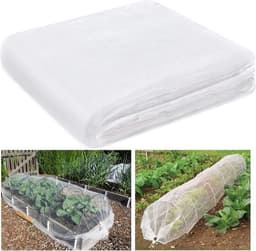
The bird sheets are 4 m across, useful on a fruit cage and bulky on a 1.2 m bed, where spare cloth that flaps in a March wind becomes a gap. Grams per square metre tell you how much cloth you are pinning. Specialist mesh is often published around 55–75 g/m². Crocus lists Enviromesh ultrafine at 0.8 mm and 70 g/m², which is not these amazon sheets. KINGLAKE is the only listing here that states a cloth weight, at 35 g/m². RIFNY, a 15 mm bird net, states about 22 g/m² and includes six staples and 100 ties. The fine sheets are mostly the net alone. A UV word in a title is not a test. None of these twelve was mesh-measured for this guide.

When the cover has to come off

Beans and strawberries need bees, which Crocus notes on its ultrafine page. Lift the mesh while French beans are in flower. The cover also changes when the job is frost. Mesh gives little warmth beside horticultural fleece, though a fine hole can still leave the air under it warmer and damper. That split is fleece or mesh for vegetables. Cabbage, kale, broccoli and sprouts still need a gap above the leaves. How the sheet sits is how to fit vegetable netting.

Common questions

What hole size do I need for carrot fly?
Use a full cover in the RHS standard band of about 1.3–1.4 mm or the fine band of about 0.8 mm, with the edges buried. A 15 mm or 20 mm bird net does not stop carrot fly. Flies can also emerge from last year’s soil, so rotate as well as cover. KINGLAKE and OAHAO state 0.8 mm. WOHOHOHO states 1 mm, which is coarser than that fine band.
Will a 15 mm or 20 mm net stop cabbage whites?
Do not count on it. The RHS says 4–7 mm can stop white butterflies only while the leaves do not touch the net. This comparison has no listing that states 7 mm. MAIYADUO, RIFNY, and Straame are pigeon sheets at 15–20 mm. For whites, use a stated 0.8 mm or 1 mm insect sheet and keep a gap above the crop.
Is 1 mm the same as 0.8 mm?
No. One millimetre is a fifth wider. WOHOHOHO’s title says 1 mm. KINGLAKE and OAHAO state 0.8 mm, the RHS fine band. The 1 mm sheet is still an insect net, and it is the weaker choice for flea beetle, allium leaf miner, or leek moth. Stretching either sheet over a hoop can widen the hole further.
How wide a sheet does a raised bed need?
Add the bed width, both side drops, and at least 5 cm to bury on every side. A 1.2 m bed with 40 cm sides needs more than 2 m before burial, so KINGLAKE at 2 m wide is tight and OAHAO at 2.5 m is the easier cut. A 4 m bird roll is wider than most single beds. Folded spare still has to be weighed down or it lifts.
Do I have to keep bees out of beans and strawberries?
You have to let them in during flowering, or you lose the pods and the fruit. Fine 0.8 mm mesh keeps bees out as well as flies, so lift it for that window. A 15–20 mm net lets bees through and does not replace insect mesh for carrot fly or flea beetle. Put the fine sheet back once flowering has finished if a later pest is still due.
Are the pop-ups big enough for a veg bed?
No. They sit around 38–45 cm tall, and Taydin’s bags are about 46 cm. That covers a tray or one pot. A kale or cabbage bed needs a sheet over hoops, or a tunnel that matches the row. DIVCHI is the tunnel format here, and its hole size is unstated, so the mesh is still unknown.

Related pages

Sources

Public UK sources named in the digest. Listings captured on 15 October 2026.

  1. RHS insect-proof mesh (retrieved 15 October 2026)
  2. RHS fleece and crop covers (retrieved 15 October 2026)
  3. RHS carrot fly (retrieved 15 October 2026)
  4. RHS cabbages (retrieved 15 October 2026)
  5. Wildlife and Countryside Act 1981, section 1 (retrieved 15 October 2026)
  6. GOV.UK wild birds: prevent damage (retrieved 15 October 2026)
  7. RSPB on netting (retrieved 15 October 2026)
  8. BBC Gardeners’ World fleece (retrieved 15 October 2026)
  9. Crocus Enviromesh ultrafine (retrieved 16 October 2026)