Independent comparisons. We may earn from shop links. More info

Oil filled vs oil free radiator

Updated: 22 October 2026

Choosing between an oil filled vs oil free radiator is less about brand logos than about how heat arrives in the room and which failure mode you can live with. An oil-filled column circulates mineral oil around an electric element. A Dimplex oil-free model heats a dry element and a panel, with no sealed oil sump. The [radiator comparison](/hub/heating/radiator) lists both families from amazon.co.uk cards in this set. Size the room first, then use this page for the technology trade-off. Peter F. checked the listings and public UK sources. There was no lab test. A qualifying purchase can earn a commission at no extra cost to you.

Choosing between an oil filled vs oil free radiator is less about brand logos than about how heat arrives in the room and which failure mode you can live with.

Our top picks

On this page

How each type works

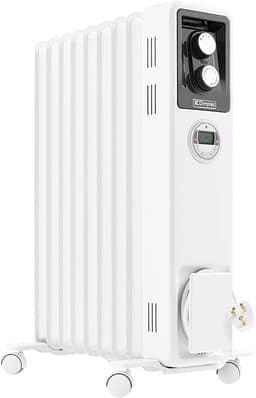
An oil-filled portable stores heat in fluid and steel fins. The element warms the oil, the oil warms the metal, and the metal warms the air by convection. There is no fan. Warm-up is gradual. After switch-off the fins can stay hot for twenty minutes or more. De'Longhi Dragon chimney fins aim to improve the air draw through the column. Oil-free Dimplex models here are the Eco Chico at 700 W and the ECR20TIE at 2 kW. They heat a dry element and the shell directly, so they feel faster at the start and cool sooner. You avoid a leak. You lose the slow tail of a heavy oil column. Two kilowatts drawn is still two kilowatts billed while the element is on.

Warm-up and residual heat

If you want heat now for a one-hour meeting, oil-free often wins the first twenty minutes. If you want the room to stay acceptable while the thermostat cycles, oil-filled mass smooths the dips. Dragon owners describe air closer to a plumbed radiator. Fin count does not change the fuse rating. An oil-free 2 kW still maxes the same socket as an oil-filled 2 kW. An ECR20TIE held at 600 W is a power-step choice, not an oil-free discount.

Running cost and thermostat myths

The Centre for Sustainable Energy, and supplier explainers, repeat the same rule: running cost follows kilowatt-hours, not the words oil-free on the box. Marketing sometimes implies a dry element is cheaper to run. In practice a 600 W step feels economical because it draws less power, not because oil-free physics beats the meter. A thermostat that cycles 30 minutes on and 30 minutes off at 2 kW averages 1 kW over the hour. The technology family does not change that sum. Compare the wattage steps you actually use.

Weight, noise, smell and leaks

Oil-filled 2 kW units often exceed 10 kg. The Eco Chico is 5.25 kg. The ECR20TIE is about 10.2 kg. The Dragon 4 is about 14.8 kg. Castors help on a flat floor. They do not make the stairs light. Both families are fanless. Reviewers mention a thermostat click on the Eco Chico at night, and an occasional oil tick. First-run smell affects both. A plastic smell is a defect on either type. A sealed column should not leak while it stays upright. Devola and Pro Breeze Smart reviews include oil under the unit after inversion or a fault. Oil-free removes that failure. It does not make the surface safe to touch.

Which to choose

For a long evening, lean oil-filled: a Dragon or a 2.5 kW column, because heat lingers after switch-off. For a hall or a box room, the Eco Chico at 700 W avoids the weight. For a 2 kW bedroom where a leak would worry you, the ECR20TIE is the oil-free match. For an app at 2 kW, the Dreo is the oil-filled option here. There is no smart oil-free model in the set. Past about 20 m², with weak insulation, neither family fixes undersizing. Raise the watts, or draught-proof, first.

Common questions

Which heats a room faster?
Oil-free panels, and lighter columns, feel faster in the first minutes. A large oil-filled unit catches up over 30–60 minutes and holds heat longer after you switch it off. For a one-hour meeting, that early gap matters. For an evening in one room, the residual warmth of the oil often matters more. The fuse rating is still the nameplate watts, not the feel in the first twenty minutes.
Are oil-free radiators cheaper to run?
Only if you use a lower wattage step or a shorter on-time. The oil-free label does not change the price of a kilowatt-hour. A 2 kW element that is on costs the same whether the heat sits in oil or in a dry panel. A thermostat that cycles the element off is what cuts the bill. Compare the step you will actually leave selected.
Do oil filled radiators leak?
A leak is uncommon when the column stays upright. Reviews tie oil under the unit to upside-down assembly, notably on Devola when the wheels are fitted, and to defects, including on the smart Pro Breeze. Check underneath during the first week. If oil appears, stop and contact the maker. An oil-free Dimplex has no sump to leak. It can still scorch if you cover it or crowd it with fabric.
Which is safer with children?
Both types have hot metal once they are warm. A tip-over cut-out helps if the unit is knocked. It does not stop a burn from a touch. A child lock on a smart model locks the buttons. It does not cool the fins. Keep either heater away from cots, and do not treat oil-free as touch-safe. Supervise young children in the room while the surface is hot.
Can an oil-free radiator replace a 2 kW oil-filled one?
The ECR20TIE matches a 2 kW output. The difference is the cool-down, not the fuse. In a draughty open-plan room you may still need a longer run on either type until you fix the draughts. Swapping technology before you deal with insulation can disappoint you twice. The Eco Chico at 700 W does not replace a 2 kW column.

Related pages

Sources

Public UK sources named below. amazon.co.uk prices, stars and review counts on these eleven listings were taken from the listing files read on 20 October 2026. Page updated October 2026.

  1. Electrical Safety First — portable heaters (retrieved 20 October 2026)
  2. Devon and Somerset Fire and Rescue — heater safety (retrieved 20 October 2026)
  3. BS EN 60335-2-30 scope (retrieved 20 October 2026)
  4. legislation.gov.uk Annex II 2015/1188 (retrieved 20 October 2026)
  5. GOV.UK ecodesign guidance (retrieved 20 October 2026)
  6. Ofgem price cap 1 October to 31 December 2026 (retrieved 20 October 2026)
  7. Centre for Sustainable Energy — room heaters (retrieved 20 October 2026)
  8. De'Longhi GB Dragon TRD40820T (retrieved 20 October 2026)