Independent comparisons. We may earn from shop links. More info

Ear plugs buying guide

Updated: 21 October 2026

You are looking at twelve amazon.co.uk listings, and the largest number on the page is often the least useful one. A night beside a snorer, a gig and a noisy DIY task need different attenuation, and a 45 dB title may not be an SNR at all. This ear plugs buying guide puts the job first, then a figure you can compare, then a plug you will keep in. Rows and badges are on the [ear plugs comparison](/hub/hearing-protection/ear-plugs). Shelf prices are from 19 October 2026. We did not lab-test the plugs. A qualifying purchase can earn a commission at no extra cost to you.

You are looking at twelve amazon.co.uk listings, and the largest number on the page is often the least useful one.

Our top picks

Loop Loop Experience 2

Best overall

Loop Loop Experience 2
9.2/10about £29.95
Loop Loop Engage 2 Plus

Alternative

Loop Loop Engage 2 Plus
8.6/10about £39.95
On this page

Start with the job, not the decibel claim

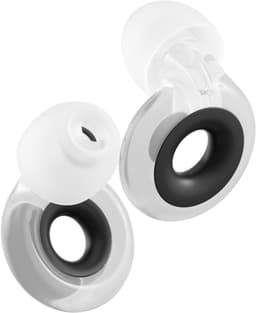
Sleep, speech, music and a loud task fail in different ways, so ask what you still need to hear. Beside a snorer you want a seal until morning, and a chance of hearing a smoke alarm if you live alone. A concert is the opposite of maximum muffling. RNID tells gig-goers to read the SNR and look for a UKCA mark. In this set, Loop Experience 2 is the filtered pair for concerts, at about £29.95 with a listed 17 dB SNR. Conversation is closer to Loop Engage 2 Plus, listed at 16 dB SNR and about £39.95, with Mute pieces the listing claims add 9 dB.

Use SNR for work, and treat 45 dB titles with care

Once the job is a loud task, use SNR, not the biggest decibel in the title. HSE’s bands are about 20 or less at 85–90 dB(A), 20–30 at 90–95, 25–35 at 95–100, and 30 or more at 100–105. Aim below 85 dB(A) at the ear, and not below 70 dB(A), or alarms and colleagues disappear. Real use is treated as about 4 dB worse than the standardised figure. The Control of Noise at Work Regulations 2005 set action values at 80 and 85 dB(A) and a limit of 87 dB(A). Protectors count towards that limit, not the action values. For work, HSE expects UKCA or CE and English instructions. BS EN 352-2 is the ear-plug standard. NRR is a US label. Laser Lite’s SNR and NRR do not match. Velvia, Exedor and CASCHO print 45 dB with no SNR line.
Loop Loop Experience 2

Testsieger

Loop Loop Experience 2
9.2/10about £29.95

Match the type to how often you will wear it

The number only counts if the plug stays in. Roll disposable foam, pull the ear up and out, and hold it while it expands. The 30-pair Laser Lite bag is about £5.85. The 200-pair refill is about £25.69 and is not reusable. ERM TOOL’s bullets say two or three uses even where the attribute says reusable. The motion is on how to insert ear plugs. Frienda is putty at about £13.99, listed at 32 dB, and it seals at the entrance. Quiet 2 is tipped silicone at about £19.95 with 24 dB SNR. Filtered plugs keep music or speech more intelligible than solid foam. That split is on foam or silicone ear plugs.

What to check on the amazon.co.uk page

Read the title against the attribute lines. If they disagree, keep both figures and do not average them. The 30-pair Laser Lite title says SNR 35 dB, the bullets say NRR 32 dB, and the attributes show both. VeoryFly’s attributes say 38 dB while the bullets say 29–38 dB SNR. Experience 2, Quiet 2 and Engage 2 Plus include a case and tips from XS to L. The top pick is the highest amazon.co.uk rating with at least 100 reviews: Experience 2 at 4.6 from 15,976. Best value is the highest review count at £15 or under rated at least 4.4: the 30-pair Laser Lite, 4.4 from 2,785, about £5.85. Compare a foam bag with a filter by the job.

Common questions

Is a higher decibel number always safer?
No. A higher figure can over-protect, so you miss an alarm, a vehicle or a colleague. HSE’s own warning is the level at the ear dropping below 70 dB(A). A 45 dB title can also be an unsupported claim rather than an SNR. Safer, for a loud task, means the right band and a seal you will keep, not the largest number on amazon.co.uk.
What is the difference between SNR and NRR?
SNR is the single number UK guidance uses to compare hearing protectors. NRR is a US label. They are not the same scale, and you should not convert one into the other. Howard Leight’s Laser Lite pages print both, and the two numbers do not even agree with each other on the listing. Quote the conflict. Do not pick the larger one because it looks safer.
Are 45 dB sleep plugs hearing protection for work?
Not on the evidence in this set. Velvia, Exedor and CASCHO print 45 dB without an SNR line, and Velvia also prints 40 dB. Workplace selection needs an SNR you can put in the HSE band, plus UKCA or CE and English instructions for PPE supplied at work. A sleep title is not that paperwork. Use a listing that states an SNR, or check the pack before you rely on it.
Should workplace plugs show UKCA or CE?
For most new PPE supplied for work in Great Britain, HSE expects UKCA or CE marking, a declaration of conformity and instructions in English. A product photo that crops the mark, or a bullet that only says certified, does not show BS EN 352-2. Northern Ireland follows its own parallel noise regime. If you are buying for a site, read the pack, not only the amazon.co.uk title.
When are ear plugs the wrong tool?
Plugs are the wrong tool when you cannot keep a seal, when you must take protection on and off constantly, or when the calculated level at the ear would fall below 70 dB(A). Ear defenders are the usual alternative, and they are a different category from this set. Pain, discharge, a stuck plug, sudden dullness or spinning is a reason to stop and get clinical help, not to try a higher decibel title.

Related pages

Sources

Public UK sources named below. amazon.co.uk prices, stars and review counts are from the twelve listings in this comparison, captured on 19 October 2026. Page updated 21 October 2026.

  1. HSE hearing protection (retrieved 21 October 2026)
  2. HSE real-world factors (retrieved 21 October 2026)
  3. HSE noise regulations (retrieved 21 October 2026)
  4. Control of Noise at Work Regulations 2005, regulation 4 (retrieved 21 October 2026)
  5. HSE PPE supply (retrieved 21 October 2026)
  6. BSI, BS EN 352-2:2020 (retrieved 21 October 2026)
  7. RNID, choose your earplugs (retrieved 21 October 2026)
  8. amazon.co.uk listing, Loop Experience 2 (retrieved 19 October 2026)