Independent comparisons. We may earn from shop links. More info

How to use a utility knife

Updated: 24 October 2026

The blade is already in your hand, the cardboard is rocking on the kitchen table, and the last cut tore instead of parting. How to use a utility knife comes down to a short edge that is actually sharp, a free hand that is not in the line, and a tin for the waste. Peter F. set this sequence from OLFA’s snap instructions, Stanley’s description of an onboard snap, HSE notes on hand knives, and two council disposal pages, checked for this guide on 22 October 2026. We did not film a cut. The [utility knife comparison](/hub/hand-tools/utility-knife) is the list of knives this project kept. A qualifying purchase can earn us a commission at no extra cost to you.

The blade is already in your hand, the cardboard is rocking on the kitchen table, and the last cut tore instead of parting.

Our top picks

On this page

Before you cut

Seat the blade before you touch the material. On a snap-off, extend only the segment you need and check that the slider has held. On a trapezoid knife, close the body until the blade does not rattle. On a shielded cutter, confirm the blade or hook deploys, or stays inside the guard, before a long seam. The HSE hand-knife note says you should not walk with an exposed blade. Put the knife down when you move the box. Keep the free hand beside the cut, not in front of it. Pull the knife away from your body. A parcel on a worktop is steadier than one on your lap. If you are scoring plasterboard, B&Q’s method is to score the ivory face, snap the board, then cut the paper on the back. A long extension on an 18 mm blade flexes and the tip snaps in the cut.

Snap or change, depending on the knife

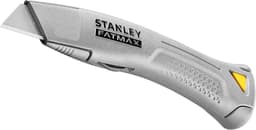
A tearing cut means the edge is dull. Forcing it is how the tip skips out of the score and into a thumb. A segmented snap-off takes a snapped tip. A trapezoid takes a whole new blade. Do not invent a snap on a knife that was not built for one. Stanley describes an onboard snap, with a magnet, on its own 18 mm snap knife. Use that motion only when your knife has that slot. The FatMax FMHT10501-0 in this comparison is a thumb-wheel change with storage for 10 blades. The listing does not describe it as a snap-off. If you do not have a spare, stop. One Draper review says the blades cannot be replaced. When that short edge is round, the cutter is finished. The snap-off versus retractable page is the choice if the next job is board rather than tape.

When to stop

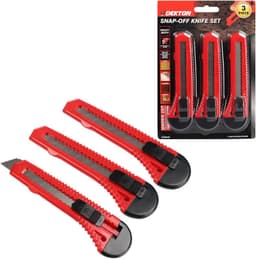
Stop when the knife will not hold the blade. Dekton reviews include a blade that slipped out of the back, a rear retainer that came loose, and knives that arrived broken. That is not fixed by pushing harder. Retire that knife. A missing blade is the same stop: one Draper buyer found the retractable blade absent on arrival. A bent tip is finished too. Do not straighten it and carry on. Rust on a snap-off segment means that segment is scrap. Thick fibreboard that the yellow concealed cutters will not open is a limit of that tool. Change to a snap-off or a trade knife for breaking cartons down.

Where the segments go

Do not drop segments into the kitchen bin loose. Westminster City Council says wrap knives in a rigid box, mark it SHARP ITEMS, and notes that small Stanley blades may go in a disposal case and then into general waste. West Sussex County Council says wrap them and hand them to recycling-centre staff for the scrap-metal bin. Trade waste is refused at those sites. Those are two councils, not a national rule. Check yours before you invent a third method. A sharps container is the better habit on a job, which is what OLFA and the HSE both point at. If the cut is a fire door, lagging you are not sure about, or a roof membrane you do not want to pierce, stop and get the person whose job that is. The safety box cutter page covers the workplace note and the public-place rule.

Common questions

How far should the blade stick out?
Far enough to cut the sheet, and no further. On card and tape that is often one snap-off segment or the short blade of a shielded cutter. On plasterboard it is a shallow score of the face paper. A long extension flexes and snaps in the cut.
How do I snap a segment without catching my fingers?
Use pliers, not your fingers. Extend to the score, point the knife away from you, set the pliers parallel to the score, snap downwards, and wear glasses. That is OLFA’s published method for its snap-off blades. Put the segment in a sharps tin immediately. If the knife has its own snap slot and magnet, use that instead of pliers, and only on that knife.
What if my knife has a built-in snapper?
Align the segment with the snap feature, snap it in the tool, and let the magnet catch the piece if the knife has one. Stanley describes that on its own 18 mm snap knife. The FatMax FMHT10501-0 in this comparison is a thumb-wheel trade knife, not described as that snapper. Do not assume every Stanley body has the slot.
The blade fell out of the back. Keep using it?
No. A retainer that has already let the blade out is a failed knife. Dekton reviews describe that fault, including a rear piece that came loose. Retract what you can, without pressing the loose blade into your hand, and stop. A knife that needs several tries to retract is in the same category if you cannot trust it to stay put.
Can I put segments in the kitchen bin?
Not loose. Westminster wants blades wrapped in a rigid box marked sharp. West Sussex wants them handed to recycling-centre staff. A kitchen caddy or a black sack with bare segments is what both pages are trying to stop. Councils differ, so read yours.

Related pages

Sources

Public UK sources and the amazon.co.uk listings for this set. Retrieved 22 October 2026.

  1. GOV.UK: Buying and carrying knives (retrieved 22.10.2026)
  2. Criminal Justice Act 1988, section 139 (retrieved 22.10.2026)
  3. Ask The Police: lock knives (Q337) (retrieved 22.10.2026)
  4. HSE: Hand knives (retrieved 22.10.2026)
  5. HSE: PUWER overview (retrieved 22.10.2026)
  6. Westminster City Council: disposing of knives (retrieved 22.10.2026)
  7. Cromwell: Safety knives expert guide (retrieved 22.10.2026)
  8. Stanley Tools UK: knives and blades (retrieved 22.10.2026)