Independent comparisons. We may earn from shop links. More info

Pointed or chisel rock hammer: match the end to the rock

Updated: 24 October 2026

You are staring at three tools that share a photo: a pointed rock pick, a geological hammer with a chisel edge, and a brick hammer with a chisel peen. The search calls all of them a rock hammer. The rock does not. A point starts a crack in hard material. A chisel edge, or a separate chisel, splits a bed. A brick hammer trims brick. Prices and ounce conflicts stay on the [rock hammer buying guide](/hub/hand-tools/rock-hammer/sub/rock-hammer-buying-guide). The eleven rows are on the [rock hammer comparison](/hub/hand-tools/rock-hammer). Peter F. used UK field notes and the saved listings, not a lab split. A qualifying purchase can earn a commission at no extra cost to you.

You are staring at three tools that share a photo: a pointed rock pick, a geological hammer with a chisel edge, and a brick hammer with a chisel peen. The search calls all of them a rock hammer. The rock does not.

Our top picks

INCLY INCLY 5-piece geology kit

Best overall

INCLY INCLY 5-piece geology kit
9.6/10about £26.99
Estwing Estwing E13PM rock pick

Alternative

Estwing Estwing E13PM rock pick
9.0/10about £39.00
On this page

Three tools that look alike

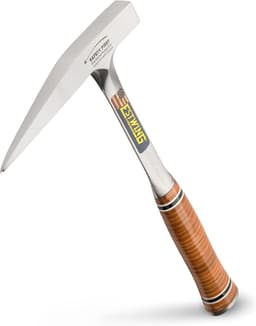
A pointed pick has a flat face opposite a point. That is the Estwing E13PM and the other pointed picks. A chisel-edge geological hammer has a blade in the head for splitting a bed. A brick hammer is a masonry tool. JOIKIT B0CY26QHG3 remains, titled as both brick hammer and rock pick, This folder has no chisel-edge Estwing, and a Picard chisel-edge hammer at about £67 excluding VAT is not an ASIN here. Once you know the end, the shortlist is the best rock hammer UK page.

When the point is the right end

Use a point on a hard loose piece, a nodule, or a crack you need to start, when a blade would skate. GEOetc's field experience points the pick at igneous and metamorphic cracks and the chisel head at sedimentary beds. The Estwing E13PM is the one-piece example: 13 oz in the title, 363 g on the listing, at £39.00. Skip the point on a soft bed you want in a sheet. A sharp point on shale can punch through the fossil. The flat face is what strikes a separate chisel. Wear impact eye protection either way. Whether the shore allows the blow is separate from the tip.
INCLY INCLY 5-piece geology kit

Testsieger

INCLY INCLY 5-piece geology kit
9.6/10about £26.99

When you want a split

A split along a bed wants a chisel edge or a separate chisel, not a harder point. A kit chisel is a second tool, not a blade forged into the head, and the listing does not prove the pick is rated to strike it. INCLY, Tanstic and Mardatt list that chisel. A guard is not eye protection, and none of these kits names EN 166 or BS EN ISO 16321-1. UK Fossils uses crack hammer for a head with no point, for people who mostly strike chisels, and that pattern is outside these pointed rows. Hard rock is the wrong place for a thin chisel edge: the edge chips.

Leave the brick hammer in the masonry search

Buy a brick hammer when the job is brick. A tubular brick hammer sold to trim bricks is the neighbour tool, and the one removed from this folder stays out. JOIKIT's pair at £14.99 is the mixed case that remains: the title says brick hammer and geological hammer, and the included-components line says two brick hammers. The item weight is 821 g, about one hammer, against a title that says two. A style line that says German is a pattern label when the origin field says China. German here is a pattern label, not a country of forge, and it does not make the head a chisel-edge hammer. The Estwing bullets say Rockford, Illinois, and the origin field on that listing is empty.

Common questions

Do I want a point or a chisel edge for fossils?
Use a point for a hard nodule or a crack you need to open, and a chisel edge or a separate chisel for a bed you want to split, such as shale. GEOetc's experience puts the point on igneous and metamorphic cracks and the chisel head on sedimentary beds. A point on a soft bed can punch through the fossil. A thin chisel edge on very hard rock is the end that chips. The shore may still say you should not swing.
Is a separate chisel the same as a chisel-edge hammer?
No. A chisel-edge hammer has the blade forged into the head. A kit chisel is a second tool you hold and strike with the hammer's flat face. INCLY, Tanstic and Mardatt list that second tool. They do not show a chisel-edge Estwing, and a Picard chisel-edge hammer in UK trade, about £67 excluding VAT, is not one of these ASINs. A hand guard on the chisel is a bullet claim, not a matched heat treatment.
Can I use a brick hammer on shale?
A chisel peen can split shale, and older field notes describe a chisel-faced hammer for that rock. The tubular brick hammer sold to trim bricks is still the wrong listing when your only job is geology. JOIKIT's £14.99 pair is titled as both a brick hammer and a rock pick, so you read it as mixed. If the job is brick, shop for a masonry hammer on purpose.
What is a crack hammer?
UK Fossils uses the name for a hammer with no point, for people who mostly strike chisels. It is not a rock pick, and it is not the chisel-edge splitter. In this folder the common head is a point opposite a face, plus a separate chisel in the kits.
Why does the style field say German?
On several sleeve-grip picks the style field says German while the country-of-origin field says China. That word is a pattern label on the listing, not proof of where the steel was forged. The Estwing E13PM bullets say Rockford, Illinois, and they do not use that style line as a German claim. A German style label does not make the head a chisel-edge geological hammer.
Do I still need eye protection with either end?
Yes. A point, a chisel edge and a separate chisel all throw chips. Kit glasses in this comparison do not name an eyewear standard. A hand guard does not replace goggles. Keep other people out of the chip path, and retire a chisel once the struck end has mushroomed. The end you chose does not change that.

Related pages

Sources

Sources from the research digest, last checked on 22 October 2026.

  1. Geological Society / CHUGD field-hammer note (March 2012) (retrieved 22.10.2026)
  2. NatureScot, Scottish Fossil Code guidance (retrieved 22.10.2026)
  3. West Dorset fossil collecting code (retrieved 22.10.2026)
  4. GOV.UK SSSI consent and enforcement (retrieved 22.10.2026)
  5. HSE, using the right type of PPE (retrieved 22.10.2026)
  6. BSI on EN ISO 16321 (retrieved 22.10.2026)
  7. Axial, Estwing E3-22P rock pick (retrieved 22.10.2026)
  8. GEOetc geological-hammer guide (retrieved 22.10.2026)