Independent comparisons. We may earn from shop links. More info

Open ended spanner set: which jaws cover the job

Updated: 23 October 2026

A 15 mm copper pipe nut is not a 15 mm nut, and the box may not contain the jaw that fits it. An open ended spanner set is a roll of fixed U-jaws, usually two metric sizes on each tool. A piece count does not say which flats you can turn. Read the pairs, then the steel name, then the stars. The [open-ended spanner comparison](/hub/hand-tools/open-ended-spanner) holds the nine amazon.co.uk listings, with shelf prices in GBP as they stood on 22 October 2026. Peter F., DIY and tools editor, used those files and public UK notes. A qualifying purchase can earn a commission at no extra cost to you.

A 15 mm copper pipe nut is not a 15 mm nut, and the box may not contain the jaw that fits it. An open ended spanner set is a roll of fixed U-jaws, usually two metric sizes on each tool.

Our top picks

BGS BGS 12-piece double open-end set

Best overall

BGS BGS 12-piece double open-end set
7.5/10about £19.09
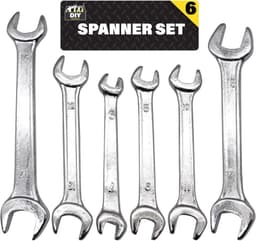
SOL SOL 6-piece double-ended set

Alternative

SOL SOL 6-piece double-ended set
6.3/10about £4.79
On this page

What you are buying

A double open-ended spanner has a fixed jaw at each end, and those ends are two different sizes. You slide it on from the side, so it can run a nut along a stud that a ring will not pass. A combination spanner is one size, open at one end and a ring at the other. If you need both on the same size, buy that set first. Chrome vanadium is a workshop phrase, not a certificate. TED still sells metric, imperial, Whitworth and BA, so an older fitting can miss every pair in a new roll. Measure an unmarked head. The naming trap is on open-ended versus combination spanners.

The pair list that matters

A useful metric pattern runs from 6×7 mm through 18×19 mm, then 20×22, 21×23, 24×27 and 30×32 mm. In this batch the long list, including 25×28 mm, is the twelve-piece BGS roll. A set that stops at 17 mm will not turn a 24 mm nut. Faithfull and Monument both state that a 15 mm compression nut is 24 mm across flats, and a 22 mm pipe nut is 32 mm. Hilka’s bullet ends at 17 mm. SOL’s pairs end at 16×17 mm. A stated 3 mm head is a different job, on thin open-ended spanners.

Steel, angle and the numbers on the shank

ISO 691 is the opening tolerance. ISO 3318:2016, as TED explains it, is a maximum head width. ISO 10102:2018 is length and maximum thickness, not strength. A public sample puts a 6×7 mm spanner at 103–144 mm long and at most 4.5 mm thick. Strength sits in ISO 1711-1 Series C. None of the nine listings print those identifiers. A hardness or newton-metre bullet is seller text. Many open-ends are angled about 15° so a flip takes a new bite. The BGS file does not print an angle. Under £15 in this batch is a short set or a single. A list through 32 mm starts near £20.

What to ignore on the listing

Ignore the item-length field until you have compared it with the jaws. BGS reads 32 mm, which repeats the largest jaw. The Draper 24 mm single repeats 24 mm. SOL reads 4.5 cm. Sort by the stamped sizes. Hilka’s title says eight pieces and the bullet lists seven, with no pairs. SOL’s highlight says combination while the pairs run from 6×7 mm to 16×17 mm. Ignore a star average from fewer than ten ratings. Who should leave each named roll is on best open-ended spanner sets.

Common questions

What sizes should a metric double open-end set include?
Look for pairs from 6×7 mm upward, and decide in advance whether you need 24×27 mm and 30×32 mm. A roll that stops at 17 mm covers many furniture and light household nuts. It does not cover a 24 mm compression nut or a 32 mm nut on 22 mm pipe. The BGS listing in this batch is the one that prints the long list, including 25×28 mm. Measure an unmarked head before you trust a thread-to-spanner habit.
Is chrome vanadium enough?
No. Chrome vanadium is the name most workshop spanners use for the steel. It does not prove jaw accuracy, hardness or compliance with an ISO strength test. A chromium-vanadium label is not itself quality, and cheaper ranges often have inaccurate sizes. Read the pairs and the review comments about fit. A carbon-steel line, where it is printed, is a step down from that workshop phrase, not a hidden upgrade.
What spanner fits a 15 mm compression nut?
A 24 mm jaw. Faithfull and Monument both give that across-flats size for a 15 mm compression nut, and 32 mm for a 22 mm pipe nut. The pipe’s nominal size is not the spanner size. A set whose largest printed jaw is 17 mm leaves you one tool short at the basin. Check that 24 mm and 32 mm are actually on the list if those fittings are the job.
Why is the Amazon length field sometimes 24 mm or 4.5 cm?
Because the field is sometimes a copy of the jaw, or a number that cannot be the real shank. The BGS field is 32 mm. The Draper 24 mm single repeats 24 mm. The SOL field says 4.5 cm. The ISO 10102 sample already expects a 6×7 mm spanner to be 103–144 mm long. Use the stamped sizes. Do not rank two sets by that length box.
What must this page refuse to claim about ISO tests?
It must not say these amazon.co.uk listings passed ISO 691, ISO 3318, ISO 10102 or ISO 1711-1. Those documents cover fit, maximum head width, length and maximum thickness, and strength. None of the nine listings print the numbers. A 3 mm claim, a hardness bullet or a newton-metre bullet is seller text. There is no laboratory winner in this file.

Related pages

Sources

Sources from the research digest, last checked on 22 October 2026.

  1. HSE, PUWER overview (retrieved 22.10.2026)
  2. ISO 10102:2018, assembly tools for screws and nuts (retrieved 22.10.2026)
  3. BSI, BS ISO 1711-1:2019 hand-operated wrenches and sockets (retrieved 22.10.2026)
  4. TED, spanners, citing ISO 3318:2016 (retrieved 22.10.2026)
  5. Haynes UK, car maintenance tools (retrieved 22.10.2026)
  6. Faithfull compression fitting spanner, 15 mm and 22 mm (retrieved 22.10.2026)
  7. Monument 15 mm and 22 mm compression fitting spanners (retrieved 22.10.2026)
  8. Teng Tools 6211, trade double open-end set (retrieved 22.10.2026)