Independent comparisons. We may earn from shop links. More info

Precision screwdriver set magnetic: laptop, watch, and the limit

Updated: 23 October 2026

You are about to open a laptop, glasses or a watch with the magnetic screwdriver set you bought for a wardrobe. Magnetic bits are for steel appliance screws. Non-magnetic precision bits are for tiny screws, and they bend on a hinge. Demagnetise before a sensor. Do not rest the tool on a pacemaker. This page stays on that limit. The rows are on the [magnetic screwdriver set comparison](/hub/hand-tools/magnetic-screwdriver-set). No field strength was measured. A qualifying purchase through our links can earn a commission at no extra cost to you.

You are about to open a laptop, glasses or a watch with the magnetic screwdriver set you bought for a wardrobe. Magnetic bits are for steel appliance screws.

Our top picks

On this page

Two bit families in one case

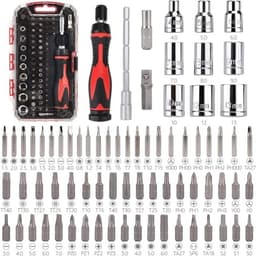
Amazon Basics is the only set here whose own bullet splits the bits. Magnetic bits are for electric appliances. Non-magnetic precision bits are for watches, phones and glasses, and they must not take an oversized screw. The other nine listings do not write that split as clearly. KELIN prints a 50 N·m claim beside precision bits, and a UK review says the smaller bits wear on tougher screws. YFNVH names watch repair on a rack with no review line. Do not treat that rack as the electronics pick. ZBXSNK includes seven precision drivers and a magnetiser at about £18.99, with only 40 ratings. Brass and most stainless screws are not held at all.

Why the small bit bends

The bit has to fill the recess. A cross blade that is too small touches a tiny patch of steel and snaps. iFixit says the same thing: fill the recess, stay on axis, and do not pry. Amazon Basics says precision bits are only for small electronic devices. UK reviews say the smallest bits can bend. There is no lab count of how often. That is enough to stop you using a glasses bit on a cabinet hinge. If the bit starts to twist, back off. Do not add force through a ratchet because the handle feels controlled. After you have bent one precision bit, retire it. A bent tip will not fill the next recess.

When to take the magnetism off

Magnetise a tip when you need to hold a small steel screw on the way to a hole you can see. Demagnetise it when the next part is a magnetic sensor, a meter movement, or a component the repair guide tells you to approach with a non-magnetic driver. Klein Tools UK's MAG2 method is to draw the shaft slowly through the demagnetise slot, without rotating it. Do not heat the tip. This page does not say a tip magnet ruins a phone or an SSD. Prefer the non-magnetic precision bits Amazon Basics already separates. A swipe will not make a brass laptop screw stick.

Pacemakers and live wires

The British Heart Foundation says keep household magnets about 15 cm from a pacemaker, and do not lean a cordless screwdriver on your chest. Sudden Cardiac Arrest UK gives the same sort of distance for a pacemaker or an ICD, and says moving the magnet away lets the device return to its settings. No gauss figure is claimed here. Do not treat these sets as cleared for an implant. If you feel unwell, move the tool away and contact your clinic. None of these listings states BS EN IEC 60900. A rubber handle is not insulation, and a small bit does not change that.

Common questions

Can I use this furniture set on a laptop?
Only the bits the listing marks for small devices, and only if they fill the recess. Amazon Basics says magnetic bits for appliances and non-magnetic precision bits for watches, phones and glasses. A furniture PZ2 bit is the wrong size for a laptop screw. A precision bit is the wrong strength for a hinge.
Why are some bits in the same case not magnetic?
Because the seller split two jobs. On Amazon Basics the precision bits are non-magnetic for watches, phones and glasses, and the appliance bits are magnetic. That is deliberate. Other sets magnetise the main bits and do not make the same split. Read the bullet before you assume every tip will pick up a screw.
Will the magnet hurt a phone or an SSD?
These sources do not show that a tip magnet ruins a phone or an SSD, and this page does not claim it. They do say to demagnetise before sensitive electronics and to use a non-magnetic driver where the repair calls for one. Amazon Basics already supplies those bits for phones.
I have a pacemaker. How close is too close?
The British Heart Foundation says keep household magnets about 15 cm from a pacemaker, and do not lean a cordless screwdriver on your chest. Sudden Cardiac Arrest UK gives the same sort of distance for a pacemaker or an ICD. No field strength was measured here, so this is not a clearance. If you feel unwell, move the tool away and contact your clinic.
The tiny bit bent. Was that the screw or the bit?
It was the bit being asked to do a larger screw's job, or a bit that did not fill the recess. Amazon Basics says precision bits are only for small devices. A KELIN review says smaller bits wear on tougher screws. Retire the bent bit. Do not try the next precision bit on a furniture screw.
How do I take magnetism off before a sensor?
Draw the shaft slowly through the demagnetise slot, without rotating it. That is the Klein Tools UK MAG2 method. Do not heat the tip. If a steel screw still sticks hard, the swipe did not take. Then use the non-magnetic precision bit if the listing supplied one.
Is this set insulated for a plug?
No. None of these sets states BS EN IEC 60900, and a soft handle is not an insulating rating. Do not open a plug, a consumer unit, or a live circuit with them. If you cannot isolate the circuit, stop and use a competent person. A small bit does not change that.

Related pages

Sources

Public UK sources are listed below. Shelf prices, stars and review counts are the amazon.co.uk figures captured on 22 October 2026. This page did not lab-test the sets. No field strength was measured.

  1. BSI, BS 2559:1994 screwdrivers and accessories (retrieved 22 October 2026)
  2. BSI, BS ISO 8764-1:1999 cross-recess driver points (retrieved 22 October 2026)
  3. ISO 1173:2001 bit shanks, 6.3 mm hex (retrieved 22 October 2026)
  4. British Heart Foundation, pacemaker questions (retrieved 22 October 2026)
  5. HSE INDG229, using hand tools (retrieved 22 October 2026)
  6. Bolts.co.uk, common recess styles (retrieved 22 October 2026)
  7. Compel, magnetic screwdriver tips (retrieved 22 October 2026)
  8. Consumer Rights Act 2015, Part 1 Chapter 2 (retrieved 22 October 2026)