Independent comparisons. We may earn from shop links. More info

How to use bar clamps on a glue-up

Updated: 22 October 2026

The glue is wet, one hand is holding a shelf against a side, and the clamp in the other hand is either about to dent the face or about to slip off the edge. How to use bar clamps, on a kitchen bench rather than a production shop, is a short sequence: dry-fit, protect the wood, tighten until a thin bead shows, and stop if the bar bows or the handle locks. Product choice stays on the [clamps set comparison](/hub/hand-tools/clamps-set). Peter F. drew the steps from public glue-up guidance and from the review notes on these packs. Nothing here was measured as a pressure in a lab. A qualifying purchase can earn a commission at no extra cost to you.

The glue is wet, one hand is holding a shelf against a side, and the clamp in the other hand is either about to dent the face or about to slip off the edge.

Our top picks

On this page

Set the joint before you clamp

Dry-fit the pieces with no glue until the joint closes by hand and the faces sit where you want them. If the dry fit needs a clamp to drag a gap shut, the joint is not ready, and more force will crush the fibres or bow the panel instead of closing a well-cut edge. Put the clamps on during that dry fit so you learn which length reaches and which handle fouls the bench. Then take them off, apply glue, and put them back in the same places. One clamp is not a glue-up. It pins one point, and the work can pivot around it. A second clamp stops that spin. Place them so they pull along the joint rather than diagonally across it. Diagonal pressure walks the joint open at the far corner. Springs are not this sequence. The TOLESA four-pack has no screw, and UK reviews say the springs often need two hands, then they snap shut at the listed 30 lb. Corner squares are not this sequence either. A reviewer of the Anylot set says they hold a corner true and do not press the joint. Which pack suits panels and frames is on clamps for woodworking.

Pads, cauls, and the pads that go missing

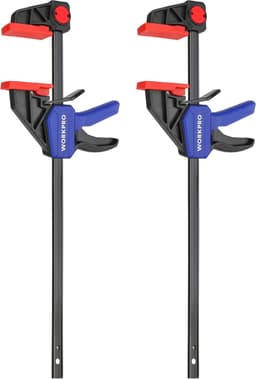
The face that meets the wood should be a pad that is actually on the jaw, or a scrap of wood you put there on purpose. A bare metal shoe leaves a dent that sanding may not lift out of a show face. Waxed paper or parcel tape on the caul stops squeezed-out glue gluing the scrap to the job. That is ordinary workshop practice, not a feature of a particular ASIN. Three packs in this set have review notes that the pads do not stay put. On the WORKPRO 305 mm pair the jaw pads come loose and replacements are hard to find. On the small WORKPRO mix the red tips pop off. On the WAIZHIUA six-pack pads are missing on arrival or fall off, and one review says the handles locked depressed within about a week. If you own one of those, assume you will clamp through a caul. The TOLESA springs include three spare pads, which fit that spring and not a bar jaw of another brand. A flat offcut, a little longer than the jaw is wide, turns a point load into a strip. If the pad is in the sweepings under the bench, the caul is the whole protection.

Turning a clamp into a spreader

Some of these clamps push as well as pull. The usual reverse, described by Wonkee Donkee for a trigger clamp that is built to come apart, is to release the fixed jaw, slide it off the bar, turn it around and click or screw it onto the other end. Do that only when the jaw on your clamp is made to release. Forcing a fixed head off a screw clamp is how the thread gets damaged. In this comparison the listings or the reviews describe a reverse on the DEKO six-piece, the HORUSDY bars, the WORKPRO 305 mm pair, the Amazon Basics six-piece, the Jorgensen parallel pair and, in the bullets, the WAIZHIUA 4-inch clamps. The Irwin mini twin’s extract does not describe a spreader, so do not assume the T54122EL7 jaw comes off. The WORKPRO 300 mm screw pair is the clear exclusion: a UK review says the jaw clamps and does not reverse. Amazon Basics reviews say the nuts that hold the reversible end can fall out. Put a hand under the end before you spin the nut off. DEKO’s listing gives the spread distance separately, out to 11-9/64 inches on the short clamps and 17-21/64 inches on the long ones. Use that number, not the clamping title, when you are pushing a frame apart.

How hard to tighten

Tighten until a thin, even bead of glue appears along the joint and the faces sit flush. Then stop. Woodsmith’s panel advice is the same idea: alternate clamps above and below the boards so the panel stays flat, and do not keep adding force once the squeeze-out shows. A single clamp in the middle of a wide panel cups the boards. Spacing on the order of 6 inches is a magazine starting point, not a setting on these handles. There is no gauge. Wood Magazine has quoted a glue-maker range around 100 to 150 psi for softwood. That is their citation, not a number you can set on a WORKPRO screw or an Irwin trigger. If the bar starts to bow, you are past a useful squeeze. A cheater bar on the handle is the wrong next step. These packs are not lifting tackle. A handle that locks down, as in the WAIZHIUA review, or a parallel clamp that closes and will not open, as in one Jorgensen review, is a faulty unit. The Consumer Rights Act 2015, section 19, is reject, repair, replacement or a reduction, claimed against the retailer. On a morticer or a saw at work, the Health and Safety Executive expects the workpiece clamped so a cutter cannot throw it. That is the employer’s system, not this glue-up. The packs this sequence assumes you already own are discussed on the best clamps set page.

Common questions

How tight should a bar clamp be on a glue joint?
Tight enough for a thin bead of glue along the joint, with the faces flush, and no tighter. If you keep winding, the bar bows or the wood dents. There is no pressure dial on these sets. A published psi range from a woodworking magazine is that magazine’s glue-maker note, not a setting you can select. Ease off if the panel cups, and add a clamp on the other face.
How do I keep the wood from denting?
Put a flat scrap caul between the jaw and the show face, and keep glue off the caul with tape or waxed paper. Use the stock pad as well when it is still attached. On the WORKPRO 305 mm pair, the small WORKPRO mix and the WAIZHIUA six-pack, reviews say the pads come off or arrive missing. A caul is the reliable face in those cases. A narrow jaw on softwood can still print a line if you over-tighten.
Which clamps in this set reverse into a spreader?
DEKO, HORUSDY’s bars, the WORKPRO 305 mm pair, Amazon Basics, the Jorgensen listing and the WAIZHIUA bullets describe a push as well as a pull. The Irwin extract used here does not describe a spreader. The WORKPRO 300 mm screw pair is clamp-only in a UK review. Reverse a jaw only when it is designed to come off. Check the spread opening as its own number.
What if the plastic pad has fallen off?
Clamp through a scrap caul and carry on with the glue-up. Do not wait on a replacement pad that reviewers of the WORKPRO 305 mm pair say is hard to find. The TOLESA springs include three spare pads, and those pads fit that spring, not a bar jaw of another brand. A missing pad is a reason to protect the wood. A handle that will no longer release is a reason to stop and return the clamp.
Why put clamps above and below a panel?
Clamps on one face only pull that face harder and cup the panel. Alternating above and below opposes that bend. Woodsmith describes the pattern for a panel glue-up. One clamp in the middle is the version that dishes the boards. You still dry-fit first, because alternating clamps will not correct a joint that does not close.
What if the handle locks or the jaw will not reopen?
Stop. A locked handle or a jaw that stays shut is a fault in the reviews of the WAIZHIUA pack and, for one unit, the Jorgensen pair. Do not add a tube to the handle to force it. Section 19 of the Consumer Rights Act 2015 is the reject, repair, replacement or reduction route against the amazon.co.uk retailer. Keep the listing that described the clamp. A home fix is not the next step.

Related pages

Sources

Public UK sources from the research digest, last checked in October 2026. Shelf prices and star lines are the amazon.co.uk figures in the display file.

  1. HSE — Safe use of woodworking machinery (ACOP L114) (retrieved October 2026)
  2. HSE — Morticer (retrieved October 2026)
  3. BSI — BS EN 847-3:2013, clamping devices for woodworking tools (retrieved October 2026)
  4. GOV.UK — General Product Safety Regulations 2005 (retrieved October 2026)
  5. legislation.gov.uk — Consumer Rights Act 2015, section 9 (retrieved October 2026)
  6. Muddy Faces — Guide to clamps and vices (retrieved October 2026)
  7. Irwin — Mini one-handed bar clamp (retrieved October 2026)
  8. Toolstation — Irwin Quick-Grip mini 2-pack (retrieved October 2026)