Independent comparisons. We may earn from shop links. More info

Metric or imperial Allen key: the sizes that round

Updated: 22 October 2026

The key goes in, it feels almost right, and a quarter turn later the socket is shiny. That is what a near size does. A metric or imperial Allen key choice is which system the bolt was made in. This page is that fork, not a second catalogue. Peter F. wrote it on 22 October 2026 from UK size guides and the listings in our [Allen key comparison](/hub/hand-tools/allen-key). We did not measure your bolt. A qualifying purchase can earn a commission at no extra cost to you. If you still need the turning sequence, that is the [how to use an Allen key](/hub/hand-tools/allen-key/sub/allen-key-how-to-use) page.

The key goes in, it feels almost right, and a quarter turn later the socket is shiny. That is what a near size does. A metric or imperial Allen key choice is which system the bolt was made in.

Our top picks

On this page

Metric first in a UK house

Start with metric. Flat-pack and a modern bike are metric, including the 4 mm and 5 mm keys in a wardrobe bag. An imperial set will feel nearly right and then damage those sockets. SAE on these listings means the inch drawer: older British and American equipment, and some US imports. Halfords says many UK cars used imperial fasteners into the early 1990s, and newer cars are metric. There is no exact swap. A slash on a bolt head is a spanner size, not proof of the hex socket in the middle. Readable metric-only lists here are the AMTOVL 9-piece, YOIbuy, Stanley and the AMTOVL T-handle. The cheaper AMTOVL page says SAE and prints no inch sizes, so treat it as metric.

The sizes that almost fit

Two pairs start and then slip. MLC's chart puts 5/32 in at 3.969 mm, 0.031 mm under 4 mm. Tool Compatibility prints about 3.97 mm. The key often enters a 4 mm socket and does not fill it. Once you turn, the corners round. 5/16 in is 7.938 mm, 0.062 mm under 8 mm. A worn 8 mm socket can accept it and then strip. Hemborta groups both pairs with the sizes that round. If the marked key wobbles before you turn, stop. A longer arm turns that gap into a round hole. G4GADGET prints 4 mm and 5/32 in together and stops at 6 mm. LOZAGU prints both spreads, including 5/16 in. Owning both is fine. Substituting them is the failure.

Labels, not a conversion chart

Millimetres are decimals. Inch sizes are fractions. SAE here means those fractions, not a near metric size. RS Components' hex-key guide pairs 4 mm with 5/32 in as if they were alternatives. That pairing is the mistake, not a conversion you can tighten with. Colour, a stamp or a separate rail has to show which key is which. An unmarked ring makes you test keys in the bolt. MULWARK prints metric to 8 mm and SAE to 1/4 in, so 4 mm and 5/32 in are both there, and 5/16 in and 10 mm are not.

Unmarked piece counts do not separate the systems

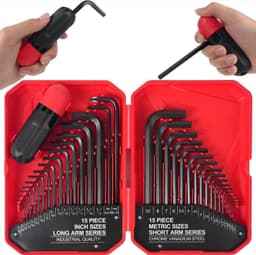
A large piece count does not separate the systems if the sizes are unmarked. ELEAD says inch and metric and does not print the sizes. D.A.Y. Republic says metric and SAE and does not print the imperial list. You cannot know whether 5/16 in is in the case without trying it in the bolt. LOZAGU prints the long lists, including those near pairs, so you can park 5/32 in away from 4 mm. The buying order for that choice is the Allen key set buying guide. If the house is only flat-pack and modern bikes, stay on metric unless the inch keys are stored apart. If the key wobbles before you load it, it is the other system.

Common questions

Are Allen keys in the UK metric?
The ones you meet on flat-pack and on a modern bike are metric. Imperial keys are for older or American equipment, not for the wardrobe cam. A UK house that only does those metric jobs does not need a SAE set. A house with both kinds of machine does.
When do I still need imperial?
When the fastener is inch-sized: older British kit, some US imports, and cars from the period Halfords describes as imperial into the early 1990s. Newer cars are generally metric. Do not read a slash on a spanner-sized bolt head as proof of the hex socket in the middle. Check the socket with a labelled key.
Will a 5/32 Allen key fit a 4 mm bolt?
It will often start. It should not be tightened. 5/32 in is 3.969 mm on the MLC chart, 0.031 mm under 4 mm. That gap is enough to round the socket once you turn. If the inch key rattles in a 4 mm socket, stop and pick up the 4 mm key.
Will 5/16 in turn an 8 mm socket?
It may enter a worn 8 mm socket, and it is the wrong key. 5/16 in is 7.938 mm, 0.062 mm under 8 mm. The larger gap still lets the corners take the load. Use 8 mm for an 8 mm socket. Owning both in one box is fine. Substituting them is how the bolt ends up round.
How do I tell the keys apart in a mixed set?
Millimetre keys are marked in decimals. Inch keys are marked in fractions, and these listings call that SAE. Keep them on separate rails or in a marked order. An unmarked ring makes you test keys in the bolt, which is the habit that loads 5/32 in into 4 mm.
Are SAE and imperial the same label on these sets?
On these amazon.co.uk listings, SAE means the inch sizes, such as 1/8 in or 5/32 in. It does not mean another metric range. A size-system field that says SAE and then prints only millimetres is a clash. The cheaper AMTOVL set has that clash. Believe the printed sizes, not the field name.
Does a 30-piece set solve this if the sizes are not marked?
No. ELEAD claims inch and metric and does not list the sizes. You cannot separate 4 mm from 5/32 in on a page that never names them. A large piece count without marks still asks you to try keys until one feels tight. That is the rounding method this page is trying to retire.

Related pages

Sources

Sources for this comparison, last checked on 22 October 2026.

  1. ISO 2936:2014, hexagon socket screw keys (retrieved 22 October 2026)
  2. HSE INDG291, providing and using work equipment safely (retrieved 22 October 2026)
  3. GOV.UK, General Product Safety Regulations 2005: Great Britain (retrieved 22 October 2026)
  4. Consumer Rights Act 2015, section 9 (retrieved 22 October 2026)
  5. Halfords, Park Tool AWS-8 ball-end hex set (retrieved 22 October 2026)
  6. Halfords basic 6-piece Allen key set (retrieved 22 October 2026)
  7. Velo, your complete guide to hex keys (retrieved 22 October 2026)
  8. RDG Tools, Bondhus ball-end hex double pack (retrieved 22 October 2026)