Independent comparisons. We may earn from shop links. More info

How to use a 1/2 inch ratchet

Updated: 22 October 2026

You are at the bench with a 1/2 inch handle in one hand and a socket in the other. How to use a 1/2 inch ratchet is four checks before you lean on the grip: seat the socket, prove the lever, pull only on the handle as made, and stop when a click does no work. The [1/2 inch ratchet comparison](/hub/hand-tools/1-2-inch-ratchet) lines up the amazon.co.uk listings if you are still choosing, and a qualifying purchase can earn us a commission at no extra cost to you. Wheels and any stated torque figure sit on the [car repairs guide](/hub/hand-tools/1-2-inch-ratchet/sub/1-2-inch-ratchet-for-cars). Peter F. updated this note on 21 October 2026 from listing details and public UK safety notes, with no lab test.

You are at the bench with a 1/2 inch handle in one hand and a socket in the other.

Our top picks

On this page

Seat the socket and set the lever before any load

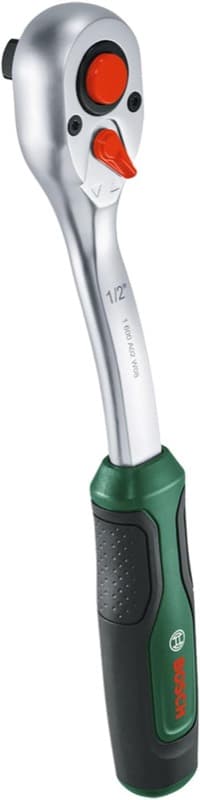
Push the socket onto the 12.5 mm square and prove the lever before the fastener takes any load. Seat it until it sits flush and the retainer clicks. ISO 1174-1 describes that retainer as a ball or a plunger. Press a quick-release button, where the listing has one, to retract the ball or plunger. The Neilsen listing does not state a button, so you pull the socket off the spring ball, while a Bosch lock button is a different control. Do not trust a printed L or R. The locked way, where the socket and handle move together in your hand, is the way the fastener will turn. For a normal right-hand thread, anticlockwise loosens and clockwise tightens.

Pull, reset, and do not chase the fastener with a pipe

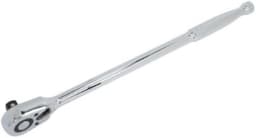
Pull through a steady arc in the locked direction, then swing back and let the head click as the pawl resets. A longer designed handle cuts the force on your hand, which is the practical point of Health and Safety Executive notes on effort. That does not allow a pipe. A 375 mm Neilsen, or a telescopic HOYETO if that is the listing you hold, is the length that design was built to. University of Essex guidance says not to put an improvised pipe on a spanner, because the tool or the fastener can fail at once, and the same shock hits a ratchet pawl. If a firm pull does nothing, stop and use a breaker bar, which has no pawl to skip.

Two reasons it clicks and nothing turns

A click with no movement is either the lever in the free direction, or the pawl slipping under a load it should hold. Check the lever first. Lift the socket off, repeat the hand test, and flip the lever if it locks clockwise when you meant to undo a right-hand thread. Until the thread resists, the pawl may not catch, so the bolt rocks with the handle. Hold the socket for the first turns. That back-drag is not always a broken gear. If the head still clicks on a hard pull in the locked direction, stop. KATSU reviews describe reverse failure, and KATSU and TOPWAY reviews describe fixings walking out of the head.

Stop when the head screws move or the fastener will not

Stop if the small screws in the head work loose, or if a steady pull on the made handle will not move the fastener. On KATSU and TOPWAY reviews, loose head screws mean you take that ratchet out of the job. Do not strip the head from this page. If the fastener will not break, use a breaker bar for the crack, then the ratchet once the thread turns. Neither tool sets torque, so a specified figure finishes on a torque wrench. Leave steering, suspension, and brake fasteners to someone equipped for them. Length and tooth count are on the buying guide.

Common questions

Which way do I turn a ratchet to loosen a bolt?
On a normal right-hand thread, anticlockwise loosens and clockwise tightens. Set the lever so the socket locks with the handle when you twist it anticlockwise, then pull. A left-hand thread reverses that pair.
How do I know the lever is set before I load it?
Test the socket in your hand before it goes on the fastener. The free way clicks, and the locked way, where socket and handle move together, is the way the fastener will turn. Printed L and R marks are not a shared code on these listings.
How does the quick release work if there is no button?
Press the button, where the listing has one, and the ball or plunger retracts so the socket slides off. The Neilsen listing does not state a button, so you pull the socket off the spring ball by hand. Bosch describes a lock button, which is a different control.
Why does the ratchet click while the bolt stays still?
If the handle sweeps and the bolt never moves under a light load, the lever is often the wrong way, so repeat the hand test and flip it. If the head still clicks on a hard pull in the locked direction, the pawl is slipping and you should stop.
Why does a loose bolt spin back and forth?
A free fastener sometimes will not ratchet until the thread resists, so the bolt rocks with the handle. That back-drag is not proof the gear has failed. Hold the socket for the first turns until the thread takes up.
Can I put a tube on the ratchet handle?
No. A tube over the grip is not a longer version of the tool. A 375 mm Neilsen, or a telescopic HOYETO if that is what you bought, is as long as that design goes. University of Essex guidance says not to sleeve a spanner with a pipe, because the tool or the fastener can fail at once.
When should I stop and change tool?
Stop when the head screws work loose, when the pawl skips under load, or when a firm pull on the made handle will not move the fastener. Use a breaker bar to crack a seized thread, then a torque wrench for a specified figure.

Related pages

Sources

Public UK sources from the research digest, used for this page on 22 October 2026. Shelf prices and star lines are the amazon.co.uk figures recorded in that digest.

  1. ISO 3315:2018, hand-operated square-drive socket wrenches (retrieved 22 October 2026)
  2. BS ISO 3315:2018 (retrieved 22 October 2026)
  3. ISO 1174-1:2011, driving squares for hand socket tools (retrieved 22 October 2026)
  4. HSE: PUWER overview (retrieved 22 October 2026)
  5. HSE: force in repetitive work (retrieved 22 October 2026)
  6. Consumer Rights Act 2015, section 9 (retrieved 22 October 2026)
  7. GOV.UK: General Product Safety Regulations 2005 (retrieved 22 October 2026)
  8. University of Essex: using hand tools safely (retrieved 22 October 2026)