Independent comparisons. We may earn from shop links. More info

How to clean a BBQ grill

Updated: 23 October 2026

The sausages are finished, the grate is dark, and you are about to attack it with whatever is in the cupboard. How to clean a BBQ grill is an order problem: brush while the grease is still soft, then any water or chemical only with the fuel isolated, then dry, then look for wires before food. Gas and charcoal do not share the same first step. Which tool to buy is on the [grill cleaner comparison](/hub/grill-accessories/grill-cleaner). This is not a timed lab clean. A purchase through our links may earn a commission at no extra cost to you.

The sausages are finished, the grate is dark, and you are about to attack it with whatever is in the cupboard.

Our top picks

On this page

The same-evening clean

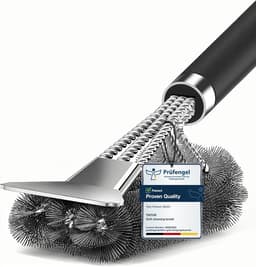
Clean on the evening you cook if you can. Warm fat lifts more easily than a black film. Heat the barbecue after cooking, then brush. Which? describes about 15 minutes of heat, then a wire brush or foil. BBC Good Food uses foil and does not recommend wire. Weber still sells a stainless brush and tells you to check it, discard loose bristles, and replace it at least every season. Wear a glove that covers the wrist. Grill Guard’s 45 cm handle keeps UK reviewers off a hot grate. It does not make the metal safe to grab. If you use wire, look at the head and the bars before you oil. Water or a cleaner starts only after the fuel is isolated.

Gas: fuel off before water

On a gas barbecue, copy Weber UK for the wet part. Disconnect the gas before you clean with liquids. Brush the grate. If you use Weber’s own grate cleaner, the brand’s note is about 30 seconds of contact, then a rinse that keeps water off the burner tubes. Dry the barbecue fully before you reconnect and light it. Water in a burner tube is how the next ignition misbehaves. A dry brush can happen while the grate is still hot and the burners are off, which is what several Grill Guard reviews describe. Do not tip a bucket through the bars into the burners. Pietuley’s steam method in this file is burners off, grate hot, including a figure above 204°C. That is still a fuel-off routine.

Charcoal: cold ash, then the grate

Let a charcoal barbecue cool before you move ash. Weber’s charcoal note is cooler, then brush. Empty the ash once it is cold, and keep the vents clear. A neglected grate can be lifted off and soaked when the maker allows it. BBC Good Food includes a soak for a deep clean. Use hot water and washing-up liquid on the grate itself, not a flood of the bowl while ash is still in it. Rinse, then dry. Oil the bars only if the manufacturer does not tell you to leave that coating dry. A wire brush after the soak still needs a bristle check.

Electric, steam, and spray

A cordless head is not a licence to lean. Winwj, SOARUN, both Sakers, and a Qimedo note repeat the same mistake: press as you would with a hand brush and the motor stops or the carbon stays. Use light passes. If the head stalls, use a scraper. Steam pads want the burners off and the grate hot, then water. Dr Magic, about £4.99 for two cans, is a flammable oven-and-grill aerosol. UK reviews mention a strong smell, and the gloves on the label are not in the box. The Health and Safety Executive says not to spray oven cleaner on hot surfaces. Read the can, ventilate, and rinse as the label says before food.

Common questions

When must the gas be disconnected?
Disconnect the cylinder before water, before a liquid grate cleaner, and before any spray. Weber UK states that disconnect for gas cleaning. A dry brush with the burners off and the gas still connected is the same-evening tidy. The moment liquid is involved, the hose comes off. Reconnect only once the burner area is dry.
What do I do with water near the burners?
Keep it out of the burner tubes. Brush and wipe the grate, and if you rinse, control the water so it does not run into the burners or pool in the firebox. Weber’s warning is there because a wet tube lights badly the next time. On charcoal, water belongs on a removed grate, not in a bowl of hot ash.
Where does a scraper fit?
Use the scraper on raised carbon and on the edge of a flat plate before you worry about a spinning head. TNTOR and Grill Guard build a scraper into the wire brush, and reviews say it takes the tougher spots. A scraper does not pull debris out from between round bars as well as a bristle or a careful foil crumple. It also does not remove the need to check for wires if the other side of the tool is a wire head.
Can I use the oven-and-grill aerosol like an oven clean?
Only if the can allows that exact use, the surface is cool, the area is ventilated, and you wear the gloves the label demands. HSE guidance is not to spray oven cleaner on hot surfaces. Dr Magic’s listing is a flammable aerosol aimed at ovens and grills, and this file does not show a garden-barbecue routine that overrides that warning. Do not spray it onto a lit grill.
What is the last step before I put food on?
The grate should be dry, free of cleaner, and checked for loose wires or flakes of old foil. Oil only if the manufacturer allows it on that coating. A clean grate is not the same as cooked food. The Food Standards Agency treats barbecue hygiene and cooking as separate: follow the barbecue maker, and use a proper cook. Poultry is cooked through at 75°C in the thickest part, which you check with a thermometer, not by how shiny the bars look.

Related pages

Sources

Public UK sources used for this comparison. Listing prices, stars, and review counts are from amazon.co.uk on 19 October 2026. The PubMed paper is a clinical review, not a UK rate.

  1. FSA — BBQ food safety (retrieved 19.10.2026)
  2. GOV.UK — It looks done: common BBQ blunders (retrieved 19.10.2026)
  3. Weber UK — grill brush (retrieved 19.10.2026)
  4. Weber UK — gas barbecue maintenance (retrieved 19.10.2026)
  5. HSE — CAIS22, cleaning in catering (retrieved 19.10.2026)
  6. HSE — cleaning products and the corrosive pictogram (retrieved 19.10.2026)
  7. BBC Good Food — how to clean a BBQ (retrieved 19.10.2026)
  8. PubMed — wire-bristle ingestion review (retrieved 19.10.2026)