Independent comparisons. We may earn from shop links. More info

Glass watering globe vs terracotta spike

Updated: October 2026

A glass watering globe vs terracotta spike is mainly a choice of release. A bare glass stem lets water out when air enters, so angle and seating can change the flow quickly. A porous terracotta or ceramic spike passes water through its wall as the compost dries, which is easier to regulate for a moist-loving houseplant. Neither mechanism makes an unstated reservoir last a known number of days. Products and captured details are in the [watering globe comparison](/hub/garden-watering/watering-globe). Prices are amazon.co.uk shelf prices from 15 October 2026. If you buy through our links, we may earn a commission at no extra cost to you.

A glass watering globe vs terracotta spike is mainly a choice of release. A bare glass stem lets water out when air enters, so angle and seating can change the flow quickly.

Our top picks

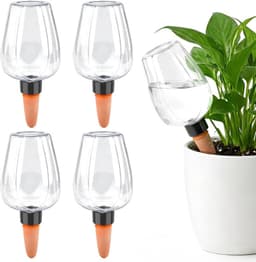
Ruichi Ruichi 4 × 500 ml

Best overall

Ruichi Ruichi 4 × 500 ml
8.4/10about £12.99
Pipihome Pipihome 4 × 350 ml

Alternative

Pipihome Pipihome 4 × 350 ml
8.4/10about £13.99
On this page

A glass stem lets air in

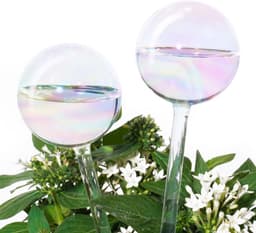
A traditional glass globe is a sealed bulb with one narrow outlet. When water leaves, an air bubble enters and more water can move. A steep angle can empty the globe in hours. Packed compost can stop it almost completely. Tomorotec is £10.99 for two, with 4.1 stars from 2,434 reviews. Riyuu is £15.99 for six, with 4.3 from 496. Those counts speak to awkward filling and narrow necks. Neither listing states millilitres. Glass suits a shaded indoor pot when you will test the angle. Make a pilot hole and never force the stem. It is a weaker choice if the pot can be knocked, or if you need a known quantity for travel. Seating steps are in how to use a watering globe.

A porous spike follows the compost

Unglazed terracotta and ceramic have tiny pores. Water moves into drier compost, and release tends to slow as that compost gets wetter. It still needs an intact cone and enough volume in the reservoir. Zirax, Ruichi and Yirong home each state 500 ml in four-packs from £12.99 to £14.99. Pipihome’s top-fill four-pack states 350 ml and uses a ceramic cone. A cracked spike can dump the reservoir. One Pipihome review says two cones had to be drilled. Terracotta does not mean two weeks. A 500 ml globe may cover roughly five to ten days for a 15 cm tropical houseplant, as a rule of thumb. For a moist-loving plant, the conditional preference is a stated volume on a porous spike. Trade-offs sit in the watering globe buying guide.
Ruichi Ruichi 4 × 500 ml

Testsieger

Ruichi Ruichi 4 × 500 ml
8.4/10about £12.99

Clear water in sun is the failure mode

Curved clear glass and water can focus sunlight onto a small hot spot. Cheshire Fire and Rescue Service warns that glass can concentrate sunlight. A clear watering bulb deserves the same caution even when a listing never mentions fire. Tomorotec says avoid prolonged direct sunlight, keep the globe filled, and place it away from dry leaves. UK reviews report a balcony fire and warn against a sunny hanging basket. Two Pipihome six-pack listings name polypropylene and terracotta, while their shared UK reviews describe a glass top and report a balcony fire, scorched wicker and an olive tree burning. Keep every clear water-filled sphere out of direct sun. Plastic reduces the chance of a thin stem snapping. That is a breakage point, not a sunlight clearance.

When to pick which

Choose a glass stem for a shaded, stable indoor pot when you accept an unstated volume and you can watch a full trial. Seat it close to vertical. Do not choose it for a sunny sill or a pot that gets knocked. Choose a terracotta or ceramic spike for a moist-loving plant when you want compost moisture to moderate the release. Prefer stated millilitres, check the cone, and test the drop before you leave. A top-fill design is easier to refill. It does not extend the reservoir. Choose neither for succulents. If 500 ml does not cover the absence you measured, capillary matting, a wick or another person may fit better. That switch is on the watering globes for holiday page.

Common questions

Does terracotta water better than glass?
Terracotta is generally easier to regulate for moist-loving compost, because water passes through a porous wall rather than an angle-sensitive open stem. It is not better in every pot. A damaged cone can leak, and a small reservoir still runs out. Match the mechanism and the stated volume to the plant.
Why does a glass globe empty when I tilt it?
Tilting can let air into the neck more readily. Each bubble that enters lets water leave, so a larger air path speeds the drain. Dry compost can increase the first draw as well. Start with damp compost and seat the stem near vertical.
Is ceramic the same idea as terracotta?
On these products, an unglazed porous ceramic cone works on the same broad principle as a terracotta spike. Moisture passes through the material into the surrounding compost. Pore structure and build quality can differ, so you still inspect and test each cone.
Can a clear plastic globe scorch a plant?
Do not assume plastic is safe in direct sun. The shape, the clear water and any glass-like part matter, and some listing materials conflict with UK review descriptions. Keep transparent water-filled spheres in the shade rather than trying to prove which part focused the light.
Should I put a glass globe on a south-facing sill?
No. Curved glass and water-filled glass can focus sunlight, which is why UK fire-service guidance keeps that sort of object off a sunny window. Move the plant or use a shaded spot. If anything is burning, call 999.
Are either type suitable for succulents?
Usually not. Both designs keep moisture in the compost, and most succulents need that compost to dry between waterings. A globe can leave the root zone too wet whether the water leaves through a glass stem or a porous cone.

Related pages

Sources

Sources checked for this comparison; research date 15 October 2026.

  1. RHS, holiday care for houseplants (retrieved 15 October 2026)
  2. RHS, how to water containers (retrieved 15 October 2026)
  3. Thompsons Plants, watering globes (retrieved 15 October 2026)
  4. Coopers of Stortford, glass globe instructions (retrieved 15 October 2026)
  5. Wilt & Water, watering globes and spikes (retrieved 15 October 2026)
  6. Cheshire Fire and Rescue Service, glass and sunlight (retrieved 15 October 2026)
  7. Ofwat, hosepipe bans (retrieved 15 October 2026)
  8. Which?, faulty product rights (retrieved 15 October 2026)