Independent comparisons. We may earn from shop links. More info

How to install a water butt

Updated: October 2026

The kit is in the porch, the hacksaw is on the bench, and the downpipe looks like a quick cut. That cut is the mistake if you have not levelled the stand or measured the pipe. This is how to install a water butt you have already bought, on a plastic downpipe, with the diverter that came in the box. What to buy is on the [water butt buying guide](/hub/garden-watering/water-butt/sub/water-butt-buying-guide). The rows are on the [water butts](/hub/garden-watering/water-butt) comparison. The Products Compared editorial team used the amazon.co.uk listings and the public fitting notes from the RHS, Screwfix, Waterwise and a Severn Trent manual. A qualifying purchase can earn a commission at no extra cost to you.

The kit is in the porch, the hacksaw is on the bench, and the downpipe looks like a quick cut. That cut is the mistake if you have not levelled the stand or measured the pipe.

Our top picks

Pluto Packaging Pluto 100 litre kit

Best overall

Pluto Packaging Pluto 100 litre kit
9.0/10about £33.69
BeGrit BeGrit collapsible butt

Alternative

BeGrit BeGrit collapsible butt
8.8/10about £59.99
Whitefurze Whitefurze 250 litre kit

Alternative

Whitefurze Whitefurze 250 litre kit
8.4/10about £79.99
On this page

Put the butt on a firm level stand

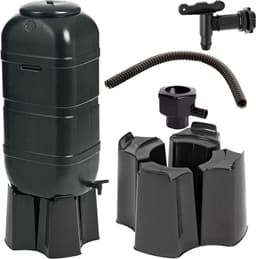
Put the stand on firm, level paving close enough for the hose in the kit. A full tank will lean if one foot sits on a soft edge. Where this set states a stand height, it is about 30.5 cm. Stand your own can under the tap before you cut anything. If the can does not fit, the stand is the wrong way up, or the butt needs a plinth. The RHS wants a firm level stand, a filter, and a close-fitting lid.

Measure round or square before you cut

There is no single UK downpipe size. Measure 68 mm round against about 65 mm square first. A diverter made for one sits badly on the other. Measure the outside of your pipe, then match it to the diverter in the box. Do not cut cast iron, asbestos-cement, or a listed downpipe. The Severn Trent manual says the job is not suitable for cast-iron downpipes. If the pipe is tight to the wall, or you are not sure what it is made of, stop. The cut length is not one national figure. Published examples run from 10 mm to 70 mm depending on the diverter, so follow the instructions in your box.

Fit the diverter so the full butt sends water back down the pipe

A working diverter sends water into the tank while there is room, and sends the excess back down the pipe once the tank is full. Screwfix describes that path. Fit the hose without a kink. The Whitefurze listing says internally threaded bosses so no drilling is required. Several buyers found the tap hole and the fill hole still sealed. Look before you assume the boss is open. If you drill, empty the butt first. The Severn Trent manual says not to use an electric drill while the butt contains water. One kit's instructions state a 27 mm hole, and reviewers used 25 mm or 26 mm bits. If water pours from the new joint while the tank is still half empty, the diverter is not seated.

Stop and call a professional for these jobs

Call a professional for a toilet, a washing machine, or a mains top-up. The Water Supply (Water Fittings) Regulations 1999, and the Scottish byelaws, stop a cross-connection to the mains. A top-up needs an air gap and notification, not a hose draped into the lid. Also call someone if the deck cannot take the full weight, or if the pipe is cast iron or on a listed building. The RHS says real hose pressure needs a pump, and fitting one is not part of the diverter instructions. A temporary use ban is a different decision, on the hosepipe ban and water butt page. Whether a folding tank or a slimline kit belongs in the gap is on the slimline water butt versus collapsible page.

Common questions

Do I have to cut the downpipe?
You cut a plastic downpipe when the diverter in your box is made to splice into it, and only after the stand is level and the can fits. Some listings say the tank sits under the pipe with no cut. Follow that listing if it is the one you bought. Cast iron, asbestos-cement, and a listed pipe are not a DIY cut. The length you remove comes from the diverter instructions, not from one figure on this page.
Will a diverter fit a square downpipe?
Only if it is made for about 65 mm square pipe. A 68 mm round fitting is the other common plastic size, and they are not interchangeable. Buyers in this set reported filler kits that missed square pipes, and one hose that was fitted and still did not fill the tank. Measure the pipe. If the kit only mentions a round cover, do not force it onto a square shoe.
What if the pipe is cast iron?
Do not cut it to fit a plastic diverter. The Severn Trent manual says that kind of kit is not suitable for cast-iron downpipes. Asbestos-cement and a listed downpipe belong in the same stop. A plumber can tell you whether another outlet is possible. Forcing a clip onto a cracked iron shoe is how the joint fails in the first storm.
The listing says no drilling, but the hole is sealed. What then?
On the Whitefurze kit the listing says internally threaded bosses so no drilling is required. Several buyers found the tap hole and the fill hole still sealed. Check the boss before you blame the tap. If you drill, empty the butt first. The Severn Trent manual says not to use an electric drill while the butt contains water. Other kits expect a stated hole, often around 27 mm. Match the bit to the spigot.
What should I do before a hard frost?
Drain the butt, disconnect the diverter, and leave the tap open. Water expands by around 9 percent as it freezes, and a full tank can split. Do this before the hard frost. If the instructions say to store the diverter inside, do that, and keep the downpipe discharging safely while it is off. A lid on an empty, dry tank is fine. A lid on a half-full tank is the opposite of the drain.

Related pages

Sources

Sources checked for this comparison. Shelf prices and star lines are from the amazon.co.uk listings on 15 October 2026.

  1. RHS, collecting, storing and using rainwater (retrieved 15 October 2026)
  2. RoSPA, garden safety (retrieved 15 October 2026)
  3. Ofwat, hosepipe bans and non-essential use bans (retrieved 15 October 2026)
  4. Thames Water, temporary hosepipe ban (retrieved 15 October 2026)
  5. Water Industry Act 1991, section 76 (retrieved 15 October 2026)
  6. Waterwise, rainwater butts (retrieved 15 October 2026)
  7. BSI, BS EN 16941-1:2024 on-site non-potable water systems (retrieved 15 October 2026)
  8. Screwfix, how a water butt diverter works (retrieved 15 October 2026)