Independent comparisons. We may earn from shop links. More info

Garden pump vs submersible

Updated: 22 October 2026

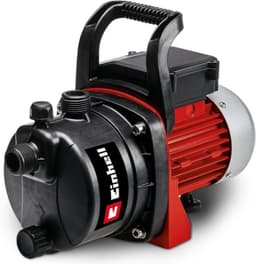
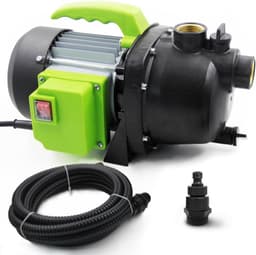
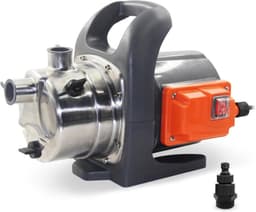
You have a water butt, an IBC or a tank, and the search results use almost the same words for an aquarium pump, a cordless barrel pump and a mains garden pump. A garden pump vs submersible choice is about where the motor sits. A surface garden pump stands beside the water and sucks. A submersible goes into the water and pushes. The three pumps on our [garden pump comparison](/hub/garden-watering/garden-pump) are all surface pumps. This page says when that is the right machine, and when you should leave the category. Listings were read on 21 October 2026 against the Einhell manual and notes from FreeFlush and GRAF UK. We did not submerge any of the three, and we did not rank submersible brands.

You have a water butt, an IBC or a tank, and the search results use almost the same words for an aquarium pump, a cordless barrel pump and a mains garden pump.

Our top picks

On this page

Two different machines

A surface pump is the box with a filler, a drain screw and an inlet for a hose. It has to be primed, and it lifts only as far as its suction figure. The Einhell GC-GP 6538, the VEATON FGP800+Hose and the VEATON FGP1200INOX each state 8 metres. The Einhell manual calls that model a surface pump and rates it IPX4. IPX4 is splash resistance. It is not a submersion rating, and this page does not quote a higher ingress figure for any of them. Putting the Einhell or either VEATON into the butt is outside the way they are specified. A submersible is lowered into the tank, with the motor in the water and a hose leaving from the top. There is no suction hose to collapse and no casing to fill from a jug. FreeFlush, on rainwater pumps, calls the submersible the quieter, hidden option, and the above-ground pump the one that is easier to service and the better choice if the tank can freeze. GRAF UK makes a similar split for its tanks: a submersible for a deep or distant underground store, and a surface pump for a ground-level tank and for frost. Those are seller guides. They shape the decision, and they are not a test of these three ASINs.

Choose the surface pump when

Choose the surface pump when the water is clean, the surface is close, and the vertical lift sits comfortably inside 8 metres. A butt or IBC at ground level, with the pump on the paving beside it, is the case these listings are built for. You can see the motor, drain it, and take it indoors before a frost. FreeFlush flags a submersible left in an above-ground tank that freezes. A surface pump you can empty avoids that, if you do empty it. The Einhell has a drain screw and a clear-water limit. You also choose it when you want to remake a hose and a foot valve without climbing into a tank. The trade-off is the suction side: a reinforced hose, airtight joints, and a prime. Waterpump.co.uk puts a practical ceiling around 8 to 9 metres, so the printed 8 metres is an edge, not a comfortable duty. If that is your garden, stay with the comparison, then read garden pump for a water butt for lids, hose length and hosepipe notices. The fill sequence is how to prime a garden pump.

Choose a submersible when

Choose a submersible when the water is deeper than the suction cap, or when the pump must live in a tank you can reach and install safely. GRAF UK points that kind of underground tank to a submersible, because a surface hose cannot invent lift past its limit. There is no 4 metre kit to argue with, because the pump is already in the water. FreeFlush's comment on noise is a description of a hidden pump, not a measurement. We do not claim every submersible is quieter, or safer. Electrics in water are why FreeFlush suggests a professional for that install. Keep it as a caution. A sprinkler does not automatically prefer the submersible. Flow still depends on the pump, the hose and the head. A small barrel pump can fill a can and still fail a rose that wants pressure. GRAF UK also says a transfer pump must not run against a closed nozzle. If your only reason is a narrow lid that will not pass a suction hose, pick a submersible specified for a water butt, with a lead and a float that suit the depth. Do not drop one of these three surface pumps in as a shortcut. Once you need that in-tank machine, you have left this category. We do not score submersible brands here.

What to skip entirely

Some results are neither a garden surface pump nor a water-butt submersible. An aquarium pump is sized for a display tank, not for a lift into a hose. A cordless transfer pump is a battery tool with a short duty, not the mains pumps on our table. Dirty water and a sump full of solids need a dirty-water pump. A borehole is not a surface garden pump. Flood and Water Pumps, in a UK irrigation note, starts from the source: a butt can be either type, and a borehole is not this machine. A booster on the household plumbing, to lift a weak tap, is another category. These garden pumps suck from a store. They are not a device to tee into the rising main. Listings were set aside from this comparison because they were submersibles, sprayers or boosters. If the cable is damaged, or the job is a permanent join to the supply, use a qualified installer and an RCD on the outdoor supply. The recommendation is conditional. For a nearby butt or IBC of clean water, and a suction hose you can seal, use a surface pump from the main comparison and keep it out of the tank. For water deeper than the stated suction, or a pump that must live in a tank you can install safely, leave this category for a submersible specified for that tank. Frost in an above-ground butt pushes you back toward the surface pump you can drain, provided the lift is short.

Common questions

Which is better for a water butt?
For a ground-level butt of clean water and a short lift, the surface pump is the better fit, because you can drain it before a frost. A submersible fits when the water is deeper than the 8 metre cap, or the lid blocks a suction hose, and only if that pump is specified for the tank.
Can I submerge the Einhell or the VEATON?
No. All three stand beside the water. The Einhell manual rates the GC-GP 6538 at IPX4, which covers splashing, and the pump has a filler hole. The VEATON listings are clean-water surface pumps with the same 8 metre suction idea. Lowering any of them into the butt floods a motor that was not sold for that. If the pump has to be in the water, buy a submersible that says so.
What if the tank is underground and deep?
Use a submersible specified for that depth, or a borehole pump if the source is a borehole. A surface garden pump is the wrong tool past its suction limit. These three state 8 metres, and a practical note sits around 8 to 9 metres. GRAF UK points deep underground tanks to a submersible. If the drop from the water surface to a surface pump is greater than the claim, leave this comparison.
What about frost?
An above-ground butt can freeze, and a submersible left in it is the case FreeFlush would rather you avoided. A surface pump can be drained and stored. The Einhell has a drain screw for water in the body. That advantage goes if you forget, because ice in the casing splits the pump. Underground tanks are the other problem: depth pushes you toward a submersible, and frost is less of the reason.
Is a cordless pump either of these?
A cordless pump is a battery transfer tool. It is not the mains surface pumps here, and it is not automatically a submersible for a butt. Read whether the body goes in the water, what the run time is, and whether it can hold sprinkler pressure. For a 230 V pump beside a shallow clean store, use the three mains listings. For a motor in a deep tank, look at a submersible rated for that tank.

Related pages

Sources

Public UK sources from the research digest, plus the amazon.co.uk prices, stars and review counts captured for these three listings on 21 October 2026. Last reviewed 22 October 2026.

  1. Water Supply (Water Fittings) Regulations 1999, Schedule 2 paragraph 15 (retrieved 21 October 2026)
  2. Water Regs UK, alternative water systems (February 2024) (retrieved 21 October 2026)
  3. Electrical Safety First, garden electrics (retrieved 21 October 2026)
  4. Electrical Safety First, plugs and fuses (retrieved 21 October 2026)
  5. Einhell UK, GC-GP 6538 (retrieved 21 October 2026)
  6. Einhell GC-GP 6538 manual (Manuals+) (retrieved 21 October 2026)
  7. Gardena UK, weak pump flow and the bubble test (retrieved 21 October 2026)
  8. Thames Water, hosepipe ban FAQs (retrieved 21 October 2026)