Double check valve outside tap: what to check
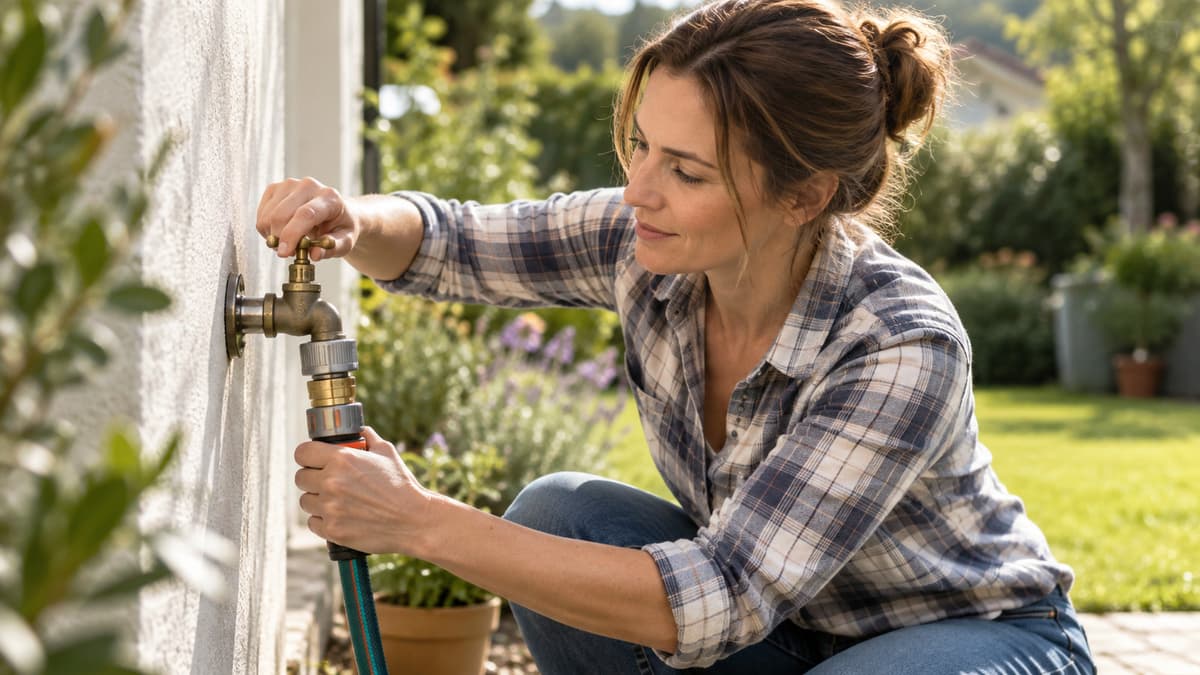
Check whether your outside tap has backflow protection, where a double check valve can sit, how frost affects it and when you need a UK plumber.
On this page

You connect the hose, turn on the outside tap and expect water to travel in one direction. The less obvious risk is backflow: contaminated water moving from the hose towards the drinking-water supply. A double check valve outside tap arrangement is intended to prevent that reversal, but the protective part may be indoors, built into the tap or attached to its outlet. You cannot confirm which arrangement you have merely because the tap works normally.
These notes follow WRAS Information and Guidance Note IRN R060. The spray-gun figures come from an amazon.co.uk listing. We have not lab-tested it. A qualifying purchase through our links can earn a commission at no extra cost to you.
In short
An ordinary hose union tap used in a house garden needs suitable backflow protection. For an existing unprotected tap, WRAS IRN R060 gives three routes: fit a double check valve inside, replace the tap with one incorporating a double check valve, or keep a suitable hose-union backflow preventer on the outlet. If you cannot identify the protection, ask a competent plumber before altering pipework or building a permanent irrigation system.
Why an outside tap needs backflow protection
Backflow can happen through back pressure or back-siphonage. In a garden, the practical concern is that the end of a hose may be lying in a puddle, submerged in a water butt, pushed into soil or connected to equipment containing something you would not want in your drinking water. A pressure change can then create a route back towards the supply. Turning off the spray gun at its trigger does not isolate that route.
Normal house-garden use is commonly treated as fluid category 3, meaning water whose quality has deteriorated enough to present a slight health hazard. A double check valve is the usual protection associated with that category. Fertiliser dosing, pesticide equipment, livestock troughs and some irrigation designs may move the installation beyond ordinary hose use and require a different assessment.
The valve contains two check mechanisms in series. A single check valve is not automatically an equivalent substitute. You also cannot judge compliance from a bulky fitting at the spout, because a correctly positioned valve may sit indoors on the branch that feeds the tap.
Three options for an existing outside tap
WRAS IRN R060 addresses an existing house installation where an outside hose union tap has no backflow protection. It sets out three practical options. Keeping those options distinct avoids assuming that the only remedy is a screw-on fitting.
An internal double check valve
A plumber fits the valve in the pipe supplying the outside tap, inside the thermal envelope. That helps with frost and keeps the outlet clear. Access still matters: a hidden fitting is harder to identify, inspect or replace.
A tap that incorporates the valve
Replacing the tap with a model that incorporates a double check valve can suit an existing installation, if the replacement matches the use and is fitted correctly. The check-valve parts then sit outside, where frost can damage water-filled components.
A hose-union backflow preventer
A suitable hose-union backflow preventer on the outlet avoids opening the pipework. It only protects while it stays fitted, not while it sits in a shed. It projects from the tap, may clash with some connectors and stays exposed to weather.
These routes are for an existing unprotected tap. They are not a reason to stack unverified adaptors until something fits. If the tap, outlet device or upstream pipe is unmarked, ask a plumber to identify what is installed.
Why the indoor position matters
For new work, water-industry guidance favours placing the double check valve inside the building, upstream of the outside tap and within the thermal envelope. Anglian Water's fixture guidance also shows a service valve upstream. The service valve allows the outside branch to be isolated. The double check valve protects against reverse flow.
Warmth alone does not make an indoor valve correct. It must protect the relevant branch, face the right way and stay accessible. A valve upstream of other outlets can protect the wrong section. If you are having a new tap fitted, ask where the backflow protection and service valve will sit before the wall is closed, and keep the product details.
A spray gun does not replace the valve
A hose spray gun changes how water leaves the hose. Its trigger, shut-off and pattern selector may make watering easier, but none of those features proves that the water supply has backflow protection. The garden guns considered for our spray hose comparison did not show a WRAS approval number in their listings for use as a backflow prevention device.
The top pick in that set is the Onarway metal spray gun, ASIN B0GCZR17M2, listed at about £15.74, with 4.7 from 262 amazon.co.uk reviews. The listing describes a 460 g zinc-alloy body, ten patterns and a trigger lock. None of that is a double check valve. A closed trigger with the tap still open leaves the hose pressurised. Choose the gun for grip and patterns, and keep backflow protection as a separate decision at the tap or supply pipe.
What you can check without altering pipework
Photograph the tap, its markings and every fitting between the outlet and the hose. Keep any model number and installation paperwork. An arrow, the letters DCV or a product number can help a plumber, but a marking is not proof that the part is in the right place or still serviceable.
Indoors, look only at the accessible route to the tap. You may find a labelled service valve and a separate check-valve body in a cupboard, utility room or under a sink. Do not remove panels or loosen joints. If the pipe disappears into a wall, note that gap rather than assuming no valve exists.
Then note how the hose is used: whether the end can sit in a puddle, butt or soil, whether a spray can reach a basin, and whether a fertiliser or chemical applicator is attached. Southern Water highlights that an outlet able to reach a basin is a different risk from routine outdoor watering.
If an outlet-mounted device must come off whenever you fit your preferred adaptor, it is not protecting the supply during that use. The useful outcome is a short note for a plumber: what is visible, what is unknown and what you intend to connect.
Frost, fixed irrigation and higher-risk uses
Southern Water advises protecting double check valves from frost, especially where the valve is built into an outside tap or screwed onto the outlet. Frozen water can damage a cartridge without splitting the outside of the fitting. Drain removable hoses and spray guns before freezing weather, as set out in store a garden hose over winter. An intact outer body does not prove the checks still work.
A tap cover can reduce exposure. It does not turn an outdoor valve into an indoor one. If a fitting has frozen, then leaks or behaves differently, isolate the branch if you can do so safely and have it checked. Permanent irrigation is a separate question: the RHS notes that mains-fed automatic systems may need a break tank with an air gap, which is not an accessory for a handheld spray gun.
When to call a plumber
Call a competent plumber when you cannot identify any backflow protection, when pipework must change, or when a replacement tap has to be chosen and fitted. Do the same if the hose will feed fixed irrigation, sit in soil or water, reach a sanitary fitting, or carry fertiliser or treatment products. Your water company can explain how the Water Supply (Water Fittings) Regulations are applied locally.
Take photographs, model numbers and a description of the intended use. Ask for the fluid category, the form of protection, where the valve will sit and how frost will be kept off it. For new work, ask for an accessible service valve upstream as well. A screw-on device can be one valid route for an existing tap only when it is suitable and stays fitted. If you are only identifying the connector, start with outside tap thread size.
Common questions
Does every outside tap already have a double check valve?
Can a double check valve stay outside on the tap?
What does fluid category 3 mean for a garden tap?
Does a hose spray gun include backflow protection?
Can frost damage a double check valve?
Who should fit a double check valve for an outside tap?

Peter F. is the editor for DIY & tools at productscompared.co.uk. Comparisons in this category are checked against amazon.co.uk listings, review evidence and public UK sources.
Related articles

Store garden hose over winter UK: drain it properly
Learn how to drain and store a garden hose over winter in the UK, including spray guns and frost-proof taps.

Outside tap thread size UK: identify BSP correctly
Measure your UK outside tap thread and tell 3/4 inch BSP from 1/2 inch BSP and GHT before you buy a connector.
Hosepipe ban: what can I water legally?
What you can still water in an English hosepipe ban, when cans are allowed, and why a spray gun is not a loophole.