Independent comparisons. We may earn from shop links. More info

How to use anvil secateurs

Updated: 22 October 2026

You already own an anvil pair, and the last cut either crushed a green shoot, stuck halfway, or left you fighting the lock. This is how to use anvil secateurs on dead or dry wood: seat the stem on the block, stop at the printed millimetre figure, and sharpen the blade rather than the block. Scores for the eight listings are on the [anvil secateurs comparison](/hub/garden-tree-and-hedge-shears/anvil-secateurs). Peter F. wrote this as a method, not a ranking, from the listings on 19 October 2026. There was no cutting test. A qualifying purchase through our links can earn a commission at no extra cost to you.

You already own an anvil pair, and the last cut either crushed a green shoot, stuck halfway, or left you fighting the lock.

Our top picks

On this page

Seat the stem on the anvil

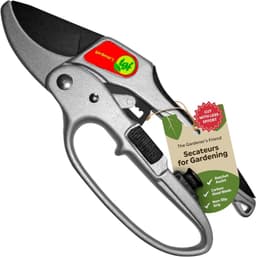
Put dead, dry or woody growth fully on the block before you squeeze, so the blade meets the stem on the flat face. Bramble and scrub are the same job. If the wood is still green, or you are deadheading a rose you care about, stop and read anvil versus bypass secateurs. A ratchet changes how many times you squeeze. It does not turn the block into a scissor cut. Keep a bud off the anvil. The RHS suggests about 0.5 cm above a healthy bud on a small branch, without a long stub. That is a pruning guide, not permission to exceed the printed cut. In this set, 2.5 cm is The Gardener's Friend only. The 6758GS and the Kew anvil state 15 mm. The 6358RS, VOTREK and Zrebcley state 20 mm. Use the figure on the tool in your hand.

If it is a ratchet, cut in stages

On a ratchet, keep the stem seated while the mechanism holds. The 6358RS listing says: squeeze until you hear the click, release the handles, and squeeze again, up to four short steps, on dead wood inside a stated 20 mm. If you open so far that the pawl loses the stem, you start again. DECERK's R mode is the same hold-and-squeeze idea. S mode is one close. Thin stems can stick. If the ratchet pin has sheared, stop. LINZI is titled as a ratchet, and a UK review says the mechanism is not there, so do not follow a four-click sequence on a tool that does not click. If the lock is what your hand cannot work, see secateurs for weak hands.

Lock it only when you mean to

Close the lock when you put the secateurs down, so the blade cannot spring open. Open it fully before you cut. A half-caught lock is how a squeeze feels weak. Reviews of The Gardener's Friend and the Kew set include locks that jam shut. Do not force a jammed catch with pliers. You can bend it or crack the handle. If gloves hide the loop, try the catch once with a bare finger. The English Garden notes that a one-sided lock is still the left-hand problem, even when the blade is centred. If you cannot open it, stop. Do not carry the pair unlocked in a pocket.

Clean, then sharpen the blade only

Lift dried sap with a nylon scourer or wire wool and a water-displacing spray, as the RHS describes, then wipe the spray off, oil the pivot, and store the tool dry. Wear gloves. Clean between plants after diseased wood. Skip wound paint. Sharpen the cutting blade, on both bevels if that is how it was ground, and leave the flat block alone. About 20–30 degrees is typical. Match the factory angle if you can still see it. Do not copy a bypass routine of one angled face and one flat face onto an anvil blade ground on both sides. If the blade no longer meets the block, replace the secateurs. Grinding the block makes the bed worse. Fetch a saw past the printed cut. Call a professional for a branch in the crown, over a road, a protected tree, or a nest in use. If you are still choosing, use the anvil secateurs buying guide.

Common questions

Should I sharpen the flat anvil block?
Leave the block as it was ground. Sharpen the cutting blade on both bevels if the edge has two, at the existing angle, then test on paper. If the blade no longer meets the block, replace the tool. Grinding the anvil to close that gap spoils the bed the stem sits on.
How do I clean sap off the blade?
Use a nylon scourer or wire wool with a water-displacing spray, then wipe the spray off and oil the pivot. Wear gloves. Store the pair dry, and clean between plants after diseased wood. Wound paint is not part of that routine. A clean anvil blade still belongs on dead wood.
What do I do if the lock will not open, including with gloves?
Stop forcing it. Gloves can miss the 6358RS finger loop, and reviews of The Gardener's Friend and the Kew set include locks that jam. Try the catch once with a bare hand. If it still will not move, you cannot start the cut. Forcing it risks the handle, which one VOTREK review already describes on first use.
How close to a bud can an anvil cut go?
On a small stem inside the printed cut, RHS guidance is about 0.5 cm above a healthy bud, without a torn stub. Keep the bud itself off the anvil. This close cut is for dead or dry material you are removing, not for shaping a valued green shoot. If the stub is long and ragged, you were too far above the bud or the blade was blunt.
When do I stop and use a saw?
Stop when the stem is thicker than the width printed on your secateurs. Most tools here stop at 15–20 mm. Only The Gardener's Friend states 2.5 cm. Use a lopper in between, then a sharp saw, and do not paint the wound. Call a professional for a branch in the crown, over a road, on a tree that may be protected, or beside a nest in use.

Related pages

Sources

Public UK sources used for this comparison. Listing prices, stars, and review counts are from amazon.co.uk on 19 October 2026.

  1. Arboricultural Association — pruning guidance (retrieved 19.10.2026)
  2. Burgon & Ball — anvil, bypass or scissor (retrieved 19.10.2026)
  3. Dan Cooper Garden — anvil or bypass (retrieved 19.10.2026)
  4. BBC Gardeners' World — secateurs (retrieved 19.10.2026)
  5. Spear & Jackson — 6758GS geared anvil (retrieved 19.10.2026)
  6. RHS — cleaning garden tools (retrieved 19.10.2026)
  7. GOV.UK — wild birds, nests in use (retrieved 19.10.2026)
  8. Arthritis UK — gardening (retrieved 19.10.2026)