Independent comparisons. We may earn from shop links. More info

How to use a garden rake

Updated: 21.10.2026

You have the rake in the shed, the lawn is a mat of dry leaves, and the last time you reached too far your back complained before the pile moved. How to use a garden rake is mostly stance and where you put the head down afterwards, not a brand shortlist. Pull debris towards you, turn your feet instead of twisting, and leave the teeth down when you stop. If the tool itself has failed, the [Rake](/hub/garden-tools/rake) comparison is the replacement table. Peter F., DIY & tools editor, drew on Worcestershire and Basingstoke guidance, not a lab test. A qualifying amazon.co.uk purchase can earn a commission at no extra cost to you.

You have the rake in the shed, the lawn is a mat of dry leaves, and the last time you reached too far your back complained before the pile moved.

Our top picks

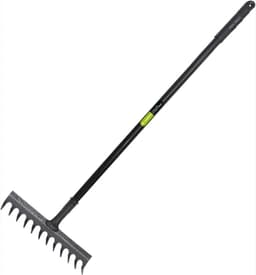
OLLIDOT OLLIDOT 17-tine bow rake

Best overall

OLLIDOT OLLIDOT 17-tine bow rake
9.1/10about £19.99
KKTECH KKTECH 12-tine garden rake

Best value

KKTECH KKTECH 12-tine garden rake
8.8/10about £12.99
On this page

Check the rake first

Before the first stroke, look at the handle, the tines and the joint. Worcestershire's safe-use sheet says to inspect the tool and to take it out of use if it fails. On a sectional rake, tighten each join by hand and then pull as if you were working. If it spins straight away, that session is not the time to just be careful. A thread that arrives stripped is a description problem. The Consumer Rights Act 2015, section 9, looks at satisfactory quality given the description, the price and the public claims. Gloves and sturdy closed shoes belong in the same check. Which head to buy is on the garden rake buying guide.

Stance and stroke

Worcestershire's stance sheet (UN3E204) puts one hand near the top of the shaft, the rake close to your body, your legs slightly bent and your weight centred. Do not fold forward at the waist. The Basingstoke volunteer manual adds feet one in front of the other, a straight back, and a warning not to overstretch. Solid foot placement matters on wet grass, where a long reach is how people slip. Pull leaves or soil towards you. Turn your feet and your body together, then draw again. Gardeners' World favours small strokes and small piles. A rake that is too long or too heavy fights this stance. If the head is still behind your heels when your arms straighten, step closer.
OLLIDOT OLLIDOT 17-tine bow rake

Testsieger

OLLIDOT OLLIDOT 17-tine bow rake
9.1/10about £19.99

Leaves and soil are different strokes

A leaf fan wants a light pull across the surface. You are gathering, not digging. Short strokes keep the tines from stabbing the sward, and a plastic fan usually skims grass more gently than a steel bow. If the fan is adjustable, open it on the open lawn and narrow it along a border. Metal fans can pull moss as a side effect. That is still not scarifying. None of the rakes in the main comparison is sold as a spring-tined rake, and a steel soil head can damage turf if you use it as if it were. A soil rake uses the tines to break the top, then the flat back to even the surface. You still pull towards your body. If the sectional joint unscrews mid-stroke, stop and retighten. That is a tool fault. It is not cured by leaning harder.

Put it down teeth-down

When you pause, the teeth go down. Worcestershire and Basingstoke both say never to leave a rake teeth-up. A head lying tines upward is a trip and a puncture waiting for a boot or a child's foot. Lay the head teeth down, or push the tines lightly into soft soil so the shaft is not sprung off the ground. If you lean it, lean the prongs inwards against a wall, not out into the path. Carry it at your side, prongs down and facing away from your leg. Stop when the job outgrows a hand rake: a large lawn, bulk aggregate, or a plate you cannot lift. The levelling plates in the comparison are about 5 to 6 kg. HSE leaflet INDG143 (January 2020) is the employer's manual-handling guidance when raking is paid work, not a kilogram limit for a householder.

Common questions

How do you hold a garden rake?
One hand sits near the top of the handle and the other lower down, with the shaft close to your body. Keep your legs slightly bent, your weight centred and your back from folding at the waist, which is the Worcestershire stance sheet. Feet go one in front of the other. If you have to lean to reach the head, step closer instead of stretching.
Should you push or pull a rake?
Pull leaves or soil towards you. Pushing the head away, especially while you step backwards, takes the load off your stance and makes a twist more likely. Turn your feet when you need a new direction. Bend your knees when you lift the pile, rather than hinging at the waist.
Which way do you leave a rake on the ground?
Teeth down. Lay the head flat with the tines on the ground or pressed into soft soil, or lean it with the prongs facing inwards. Basingstoke also says to carry it at your side with the prongs down and facing away. A teeth-up rake is the accident the volunteer guidance is written to avoid.
How do you rake leaves without a huge pile?
Use short strokes and make several small piles instead of one reach across the lawn. Dry leaves move more easily than wet ones. A tarp under each pile lets you drag them to the compost without scooping. Gardeners' World describes that pattern. It is slower per stroke and kinder on your back than a single heroic pull.
Can you use the back of a soil rake?
Yes, on a soil head. The tines break the surface and clear lumps. The flat back evens the soil once the lumps are out. That is a seedbed habit from the Basingstoke manual and from Gardeners' World. It is not how you gather leaves, and it is not a lawn-levelling plate.

Related pages

Sources

Public UK sources used for this comparison. Listing prices, stars, and review counts are the amazon.co.uk lines saved for this set. There is no laboratory test.

  1. Basingstoke and Deane — volunteer guidance on rakes (retrieved 21.10.2026)
  2. RHS — Autumn lawn care (retrieved 21.10.2026)
  3. Worcestershire County Council — Safe use of rakes (retrieved 21.10.2026)
  4. Worcestershire County Council — How to use a rake (retrieved 21.10.2026)
  5. Consumer Rights Act 2015, section 9 (retrieved 21.10.2026)
  6. House of Commons Library — Faulty goods (retrieved 21.10.2026)
  7. HSE — Manual handling at work (INDG143) (retrieved 21.10.2026)
  8. Gardeners’ World — Garden rakes (retrieved 21.10.2026)