Independent comparisons. We may earn from shop links. More info

How to set up a solar pond aerator

Updated: 22 October 2026

The box is open on the patio, the hose is still coiled, and you want bubbles before the afternoon cloud arrives. How to set up a solar pond aerator, for a kit you already own, is mostly where the panel sits and what is allowed in the water. This page follows that order: sun on the panel, housing on the bank, hose unkinked, stone in the water and not in the silt. Prices stay on the [solar pond air pump comparison](/hub/garden-ponds/solar-pond-air-pump). This is not a manual for a different brand’s day-and-night switch. A qualifying purchase can earn a commission at no extra cost to you.

The box is open on the patio, the hose is still coiled, and you want bubbles before the afternoon cloud arrives.

Our top picks

On this page

Put the panel where the sun actually hits

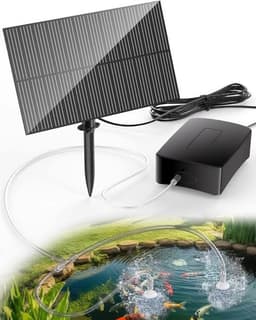
Start with the panel in direct sun, not in a bright corner that a fence shades from late morning. Shade is a common reason the bubbles fade even when the motor is fine. The hose is only about 2.7–3 m on the listings in this set, so the sunny spot has to be inside that reach. One listing prints both 8.2 feet and 3 m. That is a conflict, not a longer tube. Runtime questions belong on the battery page. Wipe pollen off the panel if the stream is weak in clear weather.

Keep the housing dry

Only the stone and the hose end go in the water. The housing stays on the bank so the hose cannot siphon back. Biling and POPOSOAP use a separate pump box. A cover on the bank is not a reason to lower the box into the pond. The PChero builds the pump into the panel, so the pump and the panel are one unit and both stay out of the water. Its depth bullet, under 60 cm and best at 0–30 cm, is about the stone. IPX5 is water jets under IEC 60529, not immersion. If the box is sitting in a puddle, lift it.

Hose and stone

Push the hose fully onto the outlet and onto the stone, then run it so it cannot kink at the rim. A kinked airline looks like a dead motor. So does a stone sunk into silt. You should see the stone, and you should see bubbles while the panel is lit. If the stream is missing, look at shade, then the bend, then the stone, before you assume the compressor has failed. Two stones share one weak flow. Several reviews on the cheaper Biling say the pump feeds one stone, not two. UK reviews on the PChero often say only one outlet passes air and that the T-connector did not fit. One stone on a single outlet matches those reports.

What this setup does not fix

A correct layout does not turn a small panel into a filter, a UV clarifier, or a de-icer, and it does not oxygenate the pond all night. If fish are gasping, read the fish pond page the same day. If ice covers fish, open a hole and do not smash the sheet, which is the RHS line. A panel in this price band is a weak sole plan for a closed sheet of ice. Call a professional for a new 230 V supply. A 230 V pond pump needs an RCD and outdoor-rated cable. If the kit you own is the wrong airflow, that choice is the best solar pond aerator page.

Common questions

Does the pump box go in the pond?
No. The housing stays on the bank, above the water, so rain and the pond cannot flood it and so the hose cannot siphon back. Only the stone and the hose end go in. Biling and POPOSOAP give you a separate box. The PChero builds the pump into the panel, so that whole unit stays out of the water too. A cover on the bank is not the same as submerging the box. IPX5, where it is printed, is a water-jet rating, not permission to immerse the housing.
How do I connect the hose and the stone?
Fit the hose fully onto the pump outlet and onto the stone, with no tight bend at the pond rim. Then put the stone in the water where you can see it, not buried in silt, and watch for bubbles while the panel is lit. If nothing moves, check shade, then the kink, then a blocked stone. A scaled stone feels like a dead motor and is often just a blocked outlet. Leave the housing closed. There is no day-night switch on these kits to flick while you are connecting the tube.
What if two stones are in the box?
The flow is shared, and on several of these listings one outlet is what buyers actually get. Use one stone first. If that stream is clear and the second leg is weak, the pump is not suddenly two pumps. Reviews on the cheaper separate-box Biling say it feeds one stone. Reviews on the PChero often say the T-connector did not fit. One stone on a single outlet is a fair setup. Forcing both and then rating the motor as failed hides the split.
Why is there no bubble when the panel is in the shade or the hose is bent?
Because the panel is the power supply, and a kink stops the air before it reaches the stone. Shade is the usual reason a working kit goes quiet. A sun-only unit stops as soon as the light goes. A battery unit only continues while that day’s charge lasts. Straighten the hose and put the panel back in sun before you treat the compressor as dead. If it has been in full sun and the stone stays silent, that is a returns question under the Consumer Rights Act 2015, not a home repair.
How deep should the stone sit?
Deep enough to be under the surface and shallow enough that you can see it working. The PChero listing says under 60 cm and best at 0–30 cm. Do not treat that bullet as a measured depth for every brand in the set. Do not bury the stone in silt. A buried stone blocks the pores and looks like a failed pump. If the pond is much deeper than the hose can reach without a kink, keep the stone nearer the margin.

Related pages

Sources

Public UK sources used for this page in October 2026. Prices, stars, airflow, and battery figures are from the six amazon.co.uk listings captured on 19 October 2026. A runtime, an IP code, and a pond-litre line are listing claims, not a laboratory result.

  1. RHS, pond care (retrieved 21 October 2026)
  2. RHS, aquatic planting (retrieved 21 October 2026)
  3. Swell UK, solar pond air pumps (retrieved 21 October 2026)
  4. Pondkeeper, oxygenate without electrical equipment (retrieved 21 October 2026)
  5. Pondkeeper, aerating your pond in summer (retrieved 21 October 2026)
  6. Electrical Safety First, garden (retrieved 21 October 2026)
  7. GOV.UK, Electrical Equipment (Safety) Regulations 2016 (retrieved 21 October 2026)
  8. GOV.UK, returns and refunds (retrieved 21 October 2026)